
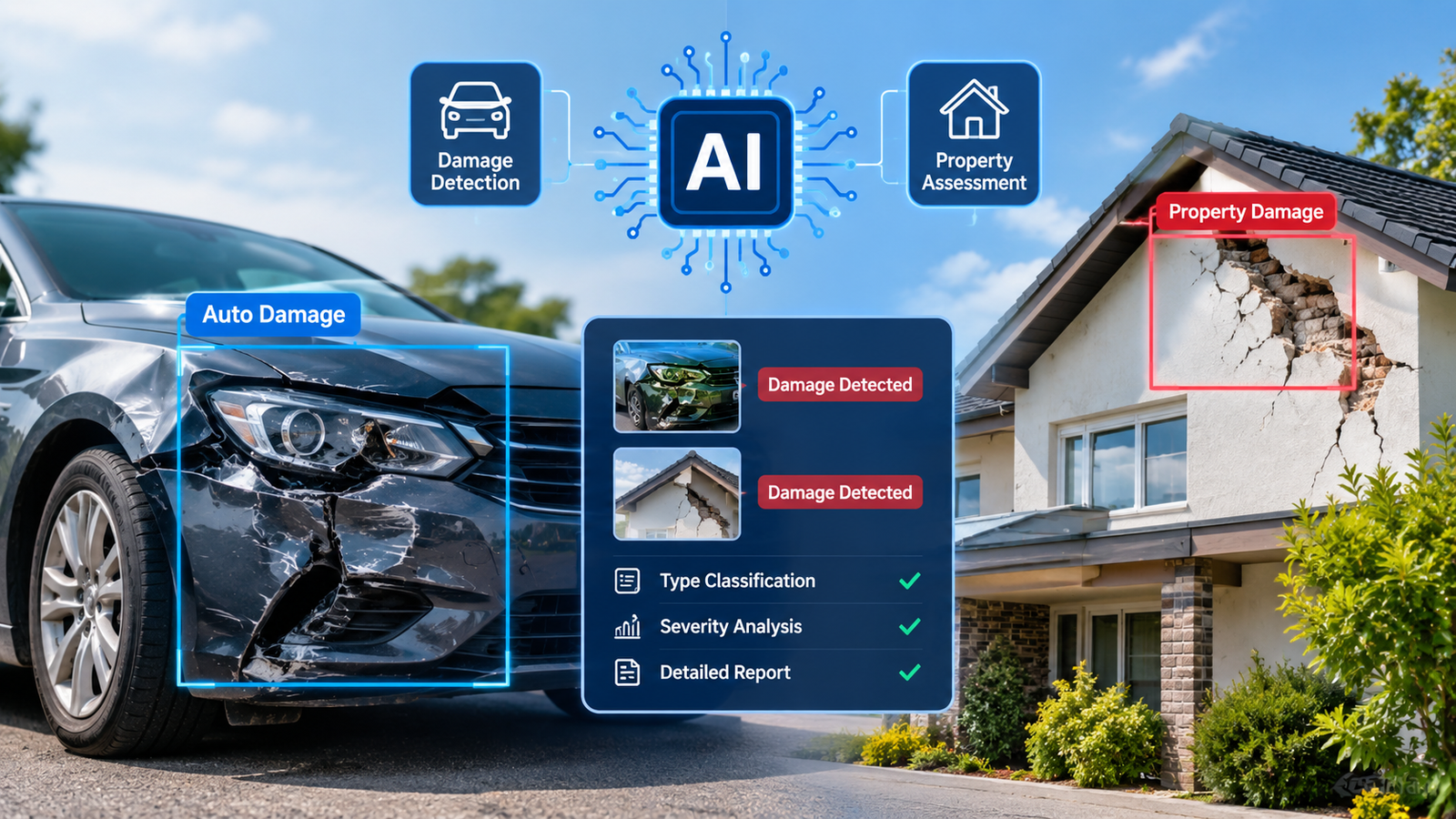
Primary topic: AI in Computer Vision for Auto and Property Damage Assessment
Research focus: Vehicle damage detection, property and building damage assessment, insurance claims automation, computer vision, image segmentation, damage severity estimation, repair cost prediction, multimodal AI, claims fraud detection, remote inspections, human-in-the-loop assessment, and AI-powered insurance workflows
What Is AI in Auto and Property Damage Assessment?
AI-powered damage assessment uses computer vision and machine learning to examine photographs, videos, scanned documents, and other visual evidence of physical damage. In auto insurance, the system may identify scratches, dents, cracked glass, broken lights, damaged bumpers, and other visible defects. In property insurance, it may detect roof damage, wall cracks, water stains, damaged flooring, broken windows, and visible storm or fire damage.
The technology can support several connected tasks. Object detection identifies where damage appears in an image, while image segmentation outlines the damaged region at a more detailed level. Classification assigns a damage category, and severity estimation attempts to determine how serious the damage appears. A separate cost model can combine these findings with labor rates, replacement parts, material prices, and local repair conditions to estimate the likely cost.
These tasks should not be treated as interchangeable. A model can detect a crack accurately but still be unable to determine whether it affects a structural component. Similarly, a vehicle image may show a damaged bumper while concealing damage to the frame, sensors, cooling system, or other components.
Detect
Identify visible damage in photos or video
Classify
Recognize the damage type and affected component
Estimate
Assess severity and likely repair requirements
Review
Validate evidence and route the claim for a decision
Why Damage Assessment Needs More Than Image Recognition
Traditional damage inspections often require a person to review photographs, inspect the asset, document the affected components, estimate the repair work, and prepare a report. This process can be slow when claims volumes rise after hailstorms, floods, wildfires, or large road accidents. It can also create inconsistent assessments when inspectors have different experience levels or receive incomplete evidence.
AI can help standardize the first stage of assessment, but a dependable system needs to understand the context surrounding an image. A small scratch on a vehicle door may require polishing, repainting, or panel replacement depending on its depth and location. A water stain on a ceiling may be cosmetic, or it may indicate an active leak that has damaged insulation and structural materials.
For this reason, damage assessment should connect computer vision to asset information, claim history, policy coverage, repair pricing, and inspection rules. The objective is not simply to recognize objects. It is to turn visual evidence into a consistent, traceable assessment that helps a qualified person make a decision.
Research Evidence: What the Studies Actually Show
The research base for vehicle damage detection is developing, with a growing focus on real-world images, damage localization, severity classification, and practical insurance workflows. Property damage assessment has a broader set of related applications, including satellite and aerial imagery for disaster mapping, building inspection, and computer vision for defects. Results from one setting should not automatically be treated as proof of performance in another.
Research Study: Vehicle Damage Detection Using Artificial Intelligence, 2025
A 2025 systematic literature review published in WIREs Data Mining and Knowledge Discovery examined AI-based vehicle damage detection. The researchers selected 55 papers after screening records from four research databases. The review covered dataset preparation, image processing, model design, evaluation methods, and the practical challenges of deploying damage detection systems.
The review found that approximately 75% of the selected studies focused on insurance claims. Other applications included car sharing, vehicle inspection, and related automotive use cases. This concentration matters because insurance claims are one of the clearest commercial settings for computer vision: the system receives damage images, identifies affected areas, and supports a decision about inspection or repair.
The review also highlighted a major limitation in the research ecosystem. Only 14 datasets among the reviewed papers were publicly available, while many studies relied on private datasets. This makes it difficult to reproduce results and compare models fairly. A model trained on one insurer’s claim images may perform differently when used with another insurer’s customers, vehicle types, camera quality, or damage patterns.
The review identifies difficult cases such as minor scratches, reflections, overlapping damage, changes in camera angle, and differences in image distance. These are not minor technical details. They directly affect whether a customer can submit useful photographs from a phone without needing a second inspection.
What this means for product development: AI teams should evaluate models on diverse, real-world images rather than relying only on a clean training dataset. Testing should include low-light images, reflective surfaces, partial obstruction, older vehicles, different paint colors, and damage that is difficult to distinguish from ordinary wear.
Source: Vehicle Damage Detection Using Artificial Intelligence: A Systematic Literature Review, 2025
Research Study: Automated Car Damage Assessment Using Computer Vision, 2024
A 2024 study in Applied Sciences examined automated car damage assessment in an insurance-company use case. The researchers developed an ensemble of 10 deep-learning detectors based on YOLOv5 and compared its performance with a YOLOv8-based approach. The work focused on damage detection under conditions relevant to insurance claims, where speed and repeatable processing are important alongside detection quality.
The study also introduced TartesiaDS, a dataset labeled with the supervision of professional insurance appraisers. That detail is important because damage labels need to reflect the practical distinctions that matter to claims teams. A generic image label such as “damaged car” is less useful than annotations identifying the affected part and the type of damage.
The authors emphasized that industry datasets and evaluation procedures are often private or inconsistent. This makes it difficult to determine whether one model is genuinely better than another in a production claims workflow. The study’s emphasis on inference speed also highlights a practical point: an accurate model must be able to process claims at the volume and latency required by an insurer.
The research supports using ensemble detection where it improves performance, but an ensemble is not automatically the best deployment choice. Multiple models can increase computational cost, infrastructure complexity, and maintenance requirements. The right design depends on the volume of incoming claims, the cost of errors, and the need for real-time results.
What this means for product development: Benchmark both detection quality and operational performance. Measure how reliably the model identifies each damage category, how quickly it processes a claim, and how often an assessor must correct its output.
Source: Automated Car Damage Assessment Using Computer Vision: Insurance Company Use Case, 2024
Research Study: DiffusionDet for Automatic Car Damage Detection, 2025
A 2025 paper in Electronics explored the use of DiffusionDet for automatic car damage detection and classification. The research builds on an insurance-oriented computer vision system designed to recognize and localize damage from images submitted by users. The authors addressed limitations involving model performance and computational efficiency, examining how a different detection approach could improve the system.
This is a meaningful research direction because customer-submitted images are not standardized inspection photographs. A user may photograph the vehicle from an awkward angle, stand too close to the damage, or submit an image in which the damaged area occupies only a small part of the frame. Detection models must handle these conditions while still locating the affected region.
The work also illustrates the relationship between model architecture and deployment constraints. A method that performs well in a research environment may need optimization before it can run economically across a large claims operation. Processing cost matters when an insurer receives thousands of claims in a short period, particularly after a major weather event.
What this means for product development: Test newer detection architectures against a practical baseline. Include inference time, hardware requirements, detection accuracy, and performance on difficult images in the evaluation, rather than selecting a model based on novelty alone.
Research Study: Severity-Aware YOLOv8 for Vehicle Damage Assessment, 2026
A 2026 paper in Scientific Reports introduced a severity-aware YOLOv8 instance-segmentation framework for vehicle damage assessment. The research focused on identifying damage regions and distinguishing levels of severity, which is a more demanding task than detecting whether damage exists.
The reported results included a Box mAP50 of 0.271 and a Mask mAP50 of 0.135 for the described experimental setup. The authors reported stronger detection of severe damage, while subtle surface defects remained challenging. These metrics should be interpreted in the context of the paper’s dataset, annotation scheme, and evaluation setup. They are not equivalent to a universal claim that the system can assess every vehicle damage scenario accurately.
The study highlights a central difficulty in automated claims: the visually obvious cases are not necessarily the cases where assessment mistakes are most costly. A large dent may be easy to locate, while a fine crack, small deformation, or damage near a sensor may be harder to identify but still require attention.
Instance segmentation is useful because it outlines the damaged region rather than only drawing a bounding box around it. That can help estimate the size and location of a defect, although segmentation alone does not determine the repair method or final cost.
What this means for product development: Evaluate severity models separately from damage detection. Use class-specific metrics, inspect subtle-damage failures, and route uncertain or potentially safety-critical cases to a human assessor.
Research Study: Multimodal AI for Automated Insurance Claims Adjudication, 2025–2026
A conference paper published in 2026 describes MMLM-CA, a multimodal framework for insurance claims adjudication that combines policy-document understanding with visual damage assessment. Its design separates the process into policy understanding, visual damage reasoning, and a consistency-checking stage.
This is relevant because a claim decision depends on more than what appears in a photograph. The system must consider the policy terms, the claim description, the evidence supplied, and the rules that govern the decision. A vision model may correctly identify a damaged component but cannot determine coverage from the image alone.
The paper reports an 8.2% improvement in adjudication accuracy compared with the methods used as its baselines. However, its experiments use the CarDD dataset for the visual damage task and synthetic claim text for policy-claim reasoning. The paper acknowledges the need for real multimodal data that connects policy documents, claim descriptions, vehicle images, and adjudication outcomes. The reported improvement should therefore be treated as an experimental result, not proof of equivalent gains in live insurance operations.
What this means for product development: Multimodal AI should connect evidence to policy rules while preserving a clear audit trail. Real-world validation should include actual claims, policy wording, assessor decisions, and repair outcomes.
Research Study: AI Impact on Insurance Claims Processing, Society of Actuaries Research Institute, 2025
The Society of Actuaries Research Institute’s 2025 report on AI in insurance provides an industry perspective on how AI is being used in claims processing. Its claims-processing figure reports that 68.8% of surveyed respondents used image recognition models, while 81.3% used claims decision recommendation models and 56.3% used data mining.
These figures are not a measure of the accuracy of damage-assessment systems, and they should not be interpreted as adoption rates for the entire global insurance market. They do, however, illustrate that image recognition is being used alongside decision-support and data-analysis capabilities in insurance operations.
This is an important distinction for product teams. Image recognition is only one component of a claims platform. Insurers also need claim intake, document processing, policy checks, fraud indicators, repair estimates, workflow routing, and records that explain how a decision was reached.
What this means for product development: Build computer vision as part of the claims process, with integrations into existing systems and clear handoffs between automated analysis and claims professionals.
Source: Society of Actuaries Research Institute, AI Impact on Insurance Industries in Greater China, 2025
Research Evidence at a Glance
| Research | Main contribution | Important limitation |
|---|---|---|
| Vehicle damage systematic review, 2025 | Maps methods, datasets, and real-world challenges | Limited public datasets and difficult image conditions |
| Automated car damage assessment, 2024 | Ensemble detection and appraiser-labeled dataset | Performance depends on dataset and evaluation design |
| DiffusionDet, 2025 | Explores an alternative detection architecture | Deployment efficiency must be assessed in context |
| Severity-aware YOLOv8, 2026 | Damage localization and severity-aware segmentation | Subtle defects remain difficult |
| Multimodal claims adjudication, 2026 | Connects policy text with visual evidence | Needs validation on real end-to-end claims |
| SOA insurance AI report, 2025 | Shows image recognition within broader claims AI | Industry survey, not a model-performance trial |
How AI Assesses Vehicle Damage
A vehicle damage assessment system usually begins with photographs submitted by a policyholder, repair shop, claims representative, or inspection partner. The system checks whether the images are usable, identifies the vehicle and its visible components where possible, and detects damaged areas.
A more advanced workflow can classify each defect, associate it with a vehicle part, estimate its apparent severity, and compare the findings with historical repair records. The output can help determine whether the claim is suitable for a low-complexity digital process or needs an in-person inspection.
Visual workflow: Auto damage assessment
Multiple angles
Blur and coverage
Detect and segment
Parts and labor
Straight-through processing, assessor review, or physical inspection
The image model should not be responsible for every decision. A separate rules engine can check whether the claim meets the insurer’s requirements, while a cost-estimation model calculates a likely repair range. Claims involving airbags, structural damage, advanced driver-assistance sensors, or uncertain safety conditions should be routed for qualified review.
How AI Assesses Property Damage
Property damage assessment has different technical requirements from vehicle inspection. A property may include a roof, exterior walls, windows, interior rooms, plumbing, electrical systems, flooring, and structural components. Damage may be visible in photographs, but its cause and full extent may not be.
For example, an image model may detect a water stain on a ceiling. It cannot reliably determine from that image alone whether the source is a leaking pipe, roof damage, condensation, or an earlier incident. Likewise, a photograph of a roof may show missing shingles but not reveal hidden water intrusion or damage beneath the surface.
Property assessment therefore benefits from combining several evidence sources:
- Customer photographs and inspection videos
- Images captured by professional inspectors
- Aerial or satellite imagery where suitable
- Property age, type, materials, and location
- Weather and disaster-event data
- Previous inspection and claims records
- Repair estimates and contractor reports
A property-focused model should be trained for the specific damage types it needs to detect. Roof damage, internal water damage, fire damage, and structural cracking are not one interchangeable computer vision task. Each has different visual signals, severity criteria, and consequences when a model makes a mistake.
Roof and exterior
Missing shingles, broken tiles, damaged siding, cracked windows, and visible storm damage
Interior surfaces
Water stains, damaged flooring, peeling paint, ceiling cracks, and visible fire damage
Large-scale events
Aerial damage mapping, affected-area estimation, and inspection prioritization
Damage Detection, Severity, and Repair Cost Are Different Models
A common product-design mistake is to treat damage detection as if it automatically produces a reliable repair estimate. In reality, these are separate tasks with different data requirements.
| AI capability | Input | Output | Main challenge |
|---|---|---|---|
| Damage detection | Images or video | Location of visible damage | Image quality and small defects |
| Damage classification | Detected region | Scratch, dent, crack, leak, or other category | Overlapping visual patterns |
| Severity assessment | Damage region and context | Severity class or estimated extent | Hidden damage and safety implications |
| Repair cost estimation | Damage, asset, labor, parts, and location | Estimated cost or cost range | Local pricing and unseen repairs |
A reliable platform should preserve these distinctions in its output. It should show what the model detected, how confident it is, which information informed the estimate, and whether a human inspection is recommended.
Multimodal AI: Connecting Images, Documents, and Claim Data
Computer vision becomes more useful when paired with language models and structured business data. A multimodal system can examine photographs, extract information from an estimate, summarize an inspector’s notes, and compare the evidence with policy conditions.
For example, a vehicle claim may include photographs of a damaged door, a customer description, a repair-shop quote, and an insurance policy. The vision model identifies the visible damage, document AI extracts line items from the quote, and a rules engine checks relevant policy requirements. A language model can then prepare a summary for the claims professional, with links to the underlying evidence.
This architecture should not allow a generative model to invent damage, repair prices, or policy terms. The system should retrieve those details from approved records and show the source of each important conclusion.
Multimodal claims architecture
Damage regions and categories
Policy and estimate extraction
Asset, history, and coverage
Connects findings, checks consistency, and preserves provenance
Reviews findings and makes or approves the decision
AI-Enabled Fraud Detection and Image Authenticity
Damage-assessment systems must consider the authenticity and relevance of submitted evidence. Images may be reused from an earlier claim, altered, taken from a different vehicle or property, or generated using AI tools. A technically accurate damage detector could still produce a misleading result if the input image does not represent the claimed incident.
Research published in 2025 discussed how generative AI could make it easier to fabricate vehicle accident evidence, including damage photographs and supporting documents. The authors also noted that detection systems have limitations and that fraudsters may adapt to countermeasures.
This creates a need for layered verification rather than relying on a single AI-generated authenticity score. A claims platform can compare image metadata when available, look for duplicate or near-duplicate images, check consistency across submitted views, compare the claimed damage with the reported incident, and request additional evidence when necessary.
Image authenticity tools should be treated as indicators, not definitive proof. Legitimate images can be compressed, edited for privacy, or stripped of metadata by ordinary messaging applications. Conversely, sophisticated manipulation may evade automated detection.
Source: A New Wave of Vehicle Insurance Fraud Fueled by Generative AI, 2025
Business Applications Across Auto and Property Insurance
AI damage assessment can support several parts of the insurance and asset-management lifecycle. The value depends on the existing workflow, the frequency of inspections, and how much manual work can safely be reduced.
| Business use case | How AI helps | Human role |
|---|---|---|
| First notice of loss | Checks image quality and identifies visible damage | Handles incomplete or complex submissions |
| Repair estimate support | Maps damage to parts or repair categories | Confirms repair method and pricing |
| Catastrophe response | Prioritizes claims and maps visible damage | Validates severe and ambiguous cases |
| Property inspection | Flags visible defects and missing evidence | Checks hidden or structural damage |
| Fleet management | Tracks recurring damage across vehicles | Approves maintenance and repair actions |
| Claims quality assurance | Finds inconsistencies between images and estimates | Investigates exceptions and disputes |
Key Technical Challenges
Image Quality and Capture Guidance
Customers do not always know how to photograph damage. Images may be blurred, poorly lit, taken from too far away, or captured at an angle that hides the damaged region. The platform should guide users to capture the full asset, the affected component, and close-up images from more than one angle.
A useful capture experience can include automatic blur detection, glare warnings, framing guidance, and prompts to photograph missing areas. This can prevent avoidable failures before the AI model begins its assessment.
Small, Overlapping, and Hidden Damage
Minor defects are often harder to detect than obvious damage. Scratches can resemble reflections, while cracks may overlap with dirt, paint lines, or shadows. Vehicle damage can also extend beneath visible body panels, and property damage may involve hidden moisture or structural issues.
The system should be allowed to return “uncertain” rather than forcing every image into a confident category. Cases with possible structural, electrical, safety, or water-ingress implications should be escalated.
Dataset Bias and Generalization
A model trained on a narrow dataset may perform poorly on unfamiliar vehicle models, property materials, geographic regions, lighting conditions, or camera devices. Damage datasets should cover the environments where the product will be used, and the organization should test performance across relevant customer and asset groups.
Repair Cost Variation
Repair costs vary by location, labor rates, parts availability, vehicle model, building material, contractor, and repair method. A visual model cannot reliably estimate these factors without additional information.
Cost estimation should therefore use current pricing sources and historical repair outcomes, with uncertainty ranges where appropriate. The estimate should identify assumptions and should not be presented as a guaranteed final settlement amount.
Expert Recommendation: Build a Damage Assessment System, Not Just a Vision Model
For insurers, insurtech startups, repair networks, and property inspection companies, the recommended approach is to develop a modular platform with separate components for image quality, damage detection, severity assessment, cost estimation, fraud indicators, and workflow management.
Start with one clearly defined use case, such as detecting common exterior vehicle damage from customer-submitted images. Build a labeled dataset with assessors, define a baseline, and test the system on images that were not used during training. Only after the detection stage is reliable should the team expand into severity estimation and repair-cost support.
The following principles should guide development:
- Use professional assessors to define damage categories and severity labels
- Keep detection, severity, and cost estimation as separate measurable tasks
- Provide clear image-capture instructions to reduce poor submissions
- Use confidence thresholds to route uncertain cases to human review
- Train and test on diverse assets, environments, and image conditions
- Connect cost estimates to current parts, labor, and repair data
- Keep a record of model outputs, evidence, corrections, and final decisions
- Monitor errors after deployment and retrain when performance changes
- Never use a visual score alone to determine safety, coverage, or fraud
Implementation Roadmap
Phase A: Define
Choose the asset type, damage categories, workflow, and acceptable error levels
Phase B: Prepare data
Collect representative images and create expert-reviewed annotations
Phase C: Validate
Test detection, severity, and image-quality performance separately
Phase D: Integrate
Connect claims, repair pricing, policy checks, and case management
Phase E: Monitor
Track errors, assessor overrides, drift, and customer outcomes
KPIs for AI Damage Assessment
| KPI | What it measures | Why it matters |
|---|---|---|
| Detection precision and recall | Correctness and coverage of damage detections | Shows missed damage and false alerts |
| Severity agreement | Agreement with qualified assessors | Tests whether severity outputs are useful |
| Estimate deviation | Difference between estimated and final repair cost | Measures financial estimation quality |
| Human override rate | How often assessors change the AI result | Reveals weak categories and workflow gaps |
| Inspection escalation rate | Claims routed for further inspection | Helps assess automation coverage safely |
| Cycle time | Time from claim submission to assessment | Measures operational improvement |
Future Predictions: 2027–2030
2027: Better Guided Self-Service Inspections
More claims platforms are likely to combine image-quality checks with step-by-step capture guidance. Instead of asking customers to upload any photographs, apps will guide them to capture the asset from required angles and request additional images when the evidence is incomplete. This should improve the quality of incoming data and reduce avoidable manual follow-up.
2028: More Multimodal Damage Assessment
Vision models will increasingly be combined with policy documents, repair estimates, asset records, and inspection notes. The most valuable systems will connect these sources while showing which evidence supports each finding. Generative AI will be useful for summarizing cases and preparing reports, but verified data and explicit rules will remain essential for financial decisions.
2029: Wider Use of Aerial and Geospatial Evidence
Property insurers and disaster-response organizations may make greater use of aerial imagery, satellite data, weather records, and ground-level photographs to prioritize inspections after major events. These sources can help identify areas that need attention, but they will not replace on-site inspection where damage is hidden or the evidence is inconclusive.
2030: More Adaptive Claims Workflows
Damage-assessment platforms may increasingly choose the next step dynamically. A straightforward, low-risk claim with clear images could move through a digital workflow, while a claim involving inconsistent evidence, uncertain severity, or possible structural damage could be routed to a specialist. The goal will be to automate suitable cases while making complex cases easier to investigate.
These are forward-looking expectations based on current technical directions, not guaranteed outcomes. Adoption will depend on data quality, insurer integration, regulatory requirements, customer trust, and demonstrated performance in real claims.
Frequently Asked Questions
How does AI assess vehicle damage from photos?
AI uses computer vision to identify damaged areas, classify visible defects, and sometimes estimate their severity. More advanced systems connect the findings with vehicle details, repair data, and claim information to support a repair estimate or inspection decision.
Can AI estimate the cost of car repairs?
Yes, AI can support repair-cost estimation by combining detected damage with vehicle details, parts prices, labor rates, and historical repair records. The estimate may be inaccurate when damage is hidden, prices are outdated, or the repair method requires professional inspection.
Can computer vision assess property damage?
Computer vision can identify visible property defects such as roof damage, broken windows, cracks, water stains, and damaged surfaces. It cannot reliably determine all hidden damage or the cause of a defect from a photograph alone.
Can AI replace insurance damage inspectors?
AI can automate parts of image review, documentation, triage, and estimation. Human inspectors remain important for uncertain cases, hidden damage, safety-critical assessments, complex repairs, and disputed claims.
How can insurers prevent AI-related damage assessment errors?
Insurers should use representative training data, evaluate models on unseen claims, monitor performance by damage type, provide confidence-based escalation, and preserve evidence for human review. Detection accuracy, severity agreement, estimate deviation, and human override rates should be monitored after deployment.
What data is needed to build an AI damage assessment system?
The main requirements include labeled damage images, asset details, expert severity assessments, repair estimates, final repair costs, and inspection outcomes. For insurance workflows, policy information and claim decisions can also help connect visual findings to operational requirements.
Final Perspective
AI-powered damage assessment is most valuable when it reduces the time and effort required to turn visual evidence into a reliable claim assessment. Research in vehicle damage detection shows progress in object detection, segmentation, severity analysis, and insurance-oriented workflows. At the same time, the literature highlights limited public datasets, difficult image conditions, inconsistent evaluation, and the challenge of recognizing subtle damage.
Property assessment adds further complexity because visible defects may not reveal their cause or full extent. A photograph of a damaged roof or stained ceiling can help prioritize an inspection, but it may not provide enough evidence to estimate the complete repair.
For that reason, the strongest systems will combine computer vision with asset data, pricing information, policy rules, document processing, fraud checks, and human review. They will also explain their findings, preserve the underlying evidence, and distinguish between what the image clearly shows and what remains uncertain.
For insurers, repair networks, property managers, and insurtech startups, the opportunity is not simply to build a model that detects damage. It is to build a dependable assessment workflow that improves speed and consistency without hiding uncertainty or making unsupported decisions.
Research Sources
- Vehicle Damage Detection Using Artificial Intelligence: A Systematic Literature Review, 2025
- Automated Car Damage Assessment Using Computer Vision: Insurance Company Use Case, 2024
- On the Application of DiffusionDet to Automatic Car Damage Detection and Classification via High-Performance Computing, 2025
- Harris Hawks–Tuned Severity-Aware YOLOv8 Instance Segmentation Framework for Vehicle Damage Assessment, 2026
- MMLM-CA: A Multimodal Large Language Model Framework for Automated Insurance Claims Adjudication Integrating Policy Document Understanding and Visual Damage Assessment, 2026
- Society of Actuaries Research Institute, AI Impact on Insurance Industries in Greater China, 2025
- A New Wave of Vehicle Insurance Fraud Fueled by Generative AI, 2025

Leave a Reply