
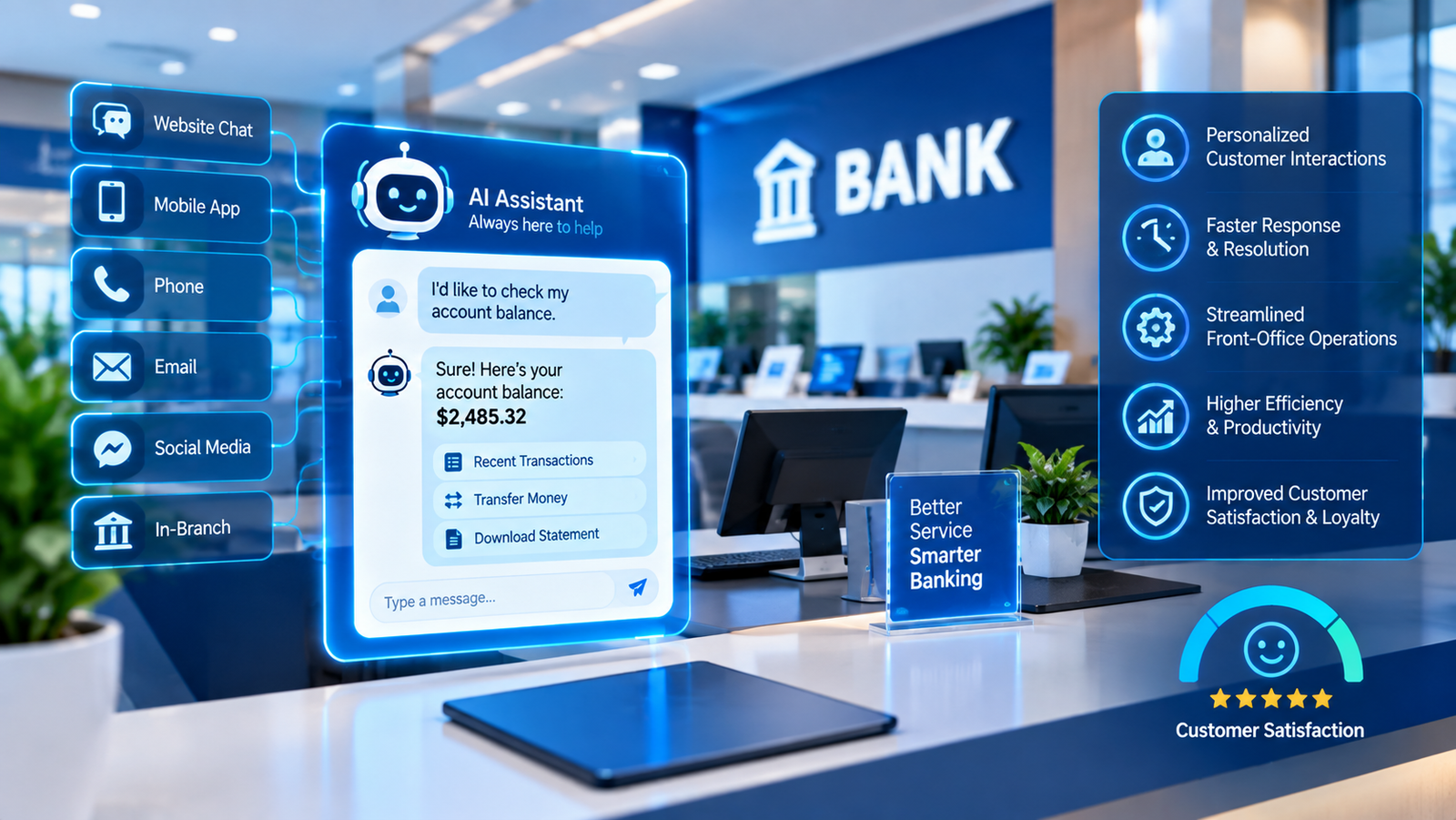
Primary topic: AI in Customer Experience and Front-Office Operations
Research focus: AI-powered customer support, intelligent contact centers, conversational AI, agent copilots, real-time sentiment analysis, customer journey orchestration, personalization, voice AI, complaint resolution, front-office automation, customer retention, and responsible AI in financial services
Why AI in Customer Experience Is Different from Basic Chatbot Automation
Customer experience covers every interaction a person has with a business, from discovering a product and opening an account to getting support, resolving a payment problem, changing a subscription, or closing an account. Front-office operations are the teams and systems that manage these interactions, including customer service, sales, onboarding, relationship management, complaints, and customer success.
Earlier customer-service automation often relied on fixed menus, keyword matching, and predefined responses. These tools can answer simple questions, but they struggle when a customer explains a problem in an unexpected way or combines several requests in one conversation.
Modern AI systems can interpret natural language, retrieve information from approved knowledge sources, summarize customer history, and recommend the next action. Generative AI can also help employees draft responses, while predictive models can identify customers who may need assistance before they contact support.
For a bank, neobank, fintech company, insurer, SaaS provider, or e-commerce platform, the objective should not be to automate every conversation. It should be to reduce customer effort while improving accuracy, resolution quality, accessibility, and operational efficiency.
Always-on assistance
Connected service
Assisted resolution
What Recent Research Says About AI Customer Experience
Research Study: Chatbots in Customer Service Within Banking and Finance
A 2025 study published in Computers in Human Behavior examined how chatbots are being used in banking and finance, what drives customer satisfaction, and how professionals view their future role. The researchers used a qualitative approach, including interviews with experienced professionals, to explore the value and limitations of chatbot-based service.
The study found that customers and professionals saw clear benefits in convenience, speed, and round-the-clock availability, particularly for simple service requests. Chatbots can provide consistent answers to common questions without requiring customers to wait for an available employee. These characteristics make them suitable for tasks such as checking service information, explaining routine processes, and helping customers navigate digital channels.
The study also identified a significant limitation: chatbot accuracy and reliability remain important concerns when requests become complex. A customer may describe a disputed transaction, a suspected account takeover, a failed payment, or a financial hardship in a way that requires context and judgment. A chatbot that misunderstands the situation can create additional frustration rather than resolve the problem.
The practical lesson is to evaluate AI by its ability to resolve the customer’s actual issue, not by the number of conversations it can contain. A well-designed system should recognize when a request is outside its reliable scope and transfer the interaction to an employee with the conversation history intact.
Research implication: Use conversational AI for accessible, routine support, but design explicit escalation paths for complex or sensitive cases.
Research Study: AI in Banking and Financial Operations, a Systematic Literature Review
A 2025 systematic literature review published in the Journal of Economic Surveys examined 157 articles on AI applications in banking and financial operations. The researchers identified themes covering customer service innovation, customer readiness, financial inclusion, regulation, explainability, and barriers to AI adoption.
The review is useful because it places customer experience within the wider operating model of a financial institution. AI-enabled service depends on more than the conversational interface. It also depends on data quality, organizational readiness, employee capabilities, customer trust, and the institution’s ability to explain and govern automated decisions.
For example, a virtual assistant may understand a customer’s question but still fail to resolve it if account information is spread across disconnected systems. Similarly, personalization may be technically possible but inappropriate if the organization cannot establish a valid purpose for using the customer’s data.
The review supports a broader implementation strategy: treat AI customer experience as a business and process transformation, not as a standalone software installation. Organizations should assess the service journey, data infrastructure, staff responsibilities, and customer expectations before expanding automation.
Research implication: AI service quality depends on the combination of technology, customer readiness, data access, governance, and operating design.
Research Study: AI Chatbots in Banking, Customer Service and Operational Efficiency
A 2025 review published in the AI and Society research ecosystem examined the use of AI chatbots in banking, drawing on 13 peer-reviewed articles and analysis of operational and customer-service themes. It explored how AI, machine learning, natural language processing, and robotic process automation can support banking service delivery.
The study identifies general inquiries and transaction-related help as important chatbot use cases. These tasks often involve repeatable questions, recognizable intent, and information that can be retrieved from approved systems. Automating them can reduce waiting and allow employees to focus on cases requiring more judgment.
However, the research also highlights limitations involving privacy, trust, and the handling of complex or emotionally sensitive requests. This matters because a banking interaction may involve more than information retrieval. Customers may be worried about lost funds, fraud, debt, or access to essential services.
A useful product design therefore separates informational assistance from actions that affect money or account access. The system can explain how to freeze a card, for example, but any actual account action should use authenticated workflows, appropriate confirmation, and a clear record of what occurred.
Research implication: Start with bounded, repeatable service tasks and introduce account-changing capabilities only when identity, authorization, and operational controls are established.
Source: “AI Chatbots in Banking: Transforming Customer Service and Operational Efficiency,” 2025
Research Study: Consumer Adoption of ChatGPT-Enabled Banking Services
A 2025 study published in Financial Innovation examined how users adopt AI-enabled banking services, using ChatGPT as the focal technology. It explored customer perceptions of AI in banking and the factors that can influence adoption.
This research matters because a customer may recognize the convenience of an AI assistant without being comfortable trusting it with financial information. Adoption depends on the perceived usefulness of the service, the effort required to use it, trust in the provider, and the perceived risks of sharing information or following an AI-generated response.
For customer experience teams, this means adoption should not be measured only by how many users open the assistant. More meaningful signals include whether customers complete their intended task, whether they return to the service, whether they understand the answer, and whether they can reach a human when needed.
The design should also make the AI’s role clear. Customers should know when they are interacting with an automated system, what information it can access, and what types of actions it can perform.
Research implication: Trust, perceived usefulness, transparency, and customer control should be treated as product requirements rather than optional interface features.
Research Study: Global AI Adoption in Financial Services
The Cambridge Centre for Alternative Finance’s 2026 Global AI in Financial Services Report examined AI adoption across financial institutions and related organizations. Its findings indicate that customer support is a leading front-office AI use case. The report states that AI-powered customer support was being piloted or deployed by 74% of surveyed organizations, with adoption reported by 82% of fintech respondents and 67% of incumbent financial institutions.
The report also found that AI use is concentrated heavily in operational improvement. This distinction matters: a financial institution may deploy AI to reduce handling time or help agents find information without changing the underlying customer journey. Those improvements can be useful, but they do not automatically create a seamless experience.
The report also highlights the difficulty of measuring AI value. Productivity gains can be visible, while the effect on broader enterprise value may be harder to isolate. Customer experience programs should therefore connect technical metrics to outcomes such as resolution, repeat contact, customer effort, complaints, retention, and service accessibility.
Research implication: Measure AI service performance using customer outcomes and operational outcomes together, rather than relying on adoption or automation rates alone.
Source: Cambridge Centre for Alternative Finance, Global AI in Financial Services Report, 2026
Research Study: Deloitte’s 2026 Research on AI-Assisted Banking Customer Service
Deloitte’s June 2026 research on AI-assisted customer service in banks examined customer expectations and executive plans for contact-center transformation. In the survey, 71% of customers identified ease of resolving an issue among their three most important support factors, followed by fast response times at 63% and a positive support experience at 52%.
The research also found that 37% of surveyed US banking executives said they were already using generative AI in contact centers, while another 37% planned to use it in 2026. The main expected benefits included improved customer satisfaction and Net Promoter Scores, alongside lower cost per contact and higher agent productivity.
Deloitte identified integration as a major obstacle: 77% of surveyed executives cited integrating new technology with existing systems and tools as a contact-center modernization challenge. Security, compliance, and legacy systems were also prominent concerns.
These findings show why a polished AI interface is not enough. If the assistant cannot access current case status, payment records, policy information, or prior contact history, it may offer a plausible answer that does not solve the problem. The customer experiences the organization’s fragmented systems, even if the AI itself appears sophisticated.
Research implication: Prioritize end-to-end resolution and system integration before expanding the number of AI features.
Where AI Creates Value Across the Customer Journey
AI can support different parts of the customer journey, but each use case requires its own data, controls, and success measures. The following map separates customer-facing assistance from employee-facing support and proactive service.
| Journey stage | AI application | Customer value | Key control |
|---|---|---|---|
| Discovery | Conversational product guidance | Find relevant information more easily | Clear disclosures and suitability boundaries |
| Onboarding | Application guidance and document assistance | Fewer confusing steps | Identity, consent, and error handling |
| Everyday use | Account questions and transaction explanations | Faster access to useful answers | Authenticated, current data |
| Problem resolution | Case summaries and next-best actions | Less repetition and faster resolution | Human escalation and audit trails |
| Retention | Service-friction and churn signals | Earlier help when a problem emerges | Fairness and appropriate use of data |
Conversational AI That Resolves Problems, Not Just Questions
A customer-service assistant should be designed around tasks and outcomes. A question such as “Where is my card?” may require a simple status lookup. “My card was charged twice” requires a different workflow that may involve transaction retrieval, duplicate-payment checks, dispute eligibility, and case creation.
A robust assistant needs to recognize the intent, collect any missing information, retrieve facts from trusted systems, and either complete an authorized action or explain the next step. If the issue requires a specialist, the assistant should transfer the conversation with a concise summary so the customer does not need to start again.
↓
Intent and urgency detection
↓
Retrieve approved customer and product information
↓
Answer, guide, or initiate an authorized workflow
↓
Verify completion
↓
Escalate with context when needed
The verification step is essential. A system should not say that a payment dispute has been filed, a card has been frozen, or a subscription has been cancelled unless the connected system confirms that the action succeeded.
Agent Copilots: Improving the Work Behind the Conversation
Customer-facing chatbots receive much of the attention, but employee-facing copilots can be equally important. A copilot can retrieve relevant policy information, summarize a long conversation, suggest a response, identify missing information, and prepare a case note.
This is especially useful in contact centers where agents switch between customer relationship management systems, payment tools, knowledge bases, ticketing platforms, and compliance applications. AI can reduce the time spent searching and writing, allowing employees to focus more attention on the customer’s actual problem.
The copilot should support the agent rather than silently take over the interaction. Employees need to verify important facts, correct generated summaries, and understand when the system is uncertain. In regulated settings, the organization should preserve the source information used for consequential recommendations.
Real-Time Sentiment and Customer Frustration Detection
Sentiment analysis can help identify whether a conversation appears positive, neutral, frustrated, confused, or distressed. In a contact center, this can be useful for detecting repeated explanations, rising frustration, or a mismatch between the customer’s needs and the automated response.
However, sentiment models can misread sarcasm, dialects, short messages, cultural expressions, or emotionally neutral language. A low sentiment score should not be treated as proof that a customer is unreasonable or that a complaint is invalid.
A responsible system uses sentiment as a service signal. For example, it may offer a human handoff after repeated failed attempts, flag a conversation for quality review, or help a supervisor identify a recurring product problem. It should not use inferred emotion as the sole basis for denying a service, changing a price, or restricting an account.
Personalization Without Making Customers Feel Watched
AI can personalize support using relevant information such as the customer’s active product, previous service requests, preferred communication channel, and current task. This can prevent customers from repeating details and make guidance more relevant.
Personalization becomes intrusive when the organization uses information that customers do not expect to be used in that context. Financial institutions should be especially careful with sensitive data, inferred vulnerability, precise location, health-related information, and behavioral signals that could reveal financial hardship.
A practical personalization framework should follow three principles:
- Relevance: Use information that directly helps complete the customer’s current task
- Transparency: Explain how personal information is used when appropriate
- Control: Give customers meaningful options for communication preferences and automated interactions
AI for Proactive Customer Experience
Most customer-service systems react after a person reports a problem. Predictive AI can help organizations identify service issues earlier, provided the model uses appropriate data and does not overstate what it knows.
For example, a system may detect a rise in failed payments, repeated login errors, delivery delays, or a sudden increase in contacts about a particular product. It can help the organization identify the source of the problem and prepare a clear customer communication.
Proactive service is most useful when the organization can take a meaningful action. Sending a generic warning based on a weak prediction may increase anxiety without helping the customer. A better approach connects the signal to a verified issue, a practical next step, and an easy way to contact support.
Visual: Front-Office AI Capability Map
- Virtual assistants
- Voice bots
- Product guidance
- Self-service navigation
- Agent copilots
- Conversation summaries
- Knowledge retrieval
- Case documentation
- Sentiment signals
- Contact drivers
- Quality monitoring
- Service-failure detection
Technology Architecture for AI Customer Experience
A production-ready platform should connect the customer interface to a controlled service layer. The AI model should not have unrestricted access to banking systems or customer records. Instead, it should retrieve only the information needed for the task and invoke approved tools through authenticated APIs.
Mobile app · Website · Chat · Voice · Email
Authentication · Consent · Session context · Channel continuity
Intent detection · Retrieval · Model routing · Policy checks
CRM · Core banking · Payments · Ticketing · Knowledge base
Monitoring · Human escalation · Logs · Evaluation · Incident handling
Risks That Can Damage Customer Trust
| Risk | How it affects customers | Practical control |
|---|---|---|
| Incorrect answers | Customers may act on false information | Ground answers in approved sources and verify critical facts |
| Failed handoffs | Customers repeat their problem or become stuck | Transfer context and offer a clear route to a person |
| Privacy misuse | Customers lose confidence in data handling | Minimize data access and enforce purpose limitations |
| Biased service | Some groups may receive worse support | Test performance across languages, accents, and user groups |
| Automation lock-in | Customers cannot reach a human when needed | Provide accessible human support and escalation rules |
| Unauthorized action | Money or account settings may be changed incorrectly | Authentication, confirmation, permissions, and audit logs |
Expert Recommendation: Build Around Resolution, Not Automation
The most useful implementation strategy is to start with a small number of high-volume customer problems and make them genuinely easier to resolve. A company should map the full process behind each problem, including the systems involved, the information needed, the actions permitted, and the situations that require a human employee.
A practical rollout should follow these priorities:
- Start with high-volume, low-risk requests such as product information, service navigation, and routine status questions
- Connect AI to approved knowledge and live systems so answers reflect current policies and customer-specific facts
- Give agents a copilot for summaries, knowledge retrieval, and response drafting before automating sensitive decisions
- Design human escalation from the beginning rather than adding it after customers encounter failures
- Measure complete resolution using repeat-contact rates, customer effort, complaint outcomes, and task completion
- Test failure cases including ambiguous requests, angry customers, unsupported languages, outages, and conflicting records
- Review data use and access permissions before allowing AI to retrieve or act on personal information
A strong AI customer experience program also needs a clear owner. Customer operations, product, technology, security, compliance, and data teams should share responsibility for the service journey. Without this cross-functional ownership, organizations risk deploying a capable model on top of a broken process.
Expert Quote
Quote reported by Deloitte in its June 2026 research on AI-assisted customer service in banking, attributed to a former bank executive.
The quote reflects the contact center’s combination of high interaction volume, repeatable workflows, conversation records, and measurable service outcomes. It should not be interpreted as a reason to automate every interaction. The opportunity is to reduce friction across the service operation while preserving human support where it matters.
Source: Deloitte Center for Financial Services, June 2026
Implementation Roadmap
Discover
Identify the most common customer problems, contact drivers, failure points, and existing service metrics
Prepare
Clean knowledge sources, map APIs, define permissions, and create escalation rules
Pilot
Launch a bounded assistant or agent copilot for selected customer journeys
Improve
Evaluate outcomes, investigate failures, retrain or revise, and expand only when controls work
KPIs for AI Customer Experience and Front-Office Operations
| Metric | What it measures | How to interpret it |
|---|---|---|
| First-contact resolution | Issues resolved in the first interaction | Track alongside repeat contacts and reopenings |
| Customer effort | How difficult it was to complete a task | Look for fewer steps and less repetition |
| Repeat-contact rate | Customers contacting support again about the same issue | A rise may indicate incomplete resolution |
| Escalation quality | Whether complex cases reach the right team with context | Measure appropriate handoffs, not simply fewer handoffs |
| Answer accuracy | Whether answers are correct and supported | Audit high-impact topics separately |
| Agent handling time | Time spent resolving a case | Interpret with quality and customer outcomes |
| Complaint rate | Formal dissatisfaction and service failures | Segment by journey and customer group |
Future Outlook: 2027–2030
2027: AI Moves from Answers to Verified Service Actions
Customer-service AI is likely to expand from answering questions toward completing bounded tasks through approved APIs. Examples include updating preferences, generating service requests, checking case status, and guiding customers through authenticated workflows. The main differentiator will be reliable execution, not merely natural-sounding conversation.
2028: Contact Centers Become AI-Assisted Service Hubs
More organizations are likely to combine conversation summaries, knowledge retrieval, quality monitoring, and real-time agent assistance in one workflow. This should reduce the need for employees to move between disconnected systems, provided integration and data governance are addressed.
2029: Proactive and Journey-Based Service Expands
AI may increasingly connect signals across onboarding, payments, support, and product use to identify service friction earlier. Organizations will need to distinguish helpful intervention from intrusive monitoring and ensure that proactive messages are based on verified, actionable events.
2030: Multimodal and Agentic Service Becomes More Common
Voice, text, documents, and visual information may be handled through more unified service interfaces. AI agents may coordinate multi-step workflows across internal systems, but financial and other consequential actions will still require permission controls, verification, monitoring, and appropriate human oversight.
These are forward-looking scenarios, not guaranteed outcomes. Adoption will depend on model reliability, customer acceptance, regulation, integration costs, and whether organizations can demonstrate better service rather than simply lower staffing costs.
Frequently Asked Questions
What is AI in customer experience?
AI in customer experience uses technologies such as machine learning, natural language processing, generative AI, and predictive analytics to help organizations understand customer needs, personalize interactions, support employees, and resolve service requests more effectively.
How does AI improve front-office operations?
AI can automate routine inquiries, summarize conversations, retrieve relevant information, assist agents, identify recurring service problems, and help route requests to the right team. Its impact depends on the quality of the underlying workflows and data.
Can AI replace customer service agents?
AI can handle some routine requests and assist employees with repetitive tasks, but complex complaints, sensitive situations, disputes, and consequential decisions often require human judgment. A hybrid model can combine automation with human support.
What is an AI agent copilot?
An AI agent copilot is a tool that supports customer-service employees during interactions. It can summarize customer history, retrieve policy information, suggest responses, and prepare case notes while leaving the employee responsible for reviewing important information and decisions.
How can businesses measure AI customer experience?
Businesses should measure first-contact resolution, customer effort, repeat-contact rate, answer accuracy, complaint outcomes, escalation quality, and employee productivity. Automation rate alone does not show whether customers’ problems were solved.
What are the main risks of AI customer service?
The main risks include inaccurate answers, privacy misuse, biased performance, poor escalation, inaccessible service, unauthorized actions, and overreliance on automation. Testing, monitoring, human support, and clear access controls help reduce these risks.
What is the best first AI use case for a contact center?
A sensible starting point is a high-volume, low-risk task with clear answers and measurable outcomes. Examples include routine product questions, knowledge retrieval, conversation summaries, and agent assistance. The choice should be based on actual contact data and operational needs.
Final Perspective
AI in customer experience is moving beyond chatbots that answer frequently asked questions. It is becoming a layer that connects customer intent, organizational knowledge, service systems, and employee decisions.
The research points to a consistent set of lessons. Banking chatbot research highlights the value of speed and availability for routine tasks, while also showing that complex requests still need human assistance. Broader systematic research emphasizes customer readiness, trust, explainability, regulation, and organizational capability. The Cambridge and Deloitte findings show that customer support is a major area of AI investment, but integration and measurement remain central challenges.
For financial institutions, neobanks, fintech companies, SaaS providers, and e-commerce platforms, the opportunity is to redesign the complete service journey. That means making it easier to find answers, complete tasks, resolve problems, and move between automated and human support without losing context.
The most effective systems will combine:
Organizations should avoid treating fewer human contacts as the main definition of success. A customer who cannot reach a person may generate fewer calls while having a worse experience. A better measure is whether the customer’s need was resolved accurately, with reasonable effort, through a channel that fits the situation.
The long-term advantage will come from building service systems that are faster where automation helps, more human where judgment matters, and accountable throughout the customer journey.
Research Sources
- Graham et al., Chatbots in Customer Service Within Banking and Finance, Computers in Human Behavior, 2025
- Singh et al., Applications of Artificial Intelligence for Optimizing Banking and Financial Operations, Journal of Economic Surveys, 2025
- AI Chatbots in Banking: Transforming Customer Service and Operational Efficiency, 2025
- Revolutionizing Banking Services with ChatGPT: An Integrated Framework for User Adoption, Financial Innovation, 2025
- Cambridge Centre for Alternative Finance, Global AI in Financial Services Report, 2026
- Deloitte Center for Financial Services, How Banks Can Turn AI-Assisted Customer Service into a Business Advantage, June 2026
- McKinsey, The AI-Powered Bank: Rewiring for Excellence in Customer Care, April 2026

Leave a Reply