
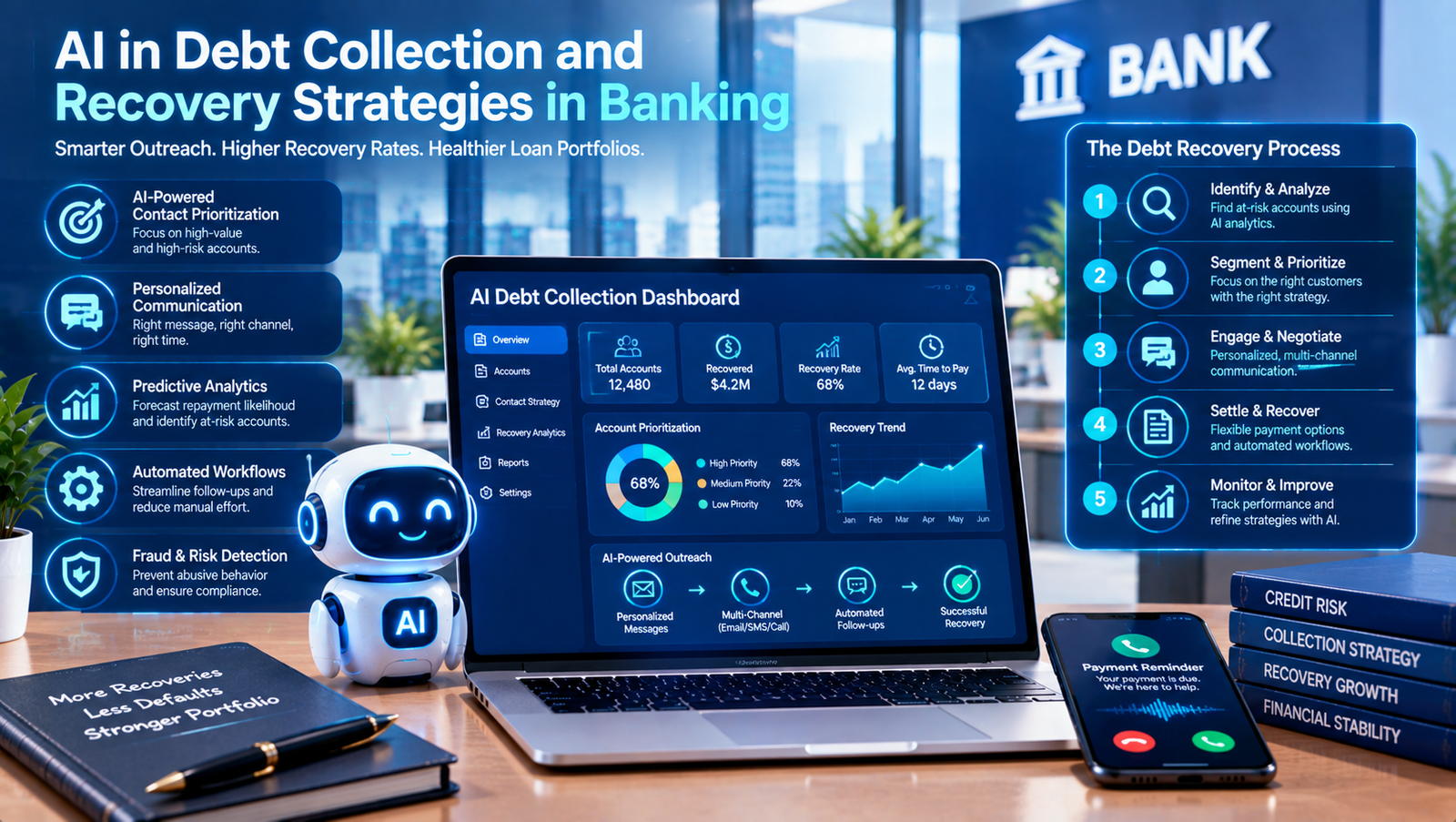
Primary topic: AI in Debt Collection and Recovery Strategies in Banking: Research, Applications, Risks & Future
Research focus: Delinquency prediction, borrower segmentation, repayment propensity, collections prioritization, AI-assisted communication, recovery forecasting, hardship detection, payment-plan recommendations, collections optimization and responsible automation.
Why Banks Are Applying AI to Debt Collection
Debt collection is a decision-making problem as much as a communication problem. When a borrower misses a payment, a bank must decide which accounts to prioritize, when to make contact, which channel to use, whether to offer a payment arrangement and when an account requires specialist attention. These decisions become difficult when a lender manages hundreds of thousands of accounts with different balances, payment histories, income patterns, products and reasons for falling behind.
Traditional collections strategies often rely on fixed rules. For example, a bank may send the same reminder after a certain number of days past due, escalate an account after another fixed period and assign cases to agents based on balance or delinquency stage.
Rules are easy to audit, but they may overlook meaningful differences between borrowers. A customer who usually pays on time and missed one installment may need a different intervention from someone who has missed several payments and repeatedly broken payment arrangements.
AI can help identify these differences by combining repayment history, account activity, previous contact outcomes, payment behavior and other lawfully available information. The aim is to improve the timing and relevance of recovery actions while reducing unnecessary contact and manual workload.
Who may fall behind?
Estimate delinquency risk before or shortly after a missed payment.
Which account needs attention?
Allocate staff time according to risk, urgency and likely benefit.
What support may help?
Match communication and repayment options to the account’s circumstances.
What actually works?
Measure repayment outcomes, complaints and customer impact.
Research Study: AI Debt Collectors Compared with Human Callers
A 2025 National Bureau of Economic Research working paper, “How Good is AI at Twisting Arms? Experiments in Debt Collection,” examined whether AI could persuade delinquent borrowers to repay as effectively as human callers.
The researchers used a regression-discontinuity design and a randomized experiment, making this particularly relevant to the real-world question of whether AI should replace human collection agents.
The study found that AI was substantially less effective than human callers in the setting examined. Moving borrowers from AI contact to human contact six days into delinquency closed much of the performance gap.
The researchers also reported that borrowers initially contacted by AI repaid 1% less of the initial late payment one year later and were more likely to miss subsequent payments than borrowers who had always been contacted by humans.
These findings challenge a common assumption in financial automation: lower contact costs do not necessarily produce better recovery outcomes. A conversation about overdue debt can involve uncertainty, embarrassment, financial stress and negotiation. A human caller may be better at responding to hesitation, building a credible commitment and adapting the conversation to the borrower’s circumstances.
For banks, the practical lesson is to test AI against human-assisted workflows using long-term outcomes, not just call completion rates or immediate promises to pay. AI may still be useful for routine reminders, self-service information and prioritization, but the study suggests that human contact can remain important when a borrower needs to make a meaningful repayment commitment.
What this means for product design:
- Use AI to support collectors rather than assuming it should replace them
- Test repayment outcomes over several months, not only immediate responses
- Escalate cases when borrowers express hardship, confusion or a need to negotiate
- Measure repeat delinquency alongside the amount recovered
Source: NBER Working Paper 33669, How Good is AI at Twisting Arms? Experiments in Debt Collection, 2025
Research Study: How Consumers Experience AI-Mediated Debt Collection
A 2026 study, “AI in Debt Collection: Estimating the Psychological Impact on Consumers,” examined consumer reactions to AI-mediated and human-mediated collection communication. The research used an experimental design involving 3,514 participants across 11 European countries.
Participants generally perceived human interactions as fairer and more likely to encourage reciprocity, while AI-mediated communication was viewed as more efficient. Human contact elicited greater empathy, but also stronger feelings of stigma. The study reported no overall difference in trust between the AI and human conditions, while exploratory analyses found variation across gender, age groups and cultural contexts.
This research adds an important dimension to recovery strategy. A collection interaction is not successful merely because it produces a payment today. The way the borrower experiences that interaction may affect willingness to engage, disclose a genuine difficulty, request support or maintain a repayment arrangement.
AI may offer a less intimidating first step for some customers, particularly when it provides a private self-service route. Yet an automated system can also sound impersonal or fail to recognize distress. The design should therefore give customers a clear way to reach a person and should avoid using emotional vulnerability as a tool to increase payment pressure.
What banks should take from this study:
- Offer a choice of self-service, digital messaging and human support where practical
- Make it easy to explain a financial difficulty without repeating the story across channels
- Measure perceived fairness, complaints and customer understanding alongside repayment
- Test experiences across different age groups and customer populations
Source: AI in Debt Collection: Estimating the Psychological Impact on Consumers, 2026
Research Study: Explaining AI-Assisted Credit Decisions to Consumers
The UK Financial Conduct Authority published research on how consumers understand explanations of AI-assisted creditworthiness decisions. The study tested whether participants could identify errors caused by incorrect data or by flaws in an algorithm’s decision logic.
The FCA found that the form of explanation affected people’s ability to recognize errors. Importantly, the effect depended on the type of error. An overview of the data available to an algorithm could make it harder for participants to spot incorrect input data, while helping them challenge a problem in the algorithm’s logic, such as failing to use relevant information.
Although this research concerns credit decisions rather than debt collection directly, it has a clear application to AI-powered recovery systems. A collections model may recommend a contact priority, payment plan or escalation based on data that is incomplete, outdated or interpreted incorrectly. If employees cannot understand the reason behind a recommendation, they may be unable to identify the problem. If customers receive vague explanations, they may not know how to correct inaccurate information.
Banks should therefore design explanations for two audiences: staff who need to review model recommendations and customers who need to understand decisions affecting their accounts. A single generic explanation is unlikely to be sufficient for both.
Practical implications:
- Show collectors the key factors behind an account’s risk or priority score
- Display the underlying account facts so staff can identify incorrect or outdated data
- Give customers a clear route to dispute errors and request human review
- Test whether explanations help people identify specific types of mistakes
Research Study: U.S. Government Review of AI in Financial Services
The U.S. Government Accountability Office published “Artificial Intelligence: Use and Oversight in Financial Services” in May 2025. The report reviewed AI use across financial services, including customer service and credit decisions, and considered potential benefits, consumer risks and regulatory oversight.
The GAO identified opportunities for AI to improve financial services while also highlighting concerns such as lending bias and cybersecurity risk. It reported that most regulators it interviewed said AI outputs informed staff decisions rather than serving as the sole basis for decisions.
This is relevant to debt collection because the same operational distinction matters: AI can identify patterns and recommend actions, but a bank still needs accountable people, controls and evidence. A model that predicts a low probability of repayment should not automatically trigger every possible escalation. The prediction is an input to a governed process, not a complete decision.
The report is broader than debt collection and should not be read as a direct evaluation of collection models. Its value is in showing how financial institutions and regulators are approaching AI oversight across high-impact financial activities.
Practical implications:
- Keep clear ownership of AI-driven collection policies
- Document where models influence decisions and where humans must intervene
- Test for disparate outcomes and data quality problems
- Maintain security controls for customer and financial information
Source: U.S. GAO, Artificial Intelligence: Use and Oversight in Financial Services, May 2025
Research Study: Consumer Protection and the Long-Term Direction of AI in Retail Finance
In 2026, the FCA published the Mills Review, examining how AI could reshape retail financial services, consumers, firms, markets and regulators through 2030 and beyond. The review considered technology development, the effects on firms and markets, consumer trends and future regulatory approaches.
This is not a controlled trial of debt collection technology. It is a forward-looking regulatory review, useful for understanding the environment in which banks may deploy AI-powered recovery tools. Its central relevance is that AI adoption changes not only internal efficiency but also how consumers experience financial services and how firms remain accountable for outcomes.
For collections teams, this means governance should be designed alongside the product. Banks should not wait until a chatbot or voice agent is already contacting delinquent customers to decide how to handle errors, complaints, vulnerable customers, disputed debts or requests for a human representative.
Practical implications:
- Include consumer outcomes in AI deployment plans from the beginning
- Assign responsibility for errors made by vendor systems and AI agents
- Set clear limits on what an automated agent may promise or change
- Monitor how automation affects complaints, access to support and repayment outcomes
Source: FCA, Review into the Long-Term Impact of AI on Retail Financial Services: The Mills Review, 2026
Research Study: Debt Collection Rules and Consumer Protections
The Consumer Financial Protection Bureau’s 2025 Fair Debt Collection Practices Act annual report summarizes the CFPB’s work administering the FDCPA and related debt-collection activity during 2024. The report is not an AI performance study, but it provides an important compliance reference for banks and collection vendors operating in the United States.
The CFPB’s Regulation F materials address communications with consumers, including prohibitions on harassment or abuse, false or misleading representations and unfair practices. They also cover requirements around information provided at the beginning of collection communications and restrictions involving time-barred debt.
These requirements matter when AI generates messages, selects contact times, manages voice conversations or helps agents prepare scripts. Automation can scale a compliant process, but it can also scale an error. A model should not be allowed to invent debt details, imply legal consequences that do not apply, make unsupported promises or continue a contact sequence after a relevant restriction has been triggered.
Banks should map each automated action to applicable legal requirements and maintain records showing what was communicated, when it was sent and which system generated or approved it.
Practical implications:
- Use approved communication templates for regulated notices
- Apply contact restrictions and dispute handling as hard controls
- Keep auditable records of messages, calls, decisions and human overrides
- Review vendor contracts and workflows for legal responsibility
Sources: CFPB, Fair Debt Collection Practices Act Annual Report 2025 and CFPB, Debt Collection Rule (Regulation F)
Where AI Fits in the Debt Recovery Lifecycle
AI should not be treated as one model that decides the entire recovery journey. Different stages have different data needs, risks and success measures. A bank may use one model to predict early delinquency, another to prioritize accounts and a separate language system to help staff draft clear communications.
Balances, due dates, payment history and contact outcomes
Delinquency probability, repayment propensity and expected recovery
Contact timing, channel, support option and case priority
Self-service, approved messaging or human conversation
Payment, arrangement kept, complaint, dispute or escalation
Predicting Delinquency Before It Becomes a Serious Problem
Early-warning models can estimate which accounts are becoming more likely to miss a payment. Depending on the product and available permissions, useful inputs may include repayment history, recent missed payments, utilization changes, returned payments, account age, previous arrangements and changes in transaction patterns.
The model should distinguish between two different questions: who is likely to become delinquent, and who is likely to repay after a particular intervention. These are not the same. A customer can have a high probability of missing a payment but also a high probability of resolving the issue after a simple reminder. Another account may have a lower delinquency probability but require a more involved intervention if it does become overdue.
Banks should use early-warning predictions to offer timely, helpful reminders and make repayment options easier to access. They should not use uncertain predictions as a reason to intensify contact before a customer has missed a payment or to make adverse decisions without a lawful basis.
Repayment Propensity and Collections Prioritization
Repayment propensity models estimate the likelihood that an account will make a payment within a defined period or after a particular action. These models can help teams decide which accounts need a call, which may respond to a digital reminder and which need a specialist review.
A useful prioritization framework considers more than the balance owed. It should include the expected benefit of an intervention, the cost of contact, the stage of delinquency, the customer’s previous responses and the possibility that the account requires hardship support.
| Account situation | Possible AI recommendation | Human control |
|---|---|---|
| First missed payment with a strong history of on-time payments | Send a clear reminder with a direct payment route | Confirm the message is accurate and permitted |
| Repeated missed payments | Prioritize review of the account and available options | Assess whether a repayment arrangement is appropriate |
| Customer reports financial hardship | Route to a hardship or specialist support workflow | Review circumstances and explain available support |
| Disputed balance or suspected account error | Pause routine recovery actions and route the case | Resolve the dispute under applicable procedures |
| Complex case with prior failed arrangements | Prepare a case summary for a trained collector | Decide the next step and document the rationale |
Personalized Repayment Plans and Affordability
AI can help compare repayment arrangements against a bank’s policies and the customer’s stated circumstances. For example, a system could calculate the effect of different installment amounts, due dates or payment frequencies and show the likely balance trajectory under each option.
However, a mathematically feasible plan is not necessarily an affordable plan. A model should not infer a customer’s full financial situation from incomplete transaction data or assume that past spending reveals what they can safely pay. Where affordability information is needed, the bank should collect it transparently and use it for a defined purpose.
A responsible repayment recommendation should show the total amount due, the payment schedule, any applicable charges, the consequences of missed installments and the available alternatives. The customer should be able to understand the arrangement before accepting it.
Potential AI capabilities include:
- Calculating repayment scenarios under approved policy rules
- Identifying arrangements that are likely to fail based on historical outcomes
- Helping agents explain the trade-offs between available options
- Flagging cases where affordability information is incomplete
- Monitoring whether customers maintain agreed payment schedules
Generative AI for Collection Agents
Generative AI can support collectors by summarizing account histories, preparing draft messages, retrieving relevant policy information and organizing case notes. These tasks can reduce time spent switching between systems and searching long interaction histories.
The safest design keeps the language model away from uncontrolled financial actions. It should not independently change balances, waive fees, promise legal outcomes, approve exceptions or create a repayment agreement outside approved rules. Instead, it should retrieve verified account information, draft a response and allow an authorized employee or deterministic workflow to approve consequential actions.
A collection copilot can be especially useful when a case has a long history. It might summarize previous contacts, payments, disputes and broken arrangements, while clearly separating verified facts from model-generated summaries. Staff should be able to open the original records rather than relying solely on the summary.
AI Voice Agents and Automated Messaging
Voice agents and messaging assistants can handle routine interactions such as explaining a due date, directing a customer to a secure payment portal or helping them request a callback. They may also offer consistent service outside normal call-center hours.
But the NBER evidence discussed earlier makes full replacement of human collectors a risky default. Automated systems may be less effective when a conversation requires negotiation, empathy or a credible repayment commitment. Banks should therefore define clear escalation triggers.
| Interaction | Automation suitability | Recommended handling |
|---|---|---|
| Routine payment reminder | High, when legally permitted | Approved automated message with a secure payment route |
| Balance or due-date question | Moderate to high | Use verified account data and offer human assistance |
| Repayment negotiation | Limited without strong controls | Use approved options and human review for exceptions |
| Hardship, distress or vulnerability | Low for autonomous handling | Offer prompt access to a trained person |
| Dispute, identity concern or legal question | Low for autonomous resolution | Route to the appropriate specialist workflow |
Measuring Recovery Performance Without Creating Harm
A recovery model should be evaluated using a balanced set of financial, operational and customer-outcome measures. A system that increases short-term collections but also increases repeat delinquency, complaints or broken repayment plans may not be improving the overall result.
- Net recovery rate
- Cost per dollar recovered
- Roll rate between delinquency stages
- Recovery timing
- Cases handled per agent
- Time to resolve a case
- Contact success rate
- Manual review workload
- Kept payment arrangements
- Repeat delinquency
- Complaints and disputes
- Access to human support
Risk Controls for AI-Powered Debt Recovery
AI collection systems can create harm when data is wrong, predictions are treated as facts or automation continues after a customer raises a dispute. The bank should define controls before deployment and test them throughout the model lifecycle.
| Risk | Potential consequence | Control |
|---|---|---|
| Incorrect account data | Wrong balance or inappropriate contact | Data validation, dispute routing and audit logs |
| Biased predictions | Unequal treatment across customer groups | Fairness testing and outcome monitoring |
| Over-contacting | Customer distress and compliance exposure | Contact limits, suppression rules and channel coordination |
| Hallucinated AI content | False claims about balances, rights or consequences | Ground responses in approved data and templates |
| Model drift | Declining accuracy as borrower behavior changes | Monitoring, back-testing and controlled retraining |
| Excessive automation | Complex cases fail to receive suitable support | Human escalation and customer choice |
Expert Recommendation: Build a Recovery Decision System, Not an AI Caller
Banks should begin with decision support and workflow improvements rather than making autonomous calls the centerpiece of their AI strategy. The evidence suggests that prediction and prioritization are promising applications, while the effectiveness of AI-led persuasion depends on the context and should be validated rather than assumed.
A practical system should combine:
- Predictive models to estimate delinquency risk and repayment propensity
- Policy rules to enforce contact limits, eligibility and approved repayment options
- Customer preference controls for channel, language and communication accessibility
- Generative AI to summarize cases and draft messages from verified information
- Human review for disputes, hardship, exceptions and complex negotiations
- Outcome monitoring to track recovery, repeat delinquency, complaints and fairness
Start with a narrow use case, such as prioritizing early-stage delinquency or summarizing account histories for collectors. Compare the AI-assisted workflow with the existing process using a controlled pilot. Evaluate both immediate recovery and longer-term outcomes, and retain the ability to roll back the system if performance or customer outcomes deteriorate.
Expert Quote and Its Implication
Rather than attributing a fabricated quotation to an individual expert, this report uses the study’s documented finding as the central evidence-based takeaway. For banks, the implication is straightforward: test AI on actual recovery outcomes and customer experience, not on automation volume alone.
Implementation Roadmap
Future Predictions: 2027–2030
2027: AI Prioritization Becomes More Common
Banks are likely to continue applying AI to account segmentation, case summaries and collections workload management. These uses fit naturally into existing systems because they assist staff rather than transfer full responsibility to an autonomous agent. The main differentiator will be whether a bank can demonstrate measurable improvement without increasing customer harm.
2028: Recovery Strategies Become More Context-Aware
Collections platforms may increasingly combine payment behavior, contact preferences, case history and customer-provided circumstances to recommend the next appropriate action. Better integration should reduce repeated questions and inconsistent messages across phone, app, email and chat. This will require strong data governance and careful separation between useful personalization and intrusive profiling.
2029: Generative AI Moves Deeper into Agent Workflows
AI copilots may become standard in larger collections operations, helping staff summarize cases, retrieve policies, draft communications and document decisions. Banks will need reliable source grounding, auditability and clear restrictions on what a model can say or do. Human review will remain important for disputes, hardship and exceptions.
2030: More Adaptive, Measurable Recovery Systems
By 2030, mature systems may coordinate predictive analytics, customer communication, repayment-plan tools and case management in one governed workflow. The strongest systems will optimize for sustainable repayment and appropriate customer treatment, not merely the number of contacts or the amount collected in the first few days.
These are directional projections, not guaranteed outcomes. Adoption will depend on model performance, consumer response, data quality, operating costs and regulatory expectations.
Frequently Asked Questions
How is AI used in debt collection and recovery?
AI can predict delinquency, estimate repayment propensity, prioritize accounts, recommend contact strategies, summarize case histories and help staff prepare communications. It can also support repayment-plan analysis when the bank has reliable information and suitable controls.
Can AI replace human debt collectors?
AI can automate routine tasks, but current evidence does not support assuming that it will outperform human collectors in every situation. A 2025 NBER experiment found AI callers less effective than human callers in the studied setting, making controlled testing and human escalation important.
How can AI improve debt recovery rates?
AI may improve recovery by helping teams focus on accounts where intervention is useful, contacting customers through suitable channels and identifying repayment options. The impact must be measured against a credible comparison group and over a period long enough to capture repeat delinquency.
Can AI recommend repayment plans?
Yes. AI can help compare approved repayment scenarios and identify arrangements that may be difficult to maintain. Banks should verify affordability information, explain the terms clearly and keep exceptions under appropriate human and policy control.
What are the main risks of AI in debt collection?
The main risks include inaccurate data, biased predictions, excessive contact, misleading AI-generated messages, poor handling of disputes, privacy violations and over-automation of sensitive cases. Governance, testing, audit trails and human escalation help reduce these risks.
How should banks measure AI collections performance?
Banks should track net recovery, cost per dollar recovered, repayment-plan completion, repeat delinquency, complaint rates, contact success, time to resolve cases and differences in outcomes across customer groups. No single metric provides a complete picture.
What is the best first AI use case for a bank’s collections team?
A focused decision-support use case is a sensible starting point. Examples include account prioritization, early-delinquency prediction or AI-generated case summaries for staff. These can be piloted without giving a model unrestricted authority to contact customers or change account terms.
Conclusion
AI can make banking debt recovery more data-driven, consistent and responsive, but its value depends on where it is applied. Predictive models can help banks identify accounts that need attention, while case summaries and workflow tools can reduce the administrative burden on collectors. Personalized repayment analysis may also help customers understand and compare available options.
The research points to a more careful conclusion about automated collection conversations. The 2025 NBER experiment found that AI callers were less effective than human callers in its setting, and the 2026 European study found meaningful differences in how people perceived AI and human interactions. These findings suggest that banks should distinguish between automating routine tasks and automating sensitive conversations.
A sustainable AI recovery strategy should combine reliable data, predictive analytics, approved policy rules, understandable explanations and human support. It should measure long-term repayment and customer outcomes, not just short-term collections volume.
The central opportunity is to move from a rigid, one-size-fits-all collections process toward a system that helps banks make better decisions while treating customers fairly. AI should help the right team take the right action at the right time, with clear evidence and accountable oversight.
Research Sources
- National Bureau of Economic Research, How Good is AI at Twisting Arms? Experiments in Debt Collection, 2025
- AI in Debt Collection: Estimating the Psychological Impact on Consumers, 2026
- Financial Conduct Authority, Credit where credit is due: Explaining AI’s Role in Consumer Credit Decisions, 2025–2026
- U.S. Government Accountability Office, Artificial Intelligence: Use and Oversight in Financial Services, 2025
- Financial Conduct Authority, The Mills Review: Long-Term Impact of AI on Retail Financial Services, 2026
- Consumer Financial Protection Bureau, Fair Debt Collection Practices Act Annual Report, 2025
- Consumer Financial Protection Bureau, Debt Collection Rule (Regulation F)
- European Banking Authority, Special Topic: Artificial Intelligence
- UK Competition and Markets Authority, Using AI Agents: Complying with Consumer Law, 2026

Leave a Reply