
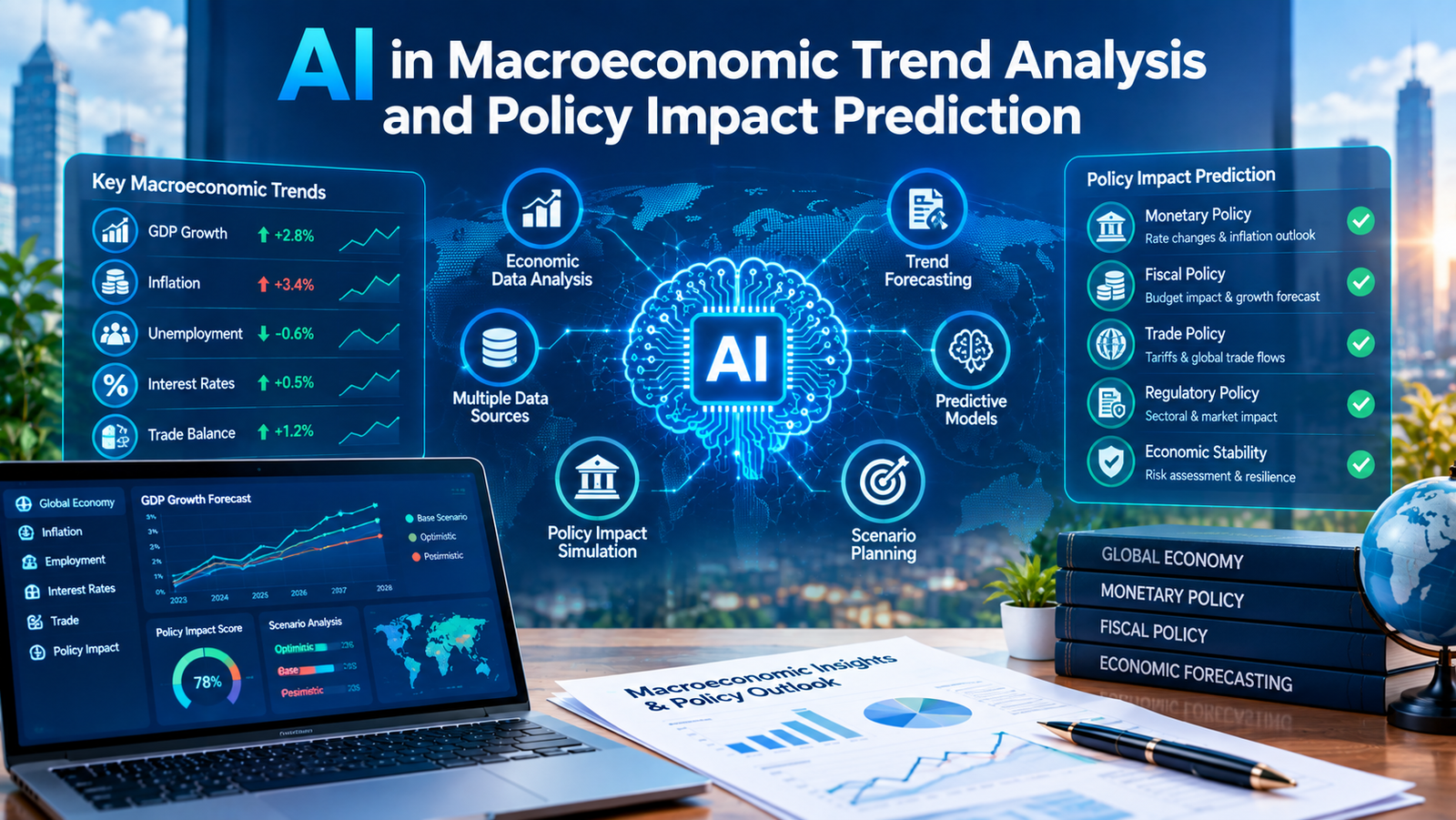
Primary topic: AI in Macroeconomic Trend Analysis and Policy Impact Prediction
Research focus: AI-powered economic forecasting, GDP nowcasting, inflation prediction, monetary and fiscal policy analysis, labor-market intelligence, interest-rate scenarios, financial stability, alternative economic data, machine learning, natural language processing, generative AI and policy simulation
What Is AI in Macroeconomic Trend Analysis?
Macroeconomic analysis examines the forces shaping an economy as a whole. Economists study indicators such as gross domestic product, inflation, employment, wages, interest rates, consumer spending, business investment, government debt, trade and financial conditions.
These indicators help governments, central banks, banks, investors and businesses understand where the economy may be heading. The challenge is that official economic data often arrives with a delay, gets revised later or fails to capture sudden changes in behavior.
AI can help by identifying patterns across large datasets, estimating missing information, interpreting economic language and testing how different conditions may affect future outcomes. Machine learning models can analyze relationships that are difficult to capture with a small number of predefined variables, while natural language processing can extract signals from reports, speeches, earnings calls and business surveys.
For example, an AI system could combine employment data, wage growth, consumer spending, business confidence and company commentary to estimate whether economic activity is strengthening or weakening. A separate model could examine how the same signals relate to inflation pressure or financial stress.
The distinction between prediction and policy impact is essential. A model that forecasts higher inflation does not, by itself, establish which policy caused that increase or which intervention would reduce it. Those questions require additional economic analysis.
Why Traditional Economic Forecasting Needs AI Support
Traditional macroeconomic models remain essential. Economists use them to explain relationships between variables, estimate policy transmission and build internally consistent scenarios. However, conventional approaches can struggle when relationships change quickly, data arrives at different frequencies or the economy experiences an unusual shock.
AI can complement these models in several ways.
Earlier signals
Estimate current economic conditions before complete official statistics become available.
More data sources
Combine economic releases with text, transactions, satellite observations and market data.
Nonlinear patterns
Detect relationships that may change across economic cycles and market conditions.
Scenario analysis
Compare possible outcomes under different assumptions about rates, prices, jobs and demand.
The objective is not to replace established economic models. It is to improve the information available to economists, policymakers and decision-makers.
Research Study: Machine Learning for Macroeconomic Forecasting
An IMF working paper, Deus ex Machina? A Framework for Macro Forecasting with Machine Learning, developed a framework for using machine learning to nowcast and forecast economic variables. The researchers compared machine learning approaches with traditional ordinary least squares models and examined whether combining multiple models could improve forecasts.
The study reported that its machine learning framework reduced forecast errors for real output growth in Turkey by at least 30% relative to traditional models. Combining several machine learning models in an ensemble reduced errors further. The framework also improved the prediction of economic volatility.
This finding matters because macroeconomic forecasting is affected by many variables at once. Consumer demand, industrial production, credit conditions, exports and employment may interact in ways that are not fully captured by a simple linear relationship.
An ensemble can combine different models, allowing the forecasting system to draw on several types of statistical patterns rather than depending on a single algorithm. The researchers also examined variable importance, helping economists understand which inputs contributed to predictions.
The result should not be interpreted as a guarantee that machine learning will reduce forecast errors by the same amount in every country. The reported performance comes from a particular empirical application, and results can vary with the economy, forecast horizon, data quality and evaluation method.
Practical implication: Economic institutions should benchmark AI models against established forecasts using historical data that was genuinely available at each forecast date. This prevents revised statistics or future information from leaking into the model.
Source: IMF Working Paper, Deus ex Machina? A Framework for Macro Forecasting with Machine Learning
Research Study: ECB Uses Machine Learning to Assess Inflation Risks
The European Central Bank has integrated machine learning into its inflation-risk analysis. In an April 2026 publication, ECB economists described a quantile regression forest model used to produce inflation forecasts and assess the risks around a baseline outlook.
Unlike a model that produces only one central forecast, a quantile-based approach can help examine the distribution of possible outcomes. This matters to monetary policymakers because the risk that inflation will be substantially higher or lower than expected can influence the appropriate policy response.
The ECB’s model draws on a broad set of economic variables, including wage developments and selling-price expectations. The institution reported that the model had been part of its broader monetary-policy preparation toolkit since the end of 2022.
The model can also help identify which factors are contributing to changes in the inflation-risk assessment. The ECB noted that wages and selling-price expectations were important forces behind revisions to its core-inflation projections during 2025.
This is a practical example of AI supporting a real policy workflow rather than operating as a standalone forecasting experiment. The model helps economists assess uncertainty around their baseline, while the wider policy process still considers other evidence and expert judgment.
For businesses, the same principle can be applied to planning. A company can use AI to estimate not only its expected input-cost growth but also the risk of a much larger increase that could affect margins, inventory decisions and financing needs.
Research Study: AI, Corporate Communications and Financial Stability
A February 2026 study in the Journal of Banking & Finance investigated whether generative AI could help predict financial stability using corporate and central-bank communications.
The researchers used TopicGPT, a prompt-based topic-modeling framework powered by large language models. Their dataset included more than 238,000 corporate earnings calls and 4,300 Federal Reserve speeches covering 2002 to 2023.
The researchers combined information from company-level communications with macroeconomic signals from central-bank speeches. They then tested whether the extracted topics improved predictions of financial-stability measures, including the National Financial Conditions Index, capital shortfall, the federal funds rate and the VIX.
The study reported that the interpretable topics generated by TopicGPT improved predictions of systemic-risk measures, particularly over longer forecast horizons, compared with traditional models.
The contribution is important because corporate communications can reveal information that is not immediately visible in headline economic indicators. Companies may discuss weakening orders, tighter financing, hiring plans, inventory pressure or rising input costs before those changes are fully reflected in official statistics.
Central-bank communications provide a different kind of signal. They can reveal how policymakers describe inflation risks, financial conditions and the balance of risks facing the economy.
Combining the two sources creates a broader view of the economic environment. However, text-based signals can be affected by communication strategy, changing language and the composition of the companies included in the dataset.
Practical implication: Financial institutions can use AI to monitor earnings calls, policy speeches and financial disclosures as an early-warning layer. The output should be treated as a signal for further analysis, not as proof that a financial crisis is imminent.
Research Study: AI and Non-Traditional Data at the Bank of Canada
The Bank of Canada’s May 2026 staff analytical paper, Integrating Non-traditional Data and AI into Central Banking: A Canadian Perspective, examines how AI can support central-bank analysis and operations.
The paper describes the use of machine learning, natural language processing and generative AI to extract information from sources such as text, speeches, images and real-time transactions. These sources can complement the conventional datasets used to monitor economic activity.
The importance of this work lies in the changing nature of economic information. Official indicators remain vital, but they are not the only evidence available to policymakers. Business commentary, payment activity and other high-frequency sources may reveal changes in demand or supply before they become clear in monthly or quarterly releases.
AI can help organize these varied sources into usable indicators. Natural language processing can classify economic commentary, while machine learning can test whether alternative data improves a forecast beyond the information already contained in standard indicators.
The paper also places AI within the institutional setting of a central bank. Data governance, analytical capacity and the reliability of new methods matter alongside technical performance.
For economic research teams, the practical lesson is to begin with a defined policy question. A new dataset is useful only if it improves measurement, interpretation or decisions enough to justify its cost and limitations.
Research Study: Satellite Data and AI for GDP Nowcasting
An IMF working paper published in January 2026 examined whether machine learning and satellite data could improve estimates of economic growth when reliable official indicators are limited.
The researchers combined satellite-based nighttime-light data with a random forest model to estimate quarterly GDP growth. They reported that adding nighttime-light information significantly improved the accuracy of estimates compared with models relying only on traditional indicators.
This approach is particularly relevant to economies where timely, comprehensive economic statistics are difficult to obtain. Satellite observations can provide an additional view of activity, especially where changes in lighting may reflect shifts in production, construction or economic activity.
However, nighttime lights are an imperfect proxy. Electricity access, energy prices, urbanization, weather, infrastructure changes and the structure of local economic activity can all affect the relationship between light intensity and output.
The value of the research is therefore not that satellites can directly measure GDP. It shows how alternative data can help fill information gaps when combined with statistical modeling and conventional economic indicators.
For policymakers, this can support more timely assessments of economic activity. For investors and businesses, similar methods may help compare regional activity or identify changes in local economic conditions, provided the model is validated for the location and purpose.
Research Study: AI and the Transmission of Monetary Policy
A Federal Reserve Bank of New York staff report published in April 2026 examined how AI could affect monetary policy through cyclical transmission, structural change and financial stability.
The paper argues that AI may influence inflation dynamics by changing production technology, pricing behavior, cost pass-through and expectations. Over a longer period, AI adoption may also affect potential output and the natural rate of interest, which are important benchmarks for monetary policy.
The report also highlights financial-stability risks. AI may improve credit allocation and risk assessment, but widespread reliance on similar models or expectations of rapid productivity gains could contribute to correlated behavior and fragile asset valuations.
One key insight is that AI adoption itself can create a complicated economic transition. If firms invest heavily in AI but experience delays before productivity gains materialize, the economy could face a combination of elevated expectations, costs and financial vulnerabilities.
This research is directly relevant to policy-impact prediction because it shows why a single-variable approach can be misleading. A change in interest rates may affect demand, financing costs, investment and labor decisions, while AI adoption may alter both the supply side and the financial environment.
The report does not suggest that central banks should abandon their existing objectives. Instead, it argues that they may need to adapt their analytical frameworks as technological change makes it harder to distinguish temporary economic fluctuations from structural shifts.
Research Evidence Dashboard
| Research | AI method or data | Main finding | Policy relevance |
|---|---|---|---|
| IMF macro forecasting | Machine learning ensembles | At least 30% lower forecast errors in the Turkey application | GDP and volatility forecasting |
| ECB inflation risk | Quantile regression forest | Forecasts and risk distribution around baseline inflation | Monetary-policy preparation |
| TopicGPT financial stability | LLM topic modeling on communications | Improved predictions for selected systemic-risk measures | Early-warning analysis |
| Bank of Canada | AI and non-traditional data | Broader information for analysis and operations | Economic monitoring |
| IMF satellite nowcasting | Random forest plus nighttime lights | Improved quarterly GDP estimates in the study | Data-scarce economies |
| New York Fed monetary policy | Economic framework and AI transmission analysis | AI can affect supply, demand and financial stability | Policy framework adaptation |
How AI Predicts Inflation and Interest-Rate Pressure
Inflation is influenced by several forces, including demand, wages, energy prices, supply constraints, exchange rates, expectations and firms’ pricing decisions. These factors do not always move together, which makes inflation forecasting difficult.
AI can combine historical inflation data with wage growth, producer prices, consumer surveys, commodity prices, business expectations and text-based information. It can then estimate the probability of different inflation outcomes.
A useful system should distinguish between headline inflation and underlying inflation. A temporary energy-price shock may raise headline inflation without creating the same persistent pressure as broad wage growth or sustained increases in services prices.
AI inflation-risk workflow
Output: a baseline forecast, upside and downside risks, key drivers and the assumptions that would change the outlook.
The policy question is not simply whether inflation will rise. It is whether the pressure is likely to persist, what is driving it and how different policy responses might affect activity and prices.
AI for GDP Nowcasting and Economic Turning Points
GDP is one of the most important measures of economic activity, but it is typically released quarterly and may be revised. Policymakers often need to assess the current quarter before the official estimate is available.
AI-based nowcasting can combine data that arrives at different frequencies, including:
- Industrial production and manufacturing surveys
- Retail sales and consumer spending
- Employment and wage indicators
- Business confidence and purchasing managers’ indexes
- Shipping, mobility and satellite observations
- Corporate earnings calls and financial disclosures
The model can update its estimate as new information arrives. This is useful when the economy changes quickly, but it also creates a risk of overreacting to noisy data. A sudden change in a single indicator should not automatically be treated as a turning point.
The best systems show how the forecast changes with each new release and identify which variables are responsible for the revision.
AI in Labor-Market and Wage Analysis
Labor-market conditions affect household income, consumer demand, business costs and inflation. AI can help economists analyze job postings, wage data, unemployment claims, labor-force surveys and company commentary to identify changes in hiring demand.
Natural language processing can also classify employer statements about recruitment, layoffs, compensation and skills shortages. When combined with conventional labor statistics, these signals may help identify shifts before they appear clearly in official employment reports.
However, job postings are not equivalent to actual vacancies, and online data can overrepresent certain industries or employers. Models should be tested against official labor-market measures and adjusted for changes in the sources themselves.
AI can also help examine how a policy change may affect different groups of workers. Such analysis requires careful attention to the population represented in the data and to the difference between correlation and causation.
AI for Fiscal Policy and Public Spending Analysis
Fiscal policy affects economic activity through government spending, taxation, transfers, subsidies and public investment. AI can help governments and research institutions assess how these measures relate to consumption, employment, business investment and public finances.
Potential applications include:
- Forecasting tax revenue under different growth and employment scenarios
- Estimating demand effects from changes in household transfers
- Identifying spending programs with unusual cost growth
- Modeling how energy subsidies may affect inflation and public budgets
- Analyzing the distributional effects of tax and benefit changes
- Monitoring procurement and public expenditure patterns
The main challenge is causal attribution. If economic growth improves after a spending program begins, that does not prove the program caused the improvement. Other changes may have occurred at the same time.
Policy evaluation therefore needs credible comparison groups, natural experiments, structural economic models or other causal methods. AI can help identify patterns and estimate outcomes, but it should not replace a sound evaluation design.
From Forecasting to Policy Impact Prediction
Forecasting and policy impact prediction are related but different tasks.
A forecast estimates what may happen under a set of assumptions. Policy impact analysis asks how outcomes could differ if a specific policy changes.
For example, a model may forecast that unemployment will rise. To estimate the effect of a tax cut, interest-rate change or public investment program, analysts need to compare outcomes under different policy scenarios while accounting for other economic forces.
| Analytical task | Question | Suitable approach |
|---|---|---|
| Nowcasting | What is happening now? | Mixed-frequency models and machine learning |
| Forecasting | What may happen next? | Time-series models, ensembles and scenario models |
| Policy simulation | What could happen under a policy change? | Structural models, causal inference and scenarios |
| Impact evaluation | What effect did the policy have? | Causal designs and counterfactual analysis |
A reliable policy-analysis platform should make these distinctions visible. It should not present a predictive association as a proven policy effect.
AI Architecture for Macroeconomic Intelligence
A production-grade system needs more than a forecasting model. It requires a data pipeline, model evaluation, scenario tools, clear visual explanations and a process for economists to challenge the results.
Macroeconomic AI architecture
Official statistics, market data, surveys, text, satellite data
Revision tracking, frequency alignment, quality checks and lineage
Forecasting, NLP, anomaly detection, causal analysis and ensembles
Scenarios, uncertainty ranges, drivers and sensitivity analysis
Economists, policy teams, risk committees and decision-makers
The data layer is particularly important. Economic statistics are often revised, and a model trained on revised data may appear more accurate than it would have been in real time. A robust system preserves historical data vintages so that evaluation reflects what decision-makers actually knew at the time.
Key Risks and Limitations
| Risk | Why it matters | Control |
|---|---|---|
| Data revisions | Historical data may differ from what was available when a forecast was made | Use real-time data vintages |
| Structural change | Past relationships may fail after a major shock | Monitor drift and test alternative regimes |
| False precision | A precise number can hide substantial uncertainty | Show ranges and scenario assumptions |
| Correlation mistaken for causation | A model may identify a relationship without establishing a policy effect | Use causal methods where appropriate |
| Data bias | Alternative data may underrepresent certain regions or groups | Measure coverage and test representativeness |
| Model concentration | Many institutions using similar models may react in correlated ways | Stress-test common dependencies |
The IMF has also emphasized that AI may affect financial stability through common dependencies, market behavior and the speed of decision-making. Its July 2026 discussion highlights the need for governance, visibility into AI use, operational resilience and international cooperation.
Expert Recommendation
Economic institutions should build AI as a decision-support capability, not as an automated policymaker. The most useful systems combine transparent economic models with machine learning and text analysis, then make the results available through clear scenario dashboards.
A practical implementation should follow these principles:
- Start with a defined economic question, such as inflation nowcasting or revenue forecasting
- Establish a traditional statistical or econometric benchmark before adding AI
- Use data that would genuinely have been available at the forecast date
- Separate forecasting from causal policy evaluation
- Display uncertainty ranges, assumptions and the main drivers of each result
- Test performance across different economic regimes and historical shocks
- Monitor data quality, model drift and changes in source coverage
- Keep economists and policy experts responsible for interpretation and decisions
- Document model limitations and maintain an audit trail for important outputs
For financial institutions and businesses, the same approach can support interest-rate sensitivity analysis, demand planning, credit-risk scenarios, commodity-cost forecasting and strategic investment decisions.
Expert Perspective
The important message is that AI’s value comes from improving the evidence available to decision-makers. It does not remove the need to interpret economic conditions, understand institutional constraints or evaluate trade-offs.
Implementation Roadmap
Start with one measurable use case
Choose a problem with a clear decision-making purpose, such as estimating quarterly GDP before the official release, forecasting inflation risks or monitoring changes in labor demand. Define how the forecast will be used and what level of error would make it unhelpful.
Build a reliable data foundation
Combine official statistics with carefully selected alternative data. Record publication dates, revisions, geographic coverage and known limitations. Ensure that the system can reproduce the information available at any historical forecast date.
Develop and benchmark models
Test suitable methods, including regression models, tree-based machine learning, quantile models, text analysis and ensembles. Compare them against established benchmarks and evaluate performance across multiple forecast horizons.
Add explanations and scenarios
Present the forecast alongside its uncertainty range, key input variables and sensitivity to assumptions. For policy analysis, show the difference between a baseline scenario and clearly defined alternatives.
Introduce governance and monitoring
Assign ownership for model validation, data quality, access control and ongoing performance reviews. Establish a process for investigating unexpected forecast changes and documenting when experts override model recommendations.
KPIs for an AI Macroeconomic Platform
| KPI | What it measures |
|---|---|
| Forecast error | How far predictions are from observed outcomes |
| Directional accuracy | How often the model correctly identifies the direction of change |
| Forecast revision stability | Whether new data causes reasonable forecast updates |
| Calibration | Whether stated uncertainty ranges match observed outcomes |
| Benchmark improvement | Whether AI adds value beyond existing models |
| Data freshness | How quickly new economic information enters the system |
| Decision usefulness | Whether outputs improve planning or policy analysis |
Future Predictions: 2027–2030
2027: More Real-Time Economic Monitoring
AI-assisted nowcasting is likely to become more common in economic research teams and financial institutions. Systems will increasingly combine official releases with business surveys, market data and text-based indicators. The main competitive difference will be the quality of the data pipeline and the ability to evaluate forecasts in real time.
2028: Text and Alternative Data Become More Integrated
Economic analysis will likely make greater use of company communications, policy speeches, online prices, satellite observations and other non-traditional sources. Large language models may help classify and summarize these sources, while statistical models convert the extracted information into measurable indicators.
The challenge will be demonstrating that each additional source improves forecasts rather than simply making the system more complex.
2029: Scenario-Based Policy Analysis Expands
AI tools may increasingly support scenario comparison across inflation, employment, growth, public finances and financial stability. Instead of presenting one forecast, dashboards may show how outcomes change under different assumptions about energy prices, trade disruptions, productivity growth or interest rates.
These systems will still need economic models and causal methods to distinguish plausible policy effects from simple correlations.
2030: Integrated Economic Intelligence Platforms
By 2030, advanced platforms may combine macroeconomic forecasting, alternative-data monitoring, text intelligence, financial-stability indicators and policy scenario tools in a shared environment. Economists may spend less time collecting and cleaning information and more time evaluating assumptions, interpreting uncertainty and communicating trade-offs.
These are reasoned expectations based on current research directions, not guaranteed outcomes. Adoption will depend on data access, institutional capability, model reliability, regulation and public trust.
Business and Startup Opportunities
AI macroeconomic analysis creates opportunities for financial technology companies, analytics providers, research firms and enterprise software developers.
- Macroeconomic Forecasting APIs: Deliver GDP, inflation, employment and economic-activity estimates to financial platforms
- Economic Intelligence Dashboards: Combine official indicators, alternative data and model-based forecasts
- AI Policy Scenario Tools: Help analysts compare assumptions and potential macroeconomic outcomes
- Inflation Risk Analytics: Support procurement, pricing, treasury and investment teams
- Alternative Data Platforms: Convert satellite, text and transaction data into validated economic indicators
- Central-Bank Communication Analytics: Track policy language and changes in economic risk assessments
- Financial Stability Monitoring: Combine corporate communications, market data and macroeconomic indicators
- AI Economic Research Assistants: Help researchers search evidence, summarize releases and prepare reproducible analysis
A particularly useful product opportunity is a macroeconomic scenario platform for corporate finance teams. It could connect inflation, rates, currency movements and demand assumptions to a company’s own budgets, helping decision-makers understand how different economic conditions could affect revenue, operating costs and financing needs.
Frequently Asked Questions
What is AI in macroeconomic analysis?
AI in macroeconomic analysis uses machine learning, natural language processing and related techniques to analyze economic data, identify trends, forecast indicators and support policy or business decisions.
Can AI predict inflation?
AI can estimate inflation and assess the risk of outcomes above or below a baseline forecast. Its accuracy depends on the data, model design, forecast horizon and economic conditions. It cannot eliminate uncertainty.
How does AI improve GDP forecasting?
AI can combine traditional economic indicators with alternative data, identify nonlinear patterns and update estimates as new information arrives. Research has also explored satellite data to improve GDP estimates where conventional data is limited.
Can AI predict the effect of an interest-rate change?
AI can support scenario analysis, but predicting a policy’s causal effect requires more than a standard forecast. Analysts need suitable economic assumptions, causal methods or structural models to estimate how outcomes might differ under alternative policies.
How do central banks use AI?
AI can support inflation-risk assessment, economic nowcasting, text analysis, financial-stability monitoring and internal operations. It supplements the broader analytical process rather than independently making monetary-policy decisions.
What are the main risks of AI macroeconomic forecasting?
Key risks include data revisions, structural changes, biased or incomplete alternative data, overfitting, weak explainability and mistaking correlation for causation. Institutions should validate models and communicate uncertainty clearly.
Will AI replace economists?
AI can automate parts of data processing, forecasting and research. Economic interpretation, causal reasoning, policy judgment and communication remain important, especially when decisions involve uncertainty and competing objectives.
Final Perspective
AI is expanding the tools available for understanding the economy. It can help economists detect changes earlier, combine information from sources that were previously difficult to analyze and examine a wider range of possible outcomes.
The research reviewed here shows several distinct paths. Machine learning ensembles can improve forecasting in particular empirical settings. The ECB uses quantile regression forests to assess inflation risks around a baseline. TopicGPT research demonstrates how corporate and central-bank communications can contribute to financial-stability prediction. The Bank of Canada is examining how AI can extract information from non-traditional data, while IMF research shows how satellite observations can improve GDP nowcasting when conventional indicators are limited.
The Federal Reserve Bank of New York’s 2026 analysis adds an important policy dimension: AI may change the economy being measured, not just the tools used to measure it. Its effects on productivity, prices, labor markets and financial stability could make established economic relationships less reliable in some circumstances.
For that reason, the strongest AI macroeconomic systems will not be the ones that produce the most confident forecasts. They will be the ones that show their assumptions, measure uncertainty, explain revisions and distinguish prediction from causal impact.
The practical direction is clear:
Together, these capabilities can help governments, central banks, financial institutions and businesses make better-informed decisions in an economy shaped by rapid technological change, shifting trade patterns, evolving labor markets and uncertain financial conditions.
Research Sources
- IMF, Deus ex Machina? A Framework for Macro Forecasting with Machine Learning
- European Central Bank, Navigating uncertain times with the help of artificial intelligence, April 2026
- Journal of Banking & Finance, Predicting financial stability with TopicGPT: Insights from corporate and central bank communications, 2026
- Bank of Canada, Integrating Non-traditional Data and AI into Central Banking: A Canadian Perspective, May 2026
- IMF, Nowcasting Economic Growth with Machine Learning and Satellite Data, January 2026
- Federal Reserve Bank of New York, Artificial Intelligence and Monetary Policy: A Framework and Perspective on Cyclical Transmission, Structural Transition, and Financial Stability, April 2026
- IMF, How Central Banks Can Contain Financial Stability Risks as AI Accelerates Change, July 2026
- Bank for International Settlements, AI and the Global Economy: Implications for Central Banks, July 2026
- OECD, Understanding the Macroeconomic Effects of AI
- IMF, Global Economic and Financial Implications of Artificial Intelligence: Lessons from a Scenario Planning Exercise, 2026

Leave a Reply