
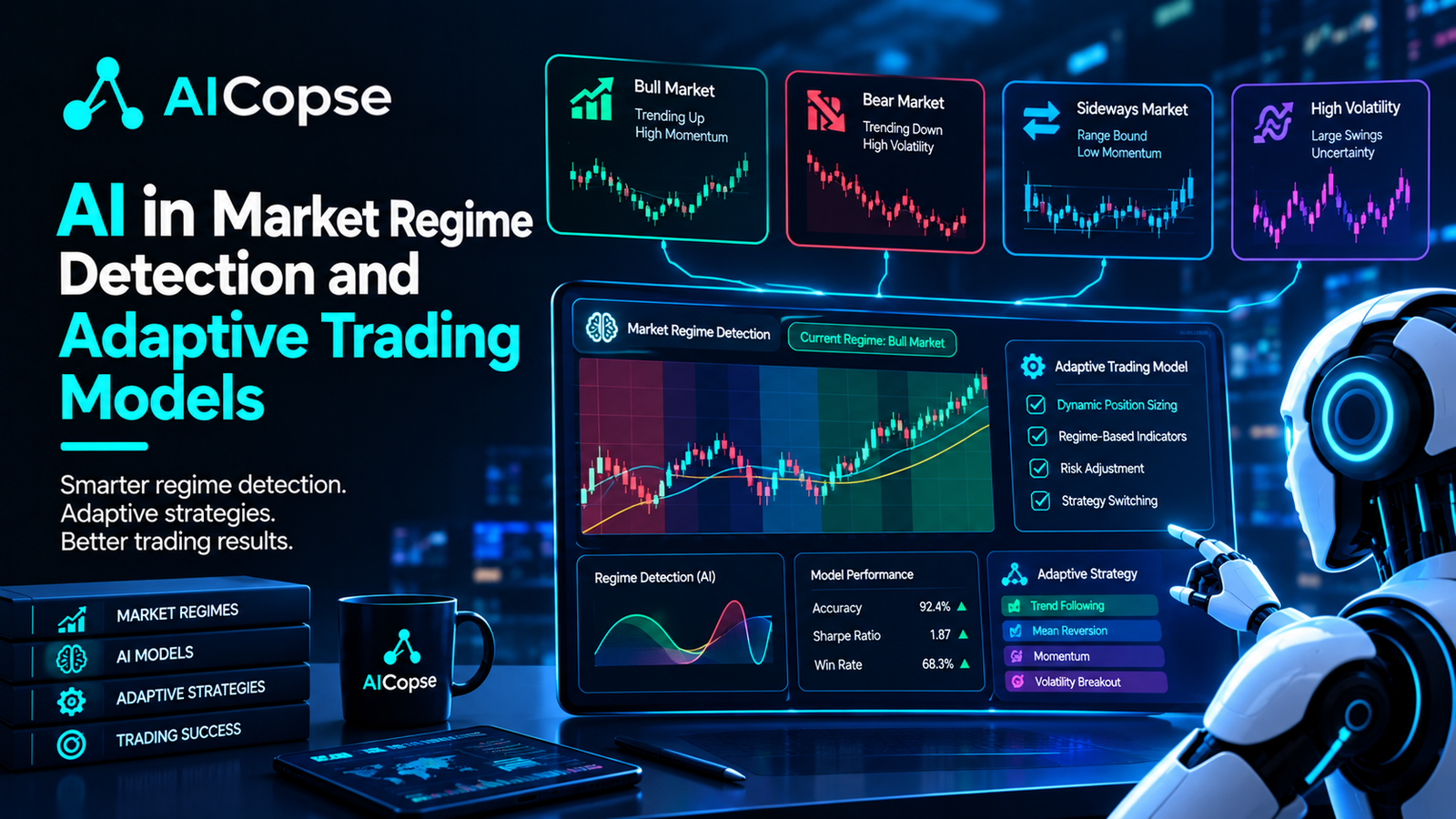
How artificial intelligence can identify changing market conditions, adapt trading strategies, and help developers build more resilient financial systems.
Quantitative Trading
Risk Management
Adaptive AI
Research focus: financial markets, including equities, exchange-traded funds, index futures, and institutional trading systems.
Financial markets do not behave the same way every day. A strategy that performs well when stock prices rise steadily may struggle when volatility increases, interest-rate expectations change, liquidity falls, or investors rush toward safer assets. These shifts are commonly described as market regimes. Artificial intelligence can help trading systems recognize these changing conditions and adjust their decisions instead of relying on one fixed set of rules.
However, regime detection is not a reliable way to predict every market crash or guarantee profitable trades. The underlying market state is not directly observable, regime labels can change, and signals may arrive after prices have already moved. A useful system must therefore combine statistical models, reliable data, execution-cost estimates, portfolio controls, and independent testing.
This report examines six research studies and related technical evidence, reviews the current regulatory and industry environment, compares the approaches used by competing educational and research resources, and explains how developers, startups, financial businesses, and quantitative research teams can build more robust regime-aware trading systems.
Key findings at a glance
- Market regimes describe changing statistical conditions, not perfectly predictable market categories.
- Hidden Markov Models, change-point detection, tree-based models, and neural networks solve different parts of the problem.
- Recent research supports testing regime-aware systems, but strong backtest results do not automatically prove durable live-trading profits.
- Adaptive models need safeguards against false signals, excessive trading, model drift, and unexpected market events.
- For many teams, the most practical starting point is a transparent regime classifier connected to a simple, risk-controlled strategy.
- In the United States, firms must assess the rules applicable to their business, including broker-dealer market-access controls where relevant.
What Is AI-Based Market Regime Detection?
Market regime detection is the process of identifying the prevailing conditions in a financial market from observed data. Instead of assuming that the relationship between price, volatility, volume, and economic indicators remains constant, a regime-aware model estimates which type of environment may currently be present.
For example, a US equity market may move from a period of steady gains and low volatility into a period of sharp price swings, falling liquidity, and rising correlations between stocks. A momentum strategy that worked during the earlier period could produce losses during the transition. A regime detection system attempts to recognize the change and provide information that can guide position sizing, strategy selection, or risk limits.
Artificial intelligence can support this process by examining relationships across large datasets. These can include price returns, realized volatility, trading volume, Treasury yields, credit spreads, options-implied volatility, market breadth, and carefully timestamped news indicators. The model searches for recurring statistical patterns rather than relying only on a human-defined market label.
Stable or trending
Price trends are more persistent, volatility is relatively contained, and liquidity conditions are supportive.
Transition or uncertainty
Signals conflict, volatility may begin to rise, and the probability of a change in market behavior increases.
Stress or high volatility
Large price swings, wider spreads, higher correlations, or rapid changes in risk appetite may require tighter controls.
Important: These are illustrative categories, not universal market states. A model may identify two, three, four, or more regimes, and its labels depend on the data, assets, time horizon, and modeling assumptions. A high-volatility market can rise sharply, fall sharply, or move in both directions.
Market regime detection versus price prediction
Price prediction estimates a future value or direction. Regime detection instead estimates the conditions under which a strategy is operating. These tasks are related, but they answer different questions. A model might be uncertain about tomorrow’s S&P 500 return while still identifying a substantial increase in volatility and recommending a smaller risk budget.
| Approach | Main question | Possible output | Main limitation |
|---|---|---|---|
| Price forecasting | Where might price move next? | Expected return or direction | Forecasts can deteriorate as relationships change. |
| Regime detection | What conditions appear to be present? | Probabilities of market states | The state is inferred, not directly observed. |
| Adaptive trading | How should the system respond? | Strategy choice, exposure, or risk limits | Incorrect responses can increase losses. |
For readers who want to explore the wider forecasting process, see AICOPSE’s guide to AI in Predictive Financial Modeling and Market Forecasting. Regime detection can complement forecasting, but it should not be treated as a substitute for a tested trading strategy.
Why Static Trading Models Struggle When Markets Change
Many trading models are trained on historical relationships between inputs and returns. The problem is that financial data is non-stationary: the distribution of returns, the relationship between assets, and the way information affects prices can change over time. A pattern that was useful in one period may weaken or reverse in another.
Consider a model trained during a long period of rising US equities. It may learn that positive momentum and strong market breadth often precede further gains. When interest-rate expectations change abruptly or an unexpected event affects liquidity, those relationships may no longer hold. If the system continues to trade at the same size, it can remain exposed to a pattern that has already weakened.
Several forces can contribute to regime changes:
- Monetary policy: Federal Reserve decisions, inflation releases, and changes in Treasury yields can alter discount rates and risk appetite.
- Economic conditions: Employment, consumer spending, growth expectations, and recession concerns can affect sectors differently.
- Market structure: Liquidity, order flow, spreads, and participation can change throughout the trading day.
- Cross-asset relationships: Stocks, Treasury securities, gold, the US dollar, and digital assets may not maintain stable correlations.
- Unexpected events: Geopolitical developments, financial stress, policy announcements, or company-specific shocks can change price behavior quickly.
- Strategy crowding: When many participants respond to similar signals, the behavior of a strategy may change as its trades affect execution prices.
The key challenge is not simply recognizing a bull or bear market after it has become obvious. It is estimating when the statistical environment is changing, deciding how much confidence to place in that estimate, and responding without creating excessive turnover.
The transition problem
The most difficult period may be the transition between regimes. A classifier can perform well during stable periods but respond too slowly when conditions change. Conversely, a highly sensitive classifier can switch labels repeatedly because of ordinary market noise. Both errors can damage a trading system.
How AI Detects Market Regimes
There is no single model that is best for every asset, market, and time horizon. A practical research process compares statistical baselines with machine learning approaches and checks whether any additional complexity improves out-of-sample decisions after costs.
Hidden Markov Models
A Hidden Markov Model, or HMM, assumes that an underlying state generates the observations seen in the data. The state itself is hidden, but the model estimates the probability of each state from observations such as returns or volatility. For example, a three-state model might identify low-volatility, high-volatility, and transitional conditions.
HMMs are useful because they provide probabilistic outputs and model transitions between states. They are also relatively understandable compared with many deep learning systems. However, the number of states must be chosen, state labels may not have a stable economic meaning, and the model can be sensitive to its training window and distributional assumptions.
Markov-switching and volatility models
Econometric models can explicitly represent changes in the behavior of a time series. Markov-switching models allow parameters to differ across hidden states. Models such as GARCH estimate time-varying volatility, while hybrid systems can combine volatility dynamics with regime probabilities. These methods are valuable benchmarks because they help researchers test whether a complex AI model adds value beyond established statistical techniques.
Tree-based machine learning
Models such as LightGBM and XGBoost can combine many inputs, including technical features, cross-asset returns, macroeconomic data, and lagged volatility. They can learn nonlinear relationships and interactions without requiring every relationship to be specified in advance. Their performance still depends on correct data timing, sensible feature selection, and careful out-of-sample testing.
Neural networks and deep learning
Recurrent neural networks and other sequential models can learn temporal relationships across long sequences. Neural networks may help when a system has enough clean data and a meaningful reason to model complex interactions. They can also overfit, require substantial monitoring, and be harder to explain. More layers do not automatically produce better market forecasts.
Change-point detection and drift monitoring
Change-point methods look for evidence that the statistical properties of a series have changed. Drift monitors can also track whether prediction errors, probability calibration, or input distributions are moving away from their expected ranges. These methods can complement regime classifiers by warning when the model may no longer be reliable.
Reinforcement learning
Reinforcement learning trains a decision-making policy using rewards that depend on actions and outcomes. In a regime-aware system, a model may receive state probabilities as inputs and choose an allocation, strategy, or risk setting. This is different from regime classification: the classifier estimates conditions, while the policy chooses an action. Reward design, transaction costs, realistic execution, and the quality of the training environment are crucial.
| Method | Best research use | Strength | Watch-out |
|---|---|---|---|
| HMM | Probabilistic state detection | Interpretable state probabilities | State instability and model assumptions |
| Markov-switching or GARCH | Statistical baseline and volatility | Established modeling framework | May miss complex interactions |
| LightGBM or XGBoost | Nonlinear regime-conditioned forecasts | Works with mixed structured features | Leakage and overfitting risk |
| Neural networks | Complex sequential patterns | Flexible nonlinear representations | Data needs and limited explainability |
| Reinforcement learning | Strategy or allocation decisions | Optimizes sequential decisions | Reward design and unrealistic simulations |
| Change-point detection | Warnings about structural changes | Can flag distribution shifts | False alarms and detection delays |
Six Research Studies and What They Actually Tell Us
Research in regime detection spans statistical finance, machine learning, portfolio management, and algorithmic trading. The following studies are especially relevant because they examine different parts of the problem. Their reported results should be interpreted in the context of each paper’s dataset, evaluation method, and limitations rather than treated as universal performance guarantees.
What the six studies collectively suggest
These studies do not establish one universally superior model. Instead, they suggest several practical research directions: use regime information as an input to decision systems, measure uncertainty, monitor changes in the data, compare against strong statistical baselines, and evaluate the full strategy rather than the classifier alone.
| Research theme | Useful takeaway | Question for implementation |
|---|---|---|
| Regime-conditioned forecasting | The state estimate may improve forecasts in some settings. | Does it improve out-of-sample results over a baseline? |
| High-frequency classification | Microstructure can contain information about short-term conditions. | Does the signal survive spread and execution costs? |
| Early warning systems | Transitions can be monitored as well as classified. | How many warnings are early, useful, or false? |
| Bayesian estimation | Uncertainty can be included in the decision process. | Does uncertainty-aware sizing improve risk-adjusted outcomes? |
| HMM plus reinforcement learning | Detection and action selection can be separated. | Does the added policy complexity outperform simple rules? |
| Systematic review | A trading model needs more than a predictive algorithm. | Can the whole system be tested and operated reliably? |
Current Developments: Why Adaptive Trading Matters in 2026
Market regime detection is becoming more relevant as financial systems process large volumes of data, respond to faster information flows, and rely on increasingly automated decisions. The following developments provide context for US-based developers and financial businesses. They do not prove that regime-aware strategies will outperform other approaches.
Federal Reserve research: model rankings depend on the forecast horizon
A Federal Reserve Finance and Economics Discussion Series paper by Rehim Kilic, initially published in August 2025 and revised in September 2026, compares econometric and machine learning methods for realized-volatility forecasting. The study examines the S&P 500 and 40 US equities.
Its findings show that the best-performing model varies by horizon. Markov-switching HAR performs best at short horizons, while ARFIMA generally leads at the monthly horizon in the reported comparison. The result is a useful reminder that model selection should reflect the decision being made, rather than assuming one AI architecture is best for every timescale.
Source: Federal Reserve research paper.
SEC and CFTC: coordination and market integrity
On March 11, 2026, the US Securities and Exchange Commission and Commodity Futures Trading Commission announced a memorandum of understanding to coordinate oversight, support lawful innovation, and protect investors and customers. The agencies also announced a Joint Harmonization Initiative.
For firms developing adaptive trading systems, the broader lesson is that innovation does not remove the need to understand which financial products, activities, and regulatory obligations apply. A model’s technical quality is only one part of the operating framework.
Source: SEC announcement, March 11, 2026.
FINRA warning: automated trading claims require scrutiny
In July 2025, FINRA warned investors about auto-trading services offered by unregistered entities. Its notice described services that promoted claims such as risk-free trading, consistent high returns, or the use of advanced AI as a reason to trust automated decisions.
This is relevant to startups building trading products and to customers evaluating them. Marketing claims should not imply guaranteed profits or present AI as a substitute for risk disclosure. A responsible product should explain its methodology, limitations, costs, and risk controls clearly.
What these developments mean for product teams
- Test different forecast horizons instead of assuming one model will work across every timeframe.
- Keep a clear record of model inputs, outputs, configuration changes, and risk decisions.
- Make performance claims traceable to documented tests and disclose material limitations.
- Review the legal and regulatory requirements that apply to the actual service and business model.
How an Adaptive Trading Model Works
A robust architecture separates data collection, regime estimation, strategy selection, risk management, and execution. This separation makes it easier to test each component and stop the system from placing trades when data or model behavior becomes unreliable.
A regime-aware trading pipeline
Prices, volume, volatility, macro data, and market breadth
Timestamp checks, missing-data handling, returns, and rolling indicators
HMM, Markov-switching, LightGBM, or another validated model
Choose strategy, adjust exposure, check limits, or reduce risk
Order checks, cost estimates, logs, alerts, and kill switch
Illustrative architecture. Actual systems require controls appropriate to their trading activity.
Step 1: Build a reliable data foundation
For a US equity strategy, a development team might begin with daily or intraday prices for liquid stocks and exchange-traded funds. It could later add volume, realized volatility, market breadth, Treasury yields, and other features that are available at the time the decision is made.
Data timing matters. Revised macroeconomic releases, adjusted prices, future index constituents, and information published after a trade can create look-ahead bias. If a backtest uses information that would not have been available at the historical decision time, its results may be misleading.
Step 2: Estimate the probability of each regime
Rather than producing only a label such as “high volatility,” the detector should ideally return a probability distribution. An illustrative output might assign a 65% probability to a stable regime, a 25% probability to a transition, and a 10% probability to a stress regime. These figures are examples, not live market readings.
Probabilities help downstream systems account for uncertainty. If the state estimate is weak or contradictory, the strategy can reduce exposure, wait for confirmation, or require additional evidence before changing its behavior.
Step 3: Connect the detector to a clear decision rule
A regime detector should not be allowed to make unlimited decisions simply because it has identified a different state. The strategy layer needs explicit rules defining which actions are allowed, how position sizes change, and when the system must pause.
| Illustrative regime | Possible strategy response | Risk control |
|---|---|---|
| Stable trend | Allow a validated trend-following model to operate. | Maintain portfolio, sector, and position limits. |
| Sideways or mean-reverting | Test a range-based or mean-reversion strategy. | Limit turnover and avoid trading weak signals. |
| High volatility | Reduce exposure or apply a separately validated defensive strategy. | Recalculate risk using current volatility and liquidity. |
| Uncertain transition | Wait for confirmation or limit new positions. | Use conservative exposure until confidence improves. |
| Data or model failure | Stop new automated decisions or switch to a safe fallback. | Trigger alerts and follow the approved recovery process. |
These responses are design examples, not investment recommendations. Whether a strategy belongs in a particular regime must be demonstrated with appropriate historical and forward testing.
How to Test Whether Regime Detection Adds Real Value
A model can appear successful because it has learned noise, used information from the future, or been tested repeatedly until one configuration looked attractive. Reliable testing must examine the full decision process and not only the model’s classification accuracy.
Use walk-forward evaluation
Train the model on an earlier period, evaluate it on a later period, and then move the training window forward. Repeat the process across different market environments. This better resembles the conditions a live system faces than randomly mixing past and future observations.
Compare with strong baselines
Test the regime-aware system against a buy-and-hold benchmark where appropriate, a simple trend strategy, a volatility-based rule, and a model that uses the same inputs without regime conditioning. If the adaptive model does not improve the relevant outcome, the additional complexity may not be justified.
Measure trading performance, not just classification accuracy
Accuracy can be misleading when regimes are imbalanced or when the cost of a false signal differs by state. A model may correctly identify most ordinary sessions but fail during the few transitions that matter most. Evaluation should include both classification measures and portfolio-level outcomes.
| Metric | What it measures | What it cannot prove alone |
|---|---|---|
| Precision and recall | How well the model identifies a defined regime. | Whether trades are profitable after costs. |
| Confusion matrix | Which regimes are commonly confused. | Whether errors have acceptable financial impact. |
| Sharpe ratio | Return relative to measured return variability. | That returns will persist or tail risk is controlled. |
| Maximum drawdown | The largest peak-to-trough portfolio decline. | The maximum loss possible in a future event. |
| Turnover and transaction costs | How much the strategy trades and what trading costs consume. | That all real-world market impact has been captured. |
| Probability calibration | Whether predicted probabilities match observed frequencies. | That the probabilities remain calibrated after a regime shift. |
Researchers should include realistic commissions, bid-ask spreads, slippage, borrow costs where relevant, and market-impact assumptions. They should also test parameter sensitivity and account for the number of configurations tried. A single attractive backtest is weak evidence when hundreds of alternatives have been explored.
Competitor and Existing Resource Analysis
Current resources on regime detection and adaptive trading fall into several groups. Academic papers provide methods and empirical evidence, quantitative research platforms provide implementation examples, and financial regulators explain responsibilities and investor risks. A useful research guide should connect these areas instead of repeating only the definition of a Hidden Markov Model.
| Resource or competitor | What it contributes | Useful angle for readers | Gap this report addresses |
|---|---|---|---|
| QuantConnect: Intraday Application of HMMs | A practical example using intraday US stock data and a three-state HMM. | Understand how a regime classifier can be implemented in a research platform. | Connect implementation details with robust validation, uncertainty, and governance. |
| QuantConnect: From Research to Production | Explains HMM concepts and the path from research to an operational strategy. | Study hidden states and the importance of risk management. | Compare different model families and explain the full testing framework. |
| Springer academic research | A hybrid HMM and discriminative approach to high-frequency regime classification. | Explore microstructure features and state-dependent trading patterns. | Translate the research idea into an accessible product and evaluation checklist. |
| Systematic review of AI trading | A broad review of AI approaches used in financial trading. | Understand the range of models and research practices. | Focus specifically on regime detection, adaptation, and the deployment lifecycle. |
| FINRA investor guidance | Explains risks associated with automated trading services and unsupported claims. | Assess product transparency and investor protection. | Connect model evaluation to responsible product design and claims. |
This is a qualitative comparison of relevant resources, not a verified ranking of search competitors. Search results, ranking positions, and competitor performance can change. The most useful content opportunity is to bring current studies, implementation choices, statistical limitations, execution costs, and US operational considerations into one coherent guide.
For related AICOPSE coverage, readers can also explore AI in Stock Market Trading Strategy Development and AI in Algorithmic Trading and Automated Strategy Execution. These topics connect the regime-detection layer to strategy design and execution.
Practical Guidance for Developers
Developers should treat regime detection as a component in a larger software system. A useful prototype does not need to start with a large neural network. It needs reliable inputs, a baseline model, repeatable tests, and a clear explanation of how a regime estimate changes downstream behavior.
A sensible technical starting point
- Start with a narrow market: Choose a defined set of liquid US equities or broad-market ETFs before expanding to multiple asset classes.
- Build a baseline: Compare a simple volatility threshold or Markov-switching model with an HMM and a tree-based model.
- Use time-aware data splits: Preserve chronological order and ensure each feature existed when the simulated decision was made.
- Separate components: Keep data preparation, regime estimation, strategy logic, risk controls, and execution in distinct modules.
- Log probabilities and decisions: Store model version, input timestamp, state probabilities, selected action, and reason for the action.
- Monitor live behavior: Track data freshness, prediction distribution, turnover, model confidence, and realized costs.
- Build a safe fallback: Define what happens when data is stale, predictions become invalid, or a risk limit is breached.
Python libraries can support a prototype. For example, pandas can handle time-series data, scikit-learn can support preprocessing and baseline classification, and a suitable HMM implementation can estimate latent states. A team can use LightGBM for structured feature modeling and a backtesting platform to evaluate a defined strategy. Tool selection should follow the research need rather than the popularity of a library.
Developers should also version their datasets, feature definitions, and model artifacts. A result that cannot be reproduced is difficult to investigate, audit, or improve. If a model changes behavior after retraining, the team should be able to identify the exact data and code versions that produced the change.
Guidance for Startups and Financial Businesses
Startups do not necessarily need to compete by building the most complex trading model. A clearer initial product may be a regime-monitoring dashboard, a portfolio-risk alert system, a research API, or a tool that helps analysts understand changing volatility and correlation conditions.
For a fintech startup
Build a regime dashboard with confidence levels, source timestamps, alert history, and configurable risk thresholds. Validate demand before offering automated execution.
For an investment business
Test whether regime information improves portfolio allocation, drawdown management, or risk budgeting compared with existing processes.
For a brokerage or trading firm
Prioritize pre-trade checks, access controls, monitoring, incident handling, and oversight of the system that can submit orders.
For an enterprise data team
Offer clean data pipelines, regime analytics, reporting, and model monitoring to internal analysts and risk managers.
Before launching a trading product, teams should determine whether their service provides general analytics, personalized investment advice, automated trading, brokerage functionality, or another regulated activity. The legal analysis depends on the actual business model, products, customers, and operating arrangements. A technical prototype alone does not answer those questions.
For US broker-dealers with market access, SEC Rule 15c3-5 is particularly relevant. The SEC’s staff guidance explains requirements involving financial and regulatory risk controls, pre-trade checks, access restrictions, and regular review of control effectiveness. The precise requirements depend on the firm and its activities, so legal and compliance teams should review the applicable rules rather than relying on a generic software checklist.
Official reference: SEC guidance on risk management controls for brokers or dealers with market access.
Common Risks and How to Reduce Them
Overfitting to historical regimes
A model may learn patterns that existed only in the training sample. Researchers should limit unnecessary parameter searches, use chronological validation, test different market periods, and report results across multiple windows. The more configurations a team tries, the greater the need to account for selection bias.
False regime changes
Ordinary price noise can make a model switch between states too often. Hysteresis rules, minimum confidence thresholds, or confirmation windows may help reduce unnecessary changes. These controls introduce a trade-off: too much smoothing can delay a response to a genuine shock.
Look-ahead bias and survivorship bias
Using future information or only the stocks that survive to the end of a historical period can make a backtest look stronger than a live strategy would have been. Historical universes, corporate actions, timestamps, and data revisions should be handled carefully.
Transaction costs and liquidity
A frequent-switching model can generate a large number of trades. If a small predicted advantage is less than the spread, slippage, or market impact, the signal may have no economic value. This is particularly important for intraday strategies and assets with uneven liquidity.
Model drift and operational failure
Data sources can change, features can break, and relationships can deteriorate. Production systems need alerting, monitoring, version control, rollback procedures, and an approved method for pausing automated actions. A model should never be allowed to override basic risk limits simply because its own confidence is high.
Overstated marketing claims
Claims such as guaranteed returns, crash-proof trading, or consistent profits from AI are not supported by regime detection alone. Businesses should publish methodology and relevant limitations, distinguish historical results from live performance, and avoid presenting experimental results as guarantees.
Expert Recommendations for Building Better Models
The following recommendations are grounded in the research and engineering considerations discussed above. They are practical design recommendations, not quotations attributed to individual researchers.
Decide whether the goal is earlier stress detection, lower drawdown, better allocation, reduced turnover, or improved execution. Choose the target before selecting the algorithm.
Compare HMM and machine learning models with volatility thresholds and established econometric approaches. Complexity is useful only when it adds measurable value.
A model that knows when its estimate is weak can support more cautious decisions. Test whether probability calibration and uncertainty-aware sizing improve outcomes.
Include calm, volatile, trending, and transition periods where the data permits. Report where the strategy works and where it fails.
Position limits, loss limits, order validation, and emergency stops should remain effective even when the AI model produces a bad prediction.
A model needs operational testing, monitoring, documentation, incident response, and governance before it can be considered ready for real trading.
Future Predictions: 2027 to 2030
The following predictions are reasoned outlooks based on the research direction and current financial technology environment. They are not confirmed future events, and the timing of adoption will vary across firms and asset classes.
| Expected direction | Why it may develop | What teams should do now |
|---|---|---|
| Hybrid statistical and AI systems | Research continues to compare machine learning with established time-series methods, suggesting that combined systems may be useful in specific settings. | Benchmark against econometric baselines before deploying complex models. |
| More uncertainty-aware allocation | Probabilistic state estimates can support decisions that reflect model confidence instead of forcing a hard label. | Track calibration and test exposure rules tied to confidence. |
| More focus on model drift | Non-stationarity can weaken forecasts precisely when market conditions change most. | Build drift monitoring, retraining reviews, and rollback procedures. |
| More integration of cross-asset data | Studies increasingly test features beyond a single asset’s price history. | Test whether additional inputs contribute stable out-of-sample value. |
| Greater demand for explainability and auditability | Automated systems need to be monitored, tested, and governed responsibly. | Record inputs, versions, decisions, and control outcomes. |
| More specialized adaptive tools | Different users need different outputs, from execution monitoring to portfolio risk dashboards. | Validate one clearly defined use case before expanding the product. |
One likely direction is not the replacement of every existing model with a large AI system. It is the use of more specialized combinations: statistical models to estimate states, machine learning to process complex features, and rule-based controls to keep decisions within approved boundaries. This approach can be easier to validate than a single system that attempts to perform every task at once.
Another likely development is greater attention to what happens when models are wrong. Firms may gain more value from detecting degraded data, reducing exposure during uncertainty, and preventing unintended orders than from small improvements in a headline accuracy score. The economic value of adaptive trading will depend on whether those capabilities improve real decisions after costs and operational constraints.
Frequently Asked Questions
What is market regime detection in AI trading?
Market regime detection uses statistical or machine learning models to estimate the current type of market environment, such as low volatility, a persistent trend, or elevated uncertainty. Trading systems may use these estimates to adjust strategy selection, position size, or risk limits.
Which AI model is best for market regime detection?
There is no universally best model. HMMs offer probabilistic state estimates, Markov-switching models provide a statistical baseline, tree-based models handle nonlinear structured features, and neural networks can model complex sequences. The best choice depends on the data, decision horizon, and out-of-sample results.
Can AI predict a market crash?
AI may identify patterns associated with rising volatility or changing market conditions, but it cannot reliably predict every crash. False alarms, sudden news, data limitations, and rapid changes in liquidity can undermine a model. A warning signal should support risk management, not be treated as certainty.
Does regime detection guarantee more profitable trading?
No. A regime classifier may improve the description of market conditions without improving trading returns. Profitability depends on the strategy, execution costs, position sizing, data quality, risk management, and whether the results persist outside the training sample.
How can a startup build an adaptive trading model?
A startup can begin with a limited universe of liquid US assets, build a transparent regime baseline, test a simple strategy, include realistic costs, and evaluate performance using walk-forward validation. Before any live deployment, it should add monitoring, independent risk controls, documentation, and a review of applicable legal obligations.
What is the difference between a market regime and market sentiment?
Market sentiment describes the tone or attitude of participants, often inferred from news, positioning, surveys, or market behavior. A regime is a broader statistical description of market conditions, which may include volatility, return behavior, liquidity, and correlations. Sentiment can be one input into a regime model, but the two concepts are not interchangeable.
How should regime-aware models be evaluated?
Use chronological walk-forward tests, compare with simple baselines, prevent look-ahead and survivorship bias, include realistic transaction costs, and report both classification and portfolio metrics. Check sensitivity to parameters and disclose the limitations of the test period.
Conclusion
AI-based market regime detection offers a structured way to respond to changing financial conditions. By estimating hidden states, monitoring volatility, and identifying changes in relationships between assets, a regime-aware system can give traders and portfolio managers information that a fixed strategy may overlook.
The strongest approach is not necessarily the most complex. Research from 2024 through 2026 illustrates the range of useful techniques, including HMMs, Markov-switching models, Bayesian methods, tree-based machine learning, and reinforcement learning. It also shows why careful evaluation matters: model rankings vary by horizon, early warnings can be wrong, and even promising backtests may not survive more rigorous statistical checks.
For developers, startups, and financial businesses serving the US market, the practical priority is to build a system that can be tested, explained, monitored, and controlled. Use a clear baseline, avoid future-data leakage, account for execution costs, and keep risk controls independent of model predictions. Regime detection should improve the decision process where evidence supports it, not become a promise of effortless profits.
Sources and Further Reading
The following sources support the research summaries and regulatory discussion in this report. Study results should be read in their original context, including their datasets, assumptions, evaluation periods, and stated limitations.
- Electronics. “Regime-Aware LightGBM for Stock Market Forecasting: A Validated Walk-Forward Framework with Statistical Rigor and Explainable AI Analysis.” 2026. Original paper.
- Koukorinis, Andreas, Gareth W. Peters, and Guido Germano. “Generative-Discriminative Machine Learning Models for High-Frequency Financial Regime Classification.” Methodology and Computing in Applied Probability, 2025. Original paper.
- Wang, L. and co-authors. “Early Warning of Regime Switching in a Financial Time Series: A Heteroskedastic Network Model.” PLOS ONE, October 2025. Original paper.
- Blanchard, Eléonore, and Pierre-Olivier Goffard. “Data Driven Investment Strategies Using Bayesian Inference in Regime-Switching Models.” Applied Stochastic Models in Business and Industry, November 2025. Original paper.
- IEEE. “HMM-Based Market Regime Detection with RL for Portfolio Management.” 2025 IEEE International Conference on Intelligent Data and Security. Study record.
- Dakalbab, Fatima, Manar Abu Talib, Qassim Nasir, and co-authors. “Artificial Intelligence Techniques in Financial Trading: A Systematic Literature Review.” Journal of King Saud University Computer and Information Sciences, March 2024. Original review.
- Kilic, Rehim. “Linear and Nonlinear Econometric Models versus Machine-Learning Models: Evidence from Realized-Volatility Forecasting.” Federal Reserve Finance and Economics Discussion Series, August 2025, revised September 2026. Federal Reserve paper.
- US Securities and Exchange Commission. “SEC and CFTC Announce Historic Memorandum of Understanding Between Agencies.” March 11, 2026. Official announcement.
- FINRA. “Know the Risks of Auto-Trading Services Offered by Unregistered Entities.” July 29, 2025. Official investor guidance.
- US Securities and Exchange Commission. “Responses to Frequently Asked Questions Concerning Risk Management Controls for Brokers or Dealers with Market Access.” Official guidance.
- QuantConnect. “Intraday Application of Hidden Markov Models.” Implementation example.
- QuantConnect. “From Research to Production: Hidden Markov Models.” Research and production discussion.
Disclaimer
This article is for educational and informational purposes only. It is not investment advice, a recommendation to buy or sell securities, a guarantee of trading performance, or legal advice. Research findings are specific to their respective datasets, methods, and evaluation periods. Historical backtests and reported model metrics do not guarantee future results. Automated trading can cause substantial losses, including losses arising from data errors, model failure, market gaps, liquidity constraints, and execution problems. Businesses should obtain appropriate legal, compliance, and financial advice before offering or deploying trading systems.

Leave a Reply