
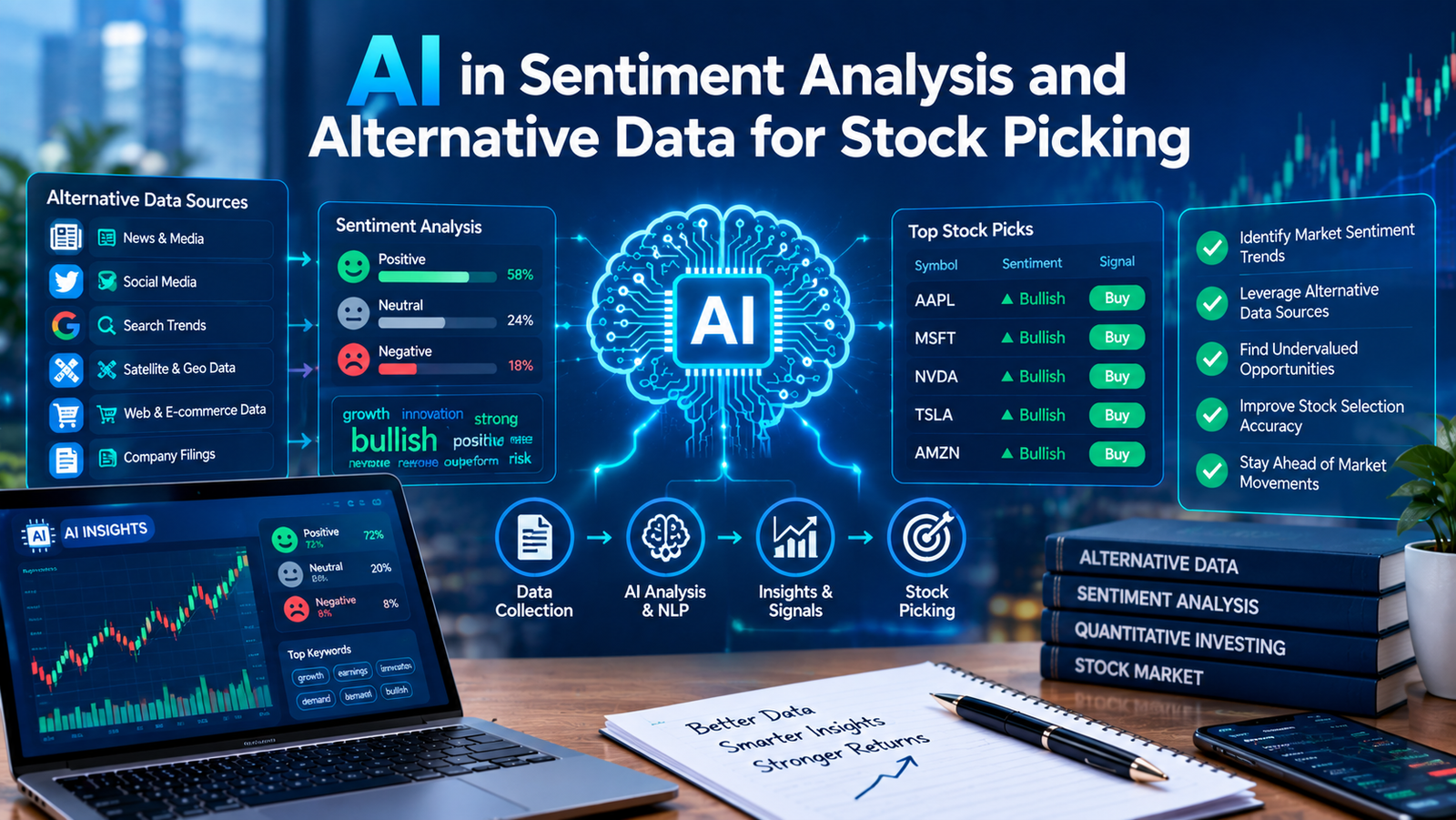
Primary topic: Artificial intelligence for stock selection, financial sentiment analysis, alternative data, investor behavior, NLP, financial large language models, and quantitative investment research
Research focus: How AI transforms unstructured information into stock-selection signals, combines news and social sentiment with market fundamentals, identifies emerging investment narratives, evaluates signal quality, and supports evidence-based portfolio decisions
What Is AI Sentiment Analysis for Stock Picking?
AI sentiment analysis uses natural language processing and machine learning to interpret opinions, expectations, concerns, and emotional signals contained in financial information. In stock picking, these signals help investors assess how market participants perceive a company, its industry, or a future business event.
Traditional stock research often starts with financial statements, valuation ratios, earnings estimates, competitive positioning, and management guidance. These remain essential, but they do not capture every change in investor expectations as it develops. News reports, earnings-call language, online discussions, job postings, product reviews, and supply-chain information can reveal changes in a company’s prospects before those changes become fully visible in reported financial results.
AI can process these sources and convert them into structured investment features. For example, a model may identify that a company’s latest earnings call contains increasingly cautious language about demand, while customer reviews suggest improving product satisfaction and job postings indicate expansion into a new business line. These signals can then be compared with valuation, revenue growth, analyst expectations, and market prices.
The objective is not to let a language model choose stocks based on its opinion. It is to create measurable evidence that can be tested within an investment process.
News, filings, reviews, web activity
Sentiment, events, entities
Predictive value, timing, costs
Selection, sizing, monitoring
Conceptual workflow. The diagram describes an investment research process, not a guarantee of investment performance.
Why Alternative Data Matters for Stock Selection
Alternative data refers to information that sits outside, or supplements, conventional financial datasets. It can help investors investigate changes in demand, customer behavior, operational activity, business momentum, and market expectations.
The most useful sources depend on the company being analyzed. Online customer reviews may be relevant to a consumer brand, while shipping activity may matter more for an industrial manufacturer. App usage can provide context for a software business, and regulatory filings may be especially important for a bank or pharmaceutical company.
| Alternative data source | Potential stock-selection insight | AI application |
|---|---|---|
| Financial news | Changing expectations, risks, catalysts | Sentiment and event extraction |
| Earnings calls and filings | Management confidence, guidance, business risks | Financial language analysis |
| Social media and forums | Investor attention, expectations, crowd behavior | Sentiment, topic and bot detection |
| Product reviews | Customer satisfaction and product problems | Aspect-based sentiment |
| Web and app activity | Consumer interest and engagement trends | Time-series forecasting and anomaly detection |
| Job postings | Hiring direction and capability investment | Entity classification and trend analysis |
| Supply-chain and shipping data | Potential production or demand changes | Pattern detection and forecasting |
Alternative data is not automatically superior to conventional financial information. Some sources are delayed, incomplete, expensive, difficult to license, or biased toward particular customer groups. A dataset becomes useful only when it has a clear relationship to a business question and adds information that the market has not already fully incorporated.
Research Study: Financial NLP and the Changing Role of AI in Investment Research
A 2025 survey published in Information Fusion examined natural language processing across ten financial applications, including sentiment analysis, financial forecasting, portfolio management, risk management, regulatory compliance, and digital assets.
The review is important because it places sentiment analysis within a wider financial research pipeline. Financial NLP is not limited to assigning positive or negative labels to text. It can also extract events, identify entities, summarize narratives, support financial question answering, and organize unstructured information for quantitative models.
For stock picking, this wider view matters. A headline that says a company is expanding may sound positive, but the investment implication depends on the cost of expansion, the market opportunity, the company’s existing valuation, and whether investors already expected the announcement. Event extraction and financial context can help distinguish these situations.
The review also highlights continuing challenges around financial language, data quality, evaluation, and the connection between NLP outputs and real investment tasks. A model that understands a sentence correctly may still fail to generate a useful trading signal.
What this means for investors:
- Combine sentiment classification with event and entity extraction
- Evaluate whether the information changes an investment thesis
- Measure incremental value against financial and market data
- Test performance across different assets, sectors, and market regimes
Source: Du et al., “Natural language processing in finance: A survey,” Information Fusion, 2025
Research Study: FinGPT-Based Sentiment and Hybrid Stock Forecasting
A June 2026 study in Scientific Reports examined a forecasting framework that combines FinGPT-derived sentiment from Twitter data with historical prices and technical indicators. The researchers evaluated four deep-learning architectures across eight major NASDAQ and NYSE stocks.
The models included CNN, LSTM, attention-based LSTM, and a hybrid attention-LSTM-CNN architecture. The study reported that adding FinGPT sentiment improved forecasting accuracy across the evaluated models, with the hybrid architecture performing best in the reported experiments.
This research is directly relevant to AI stock picking because it tests sentiment as an additional feature rather than treating text analysis as a complete investment strategy. Historical prices capture market behavior, technical indicators summarize aspects of price and volume, and sentiment provides information about how investors are discussing the assets.
The combination may help a model distinguish situations where similar price patterns occur alongside different information environments. For example, a price decline accompanied by improving sentiment may represent a different setup from a decline accompanied by worsening sentiment and negative company news.
However, the study covers a limited group of stocks and does not establish that the same performance will hold across all securities, time periods, or live portfolios. Forecasting accuracy also does not automatically establish profitability after transaction costs, turnover, and risk.
Practical implications:
- Treat financial sentiment as one feature within a broader forecasting model
- Test whether sentiment improves results over a price-only baseline
- Evaluate the model on unseen periods and different market conditions
- Convert forecasts into portfolio returns only after realistic trading-cost tests
Research Study: AI-Driven Sentiment Analysis Across Financial Sectors
A study published online in August 2026 in the Journal of Modelling in Management investigated AI-driven sentiment analysis using a hybrid LSTM and Random Forest framework. Its dataset combined stock prices, macroeconomic indicators, and text from sources including Reddit, Twitter, Bloomberg, and Reuters, covering 2019–2024.
The study used transformer-based language processing, including FinBERT, to quantify sentiment and then tested whether the resulting signals could contribute to forecasting. It reported directional relationships between social sentiment and short-term stock movements in technology and finance, while finding less sensitivity in sectors such as healthcare and energy.
The sector difference is a meaningful result for stock-selection systems. Investor discussion can have a strong influence on attention-sensitive companies, but it may be less informative for businesses whose value depends more heavily on regulated pricing, long product cycles, or operational factors.
The reported hybrid model achieved 68.5% directional accuracy and a 22% reduction in prediction error relative to the study’s ARIMA benchmark. These are study-specific findings, not a general performance expectation for sentiment strategies.
The work also raises concerns about sentiment manipulation, transparency, and AI governance. Those issues become especially important when social-media signals are used to select stocks or influence trading decisions.
Practical implications:
- Build sector-specific sentiment models rather than assuming one model fits every industry
- Test whether sentiment adds value beyond simple price and volatility features
- Separate genuine investor discussion from coordinated or automated activity
- Revalidate signals when the market environment or platform behavior changes
Research Study: Financial Sentiment Models and the Difference Between Accuracy and Investment Value
A 2026 working paper, “Evaluating Financial Sentiment in the Age of AI,” compared twelve sentiment models, including dictionary-based methods, finance-specific transformer models, and general-purpose open-source large language models.
The researchers evaluated two distinct questions: whether the models correctly interpreted financial language, and whether their sentiment measures had meaningful relationships with financial outcomes.
The findings highlight a critical distinction. General-purpose LLMs achieved classification performance comparable to finance-specific transformer models without task-specific fine-tuning. However, stronger classification performance did not translate into stronger economic relationships. Several models produced sentiment measures associated with earnings surprises, but none showed a statistically significant relationship with next-day stock returns in the reported analysis.
This is a particularly useful finding for investment teams. A model may correctly recognize that a news story is negative, but the stock may rise because the news is less negative than expected. Similarly, a positive announcement may have little effect if the market anticipated it.
Sentiment quality and investment value are therefore different evaluation problems.
Practical implications:
- Do not select a model based only on sentiment accuracy
- Test whether its signals predict outcomes relevant to the strategy
- Compare against simple baselines and existing investment factors
- Measure economic value after realistic costs and portfolio constraints
The paper is a working paper, so its findings should be interpreted in light of its methods, data, and review status.
Source: Bisharat and Hean, “Evaluating Financial Sentiment in the Age of AI,” 2026 working paper
Research Study: Financial Sentiment and Algorithmic Trading Performance
A study published online in July 2026 examined how financial sentiment analysis could be translated into trading strategies. The researchers evaluated tweets associated with 25 large-cap stocks using BERTweet, RoBERTa, and FinBERT. They aggregated sentiment daily and converted the resulting measures into portfolio signals.
The strategies were compared with buy-and-hold benchmarks. The study reported that sentiment-based portfolios outperformed the selected benchmarks, while also identifying data noise and domain dependency as important challenges.
This study is useful because it moves beyond sentiment classification and tests a trading application. It also illustrates why a stock-picking system must specify how sentiment becomes an investment decision. A positive score could affect a stock’s ranking, position size, or eligibility for a portfolio, but those choices need to be defined and tested.
The result should not be read as proof that sentiment-based strategies will outperform in live markets. Backtest performance can depend on the sample period, the assets selected, the timing of data collection, trading costs, and the benchmark used.
Practical implications:
- Test sentiment-based portfolios against relevant investable benchmarks
- Include transaction costs, slippage, and turnover
- Test whether results persist across different time periods
- Avoid selecting a strategy solely because it performed well in one historical sample
Source: “Financial sentiment analysis meets algorithmic trading: a performance-based approach,” 2026
Research Study: AI-Generated Social Media and Sentiment Manipulation Risk
A 2026 study in Future Business Journal investigated how AI-generated bots can distort social-media sentiment used in investment decisions. It used a controlled simulation design involving 1,091 financial tweets and 320 independent tests across four bot scenarios, including positive amplification, negative amplification, benign paraphrasing, and noisy bot activity.
The study examined how contaminated social-media streams could affect sentiment measurements when models had been trained on clean historical data. Its focus was not simply whether an AI model could classify text, but whether the information feeding the model could be manipulated.
This is a growing concern for alternative-data investing. A sudden increase in positive posts may reflect genuine investor interest, coordinated promotion, automated posting, or a mixture of these factors. If a stock-selection model treats all posts as independent expressions of investor opinion, it may mistake artificial activity for a meaningful change in market sentiment.
The risk is especially relevant to smaller or less liquid stocks, where concentrated online activity can be more influential and where a model’s signal may be easier to manipulate.
Practical implications:
- Estimate the share of activity generated by suspicious or repetitive accounts
- Track posting concentration and unusual bursts in discussion
- Avoid treating post volume as a direct measure of investor conviction
- Apply stricter validation before trading signals from thinly traded securities
From Sentiment Score to a Stock-Picking Signal
A sentiment score is only the starting point. A stock-selection process needs to connect the language signal to an investment hypothesis.
Consider a company that receives a wave of positive news coverage. The model should identify the company, determine what changed, distinguish the event from repeated reporting, and assess whether the news is material. It should then compare the event with valuation, market expectations, and other evidence before assigning a stock-selection signal.
A practical scoring framework can combine several dimensions.
Example framework only. Weights must be calibrated and tested for the investment strategy.
The scorecard should not be treated as a universal formula. Different strategies will require different weights, and some signals may be unsuitable for certain asset classes or investment horizons.
Sentiment Is Not the Same as Investor Expectations
One of the most important challenges in stock picking is distinguishing sentiment from surprise. Markets respond not only to whether information is good or bad, but also to how it compares with what investors already expected.
For example, a company may report revenue growth of 10%. That sounds positive in isolation, but if analysts expected 15%, the announcement may disappoint investors. Conversely, a company reporting a loss may rise if the loss is smaller than expected and management provides stronger guidance.
AI systems should therefore extract expectations and changes in expectations where reliable data is available.
Useful features include:
- Difference between reported results and consensus estimates
- Changes in management guidance
- New information compared with previous company statements
- Changes in analyst language and estimate revisions
- Sentiment shifts before and after an event
- Market reaction relative to the broader sector
This approach helps prevent a model from confusing positive wording with positive investment information.
How AI Can Combine Sentiment With Fundamental Data
Sentiment is often most useful when it complements rather than replaces fundamental analysis. A stock may have positive sentiment but weak cash flow, high debt, or an expensive valuation. Another company may have muted public attention while showing improving margins and strong balance-sheet quality.
A multi-factor system can combine these inputs.
| Signal family | Example features | Portfolio role |
|---|---|---|
| Sentiment | News polarity, sentiment change, emotional tone | Measure information and investor perception |
| Events | Earnings, product launches, legal or regulatory events | Identify potential catalysts and risks |
| Fundamentals | Revenue growth, margins, debt, cash flow | Assess business quality and financial resilience |
| Valuation | Multiples, earnings yield, valuation relative to peers | Assess how expectations are priced |
| Market data | Momentum, volatility, liquidity, volume | Assess market confirmation and trading conditions |
| Alternative data | App activity, reviews, hiring, supply-chain signals | Estimate business trends not yet fully reflected in reports |
The model can rank stocks based on the combined evidence, but the portfolio process must still account for diversification, liquidity, risk limits, and investment objectives.
Building a Reliable AI Sentiment Pipeline
A production-grade sentiment system requires more than a language model and a feed of headlines. The data must be collected, cleaned, timestamped, linked to the correct company, scored, and evaluated before it is used in an investment decision.
Licensed news, filings, social posts, alternative datasets
Deduplication, timestamps, spam filtering, source checks
Entity linking, sentiment, events, novelty
Aggregation, confidence, sector context
Out-of-sample tests, costs, robustness
Ranking, risk controls, monitoring
Data quality and timing
Financial signals are highly sensitive to timing. A model must not use information before it was actually available to the investor. If a news article is timestamped after market close, a backtest should not assume the strategy traded on it earlier that day.
The system should also remove duplicate articles, identify syndicated reporting, and distinguish original reporting from commentary that repeats the same event. Otherwise, a single announcement may appear to be a broad increase in sentiment simply because many websites republished it.
Entity resolution
Company names can be ambiguous. A company may share a name with a product, a person, or another listed entity. AI should link text to the correct issuer and, where appropriate, distinguish parent companies, subsidiaries, competitors, and suppliers.
Sentiment aggregation
A useful company-level signal should consider more than the average sentiment score. It can include the number of independent sources, the speed of sentiment change, the reliability of each source, the novelty of the event, and the degree of disagreement across sources.
Model monitoring
Language, platforms, and market behavior change. Models should be monitored for declining accuracy, changing data distributions, increased bot activity, and shifts in the relationship between sentiment and returns.
Backtesting: The Difference Between a Research Signal and an Investable Strategy
A sentiment signal can look compelling in a historical dataset and still fail when deployed. The most common causes include look-ahead bias, overfitting, unrealistic execution assumptions, survivorship bias, and repeated testing until a favorable result appears.
A robust evaluation should include:
- Point-in-time data, including the original publication timestamps
- Separate training, validation, and test periods
- Walk-forward testing across changing market conditions
- A benchmark using the same investment universe
- Transaction costs, spreads, slippage, and market impact
- Portfolio turnover and capacity analysis
- Performance by sector, market capitalization, and volatility regime
- Checks for survivorship bias and delisted securities
The team should measure both predictive and portfolio outcomes. Classification accuracy, precision, recall, and calibration can assess the model’s language outputs. Portfolio measures such as excess return, drawdown, turnover, Sharpe ratio, and capacity help determine whether the signal is useful in practice.
A strategy should not be considered successful merely because it predicts whether a stock rises or falls more often than chance. The size of gains and losses, timing, costs, and exposure to common risk factors all matter.
Alternative Data Risks: Privacy, Licensing, and Representativeness
Alternative data can create legal and ethical concerns when it contains personal information, is collected without appropriate permissions, or is used outside the terms of its license. Public availability does not automatically mean that a dataset can be used for every commercial purpose.
Investment teams should document where data comes from, what rights they have to use it, how long it can be retained, and whether it contains sensitive or identifiable information. They should also assess whether the data represents the population or business activity it claims to measure.
For example, app-store reviews may disproportionately represent highly engaged customers. Social-media discussions may overrepresent younger users or unusually vocal investors. A model trained on these sources could mistake the behavior of a narrow group for the views of the entire market.
Data governance should therefore be part of the investment design, not a compliance check added after the model is built.
Expert Recommendation: Build an Evidence-First Stock-Picking System
For investment firms and fintech companies, the recommended approach is to build a system in which AI extracts evidence and quantitative research determines whether that evidence deserves portfolio weight.
Start with a narrow investment question. For example, test whether changes in earnings-call sentiment improve stock rankings over a fundamental model. Then add one alternative data source and evaluate whether it provides incremental value. This is more informative than combining many datasets and models at once, because it helps identify which components actually contribute to the result.
The recommended operating principles are:
- Use finance-aware NLP for financial language and test general-purpose LLMs against it
- Separate sentiment, event materiality, novelty, and source reliability
- Combine text-derived signals with fundamentals, valuation, and market data
- Maintain point-in-time datasets and prevent information leakage
- Test performance across sectors and market regimes
- Account for data licensing, privacy, and source reliability
- Monitor bot activity and coordinated sentiment manipulation
- Keep human review for unusual, high-impact, or low-confidence signals
- Document model changes and preserve reproducible research results
The SEC’s discussion of predictive data analytics highlights the importance of conflicts of interest when firms use analytics to shape interactions with investors. In a stock-selection context, this reinforces the need for clear governance, appropriate disclosures, and controls over how model outputs are used. The statement is a regulatory perspective on predictive analytics, not an endorsement of any particular sentiment strategy.
Expert Quote
“regardless of the technology used, firms meet their obligations not to place their own interests ahead of investors’ interests.”
Source: Gary Gensler, U.S. Securities and Exchange Commission, Statement on Conflicts of Interest Related to Uses of Predictive Data Analytics, July 26, 2023. The excerpt is presented in the context of investment-firm obligations, not as a claim about sentiment-model performance.
Future Predictions: 2027–2030
2027: Event-Aware Sentiment Becomes More Common
Investment systems are likely to move further beyond simple positive and negative labels. Models will increasingly distinguish earnings surprises, guidance changes, product announcements, litigation, regulatory decisions, supply-chain disruptions, and other event types. The practical benefit will depend on whether these classifications improve the timing and quality of investment decisions.
2028: Alternative Data Fusion Becomes More Selective
As more datasets become available, firms will face greater pressure to demonstrate that each source adds measurable value. Rather than collecting every possible signal, mature teams will prioritize datasets with clear economic logic, reliable licensing, and repeatable performance. Data provenance and point-in-time integrity will become central parts of model governance.
2029: Multimodal Financial Research Expands
Financial AI may increasingly combine text with tables, charts, audio from earnings calls, and other structured or unstructured inputs. This could help models connect management commentary with reported figures and market reactions. The challenge will be to verify that multimodal features improve out-of-sample results rather than simply making the model more complex.
2030: AI Research Copilots Become More Integrated With Portfolio Workflows
AI assistants may increasingly help analysts search filings, compare company narratives, summarize new events, investigate anomalies, and explain changes in stock rankings. In institutional settings, these tools are likely to work alongside established research and portfolio systems rather than operate as unrestricted autonomous stock pickers.
Event-aware sentiment and entity-level analysis
More rigorous alternative-data selection
Multimodal financial research
Integrated analyst and portfolio copilots
These are reasoned technology outlooks, not guaranteed outcomes or investment forecasts.
Business and Startup Opportunities
AI sentiment analysis and alternative data create opportunities for financial technology companies, quantitative research teams, and investment-data providers.
- Financial Sentiment API: Deliver entity-level sentiment, event classification, and confidence scores to investment platforms
- Alternative Data Intelligence: Combine licensed business signals with company-level research dashboards
- Earnings Call Intelligence: Track changes in management language, guidance, and risk disclosures
- Sentiment Manipulation Detection: Identify suspicious posting patterns and coordinated online activity
- AI Equity Research Copilot: Help analysts investigate companies, summarize filings, and compare competing narratives
- Sector-Specific NLP: Build language models for industries with specialized terminology and distinct information cycles
- Signal Validation Platform: Test sentiment features against point-in-time market data and portfolio benchmarks
- Alternative Data Governance: Track data provenance, permissions, freshness, and model usage
The clearest product opportunity is not necessarily another stock-prediction chatbot. A more defensible product may be an auditable research platform that connects each investment signal to its source material, explains why the signal changed, and measures whether it contributes to an investment process.
Frequently Asked Questions
What is AI sentiment analysis in stock picking?
AI sentiment analysis uses natural language processing and machine learning to interpret financial news, social media, company disclosures, and other text. The resulting features can help investors evaluate market expectations and rank stocks when combined with financial and market data.
Can AI sentiment analysis predict stock prices?
Some studies report improvements in forecasting when sentiment is combined with historical prices and other features. Results vary by dataset, sector, time horizon, and model. Better sentiment classification does not necessarily translate into profitable trading.
What is the difference between sentiment analysis and alternative data?
Sentiment analysis is a method for interpreting language and opinions. Alternative data is a broader category that includes sources such as app activity, product reviews, web traffic, job postings, and supply-chain information. AI can analyze both text-based and non-text-based alternative data.
Which AI models are used for financial sentiment analysis?
Common approaches include finance-specific transformer models such as FinBERT, general-purpose large language models, recurrent neural networks, and hybrid architectures. The appropriate model depends on the task, data, latency requirements, cost, and validation results.
Why can positive sentiment lead to falling stock prices?
A stock’s price reflects expectations, not just the tone of the latest information. If positive news is weaker than investors expected, the price may fall. Valuation, market conditions, and the information already reflected in the share price also matter.
What are the main risks of AI sentiment-based investing?
Key risks include noisy data, inaccurate company identification, bot manipulation, overfitting, look-ahead bias, model drift, data licensing issues, and trading costs. These risks require careful validation and ongoing monitoring.
How should investors evaluate a sentiment model?
Evaluate both language quality and investment usefulness. Test sentiment accuracy, event extraction, out-of-sample predictive value, portfolio returns, turnover, drawdowns, transaction costs, and performance across different market regimes.
Can AI replace financial analysts in stock selection?
AI can help analysts process information, identify patterns, and monitor companies, but investment decisions still require financial judgment, risk assessment, validation, and accountability. AI is most useful when it improves a well-defined research process.
Final Perspective
AI sentiment analysis is becoming a more sophisticated part of quantitative stock research. The field is moving from basic positive-or-negative classification toward financial language understanding, event extraction, entity-level analysis, multimodal research, and the integration of alternative data with conventional investment signals.
The recent research offers both opportunity and caution. The 2026 FinGPT study reports improved forecasting when sentiment is combined with prices and technical indicators. A 2026 cross-sector study reports that sentiment effects differ between industries. Research on AI-generated social-media activity demonstrates that sentiment streams can be manipulated. Meanwhile, a 2026 working paper finds that stronger language-classification performance does not necessarily create stronger relationships with next-day stock returns.
These findings point to a clear conclusion: the value of AI sentiment analysis depends on how carefully it is connected to the investment question.
For stock picking, the system must determine whether information is relevant, new, credible, material, and not already reflected in the price. It must also establish whether the signal improves portfolio decisions after costs and risk constraints.
The most useful architecture combines:
The opportunity is not to let AI declare which stocks are winners. It is to help investment teams discover meaningful changes in business conditions and investor expectations, test those signals rigorously, and make decisions with clearer evidence.
For asset managers, fintech companies, quantitative researchers, and investment platforms, that is the durable value of AI-driven sentiment analysis: better information processing, more disciplined research, and a measurable way to evaluate whether alternative data deserves a place in the portfolio process.
Research Sources
- Du et al., Natural language processing in finance: A survey, Information Fusion, 2025
- Golabzaei, Taheripour and Sadjadi, Enhancing stock market price prediction through FinGPT-driven sentiment analysis, Scientific Reports, 2026
- Khalil, AI driven sentiment analysis in financial markets: using transformer base models and social media signals for stock market predictions, 2026
- Bisharat and Hean, Evaluating Financial Sentiment in the Age of AI, 2026 working paper
- Financial sentiment analysis meets algorithmic trading: a performance-based approach, 2026
- Tetik, When bots mislead markets: asymmetric contamination risk in sentiment-based investment decisions, Future Business Journal, 2026
- U.S. Securities and Exchange Commission, Statement on Conflicts of Interest Related to Uses of Predictive Data Analytics, 2023

Leave a Reply