
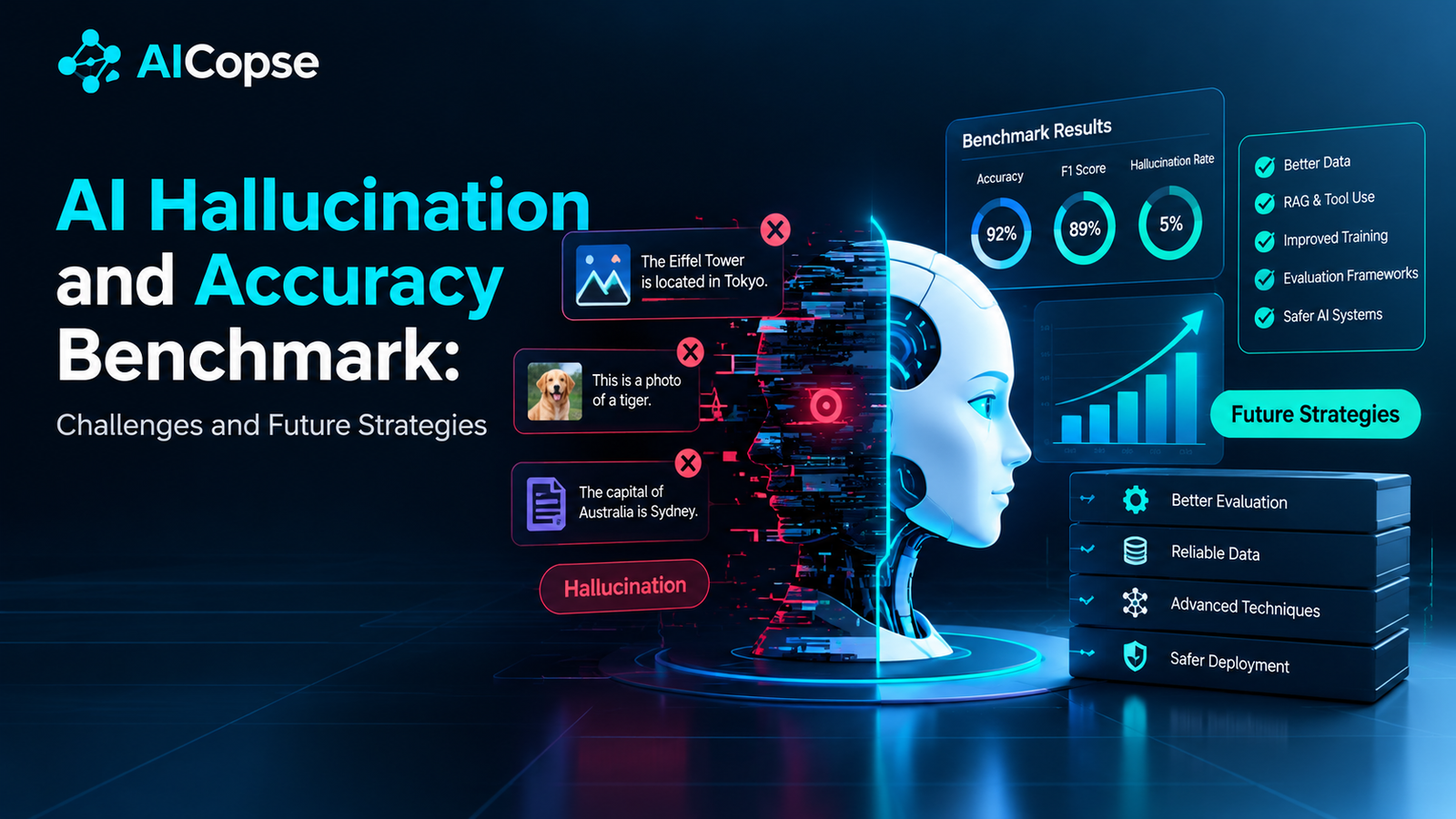
AI Hallucination and Accuracy Benchmark 2026: Challenges, Research, and Future Strategies
Artificial intelligence can write reports, answer complex questions, summarize documents, analyze code, and help businesses make decisions. But there is a serious problem behind these capabilities: AI can produce information that sounds convincing but is factually wrong. It can invent research papers, misquote people, provide incorrect legal references, misunderstand documents, and state uncertain information as if it were a verified fact.
This problem is known as AI hallucination. In 2026, it remains one of the most important challenges in building trustworthy AI systems. Newer models can perform better on many tasks, but improvements in reasoning and language quality do not automatically guarantee factual accuracy. A fluent answer can still contain unsupported claims, and a correct answer can still be unreliable if the model cannot explain where its information came from.
Research published in 2025 and 2026 provides a more detailed picture of this problem. Google DeepMind’s FACTS Benchmark Suite found that all evaluated models scored below 70% overall on its factuality benchmark. A 2026 study in Nature showed that conventional accuracy-based evaluations can reward guessing instead of admitting uncertainty. Research using real human-AI conversations found that hallucinations were present in a substantial share of sampled interactions, while a large-scale scientific citation audit identified nearly 147,000 estimated nonexistent references in 2025 alone.
These results do not mean that every AI response is inaccurate or that every model has the same error rate. They show that accuracy depends on the question, available evidence, model, evaluation method, and consequences of getting an answer wrong.
Key findings from AI hallucination research in 2026
- 68.8%: The overall FACTS Benchmark Suite score reported for Gemini 3 Pro in December 2025. The benchmark covered grounding, multimodal factuality, parametric knowledge, and search.
- 31.4%: The share of query-response pairs classified as containing hallucinations in the AuthenHallu benchmark, built from authentic human-AI interactions and published at LREC 2026.
- 60.0%: The hallucination proportion reported for the challenging Math and Number Problems category in AuthenHallu.
- 17% to 33%: The hallucination range reported for the legal AI research products examined in a preregistered 2025 study.
- 146,932: A conservative estimate of nonexistent scientific references in 2025, identified by a 2026 preprint auditing 111 million references across 2.5 million papers.
- 4,326 questions: The number of factual questions in the SimpleQA benchmark used in the 2026 Nature paper’s experiments.
- 12,000 test cases: The size of PROBE, a 2026 benchmark that evaluates separate stages of hallucination detection.
What Is AI Hallucination?
AI hallucination occurs when a model generates information that is false, unsupported by available evidence, inconsistent with its source material, or presented with more certainty than the evidence justifies. The term is widely used for large language models, although similar problems can occur in AI systems that process images, audio, video, and other data.
A hallucination is not always an obviously absurd answer. In many cases, the response looks professional and contains accurate details alongside one fabricated statement. That combination makes the problem difficult to detect, particularly when the reader does not already know the subject.
Consider an AI-generated research report that correctly describes a scientific field but cites a paper that does not exist. The general explanation may be useful, yet the fabricated reference makes the report less trustworthy. Similarly, an AI assistant might summarize most of a contract correctly but incorrectly state that a clause allows cancellation without a penalty.
The model gives an incorrect date, name, statistic, event, scientific claim, or other factual statement.
The model invents a citation, quotation, URL, court case, document, or source that does not support the claim.
The model contradicts, misreads, or adds unsupported information to the supplied document.
The model presents a weakly supported answer as certain instead of acknowledging uncertainty.
Hallucination versus an ordinary mistake
Not every inaccurate AI output is best described as a hallucination. A system can make a calculation error, retrieve an outdated web page, misunderstand an ambiguous question, or use incomplete source material. These failures overlap, but distinguishing them helps developers identify the correct solution.
For example, if an AI assistant reports last year’s revenue because it retrieved an outdated financial report, the main problem may be retrieval freshness. If it invents a new revenue figure that appears in no source, the problem is closer to a factual hallucination. If it quotes the right document but reverses the meaning of a sentence, it has a grounding or interpretation failure.
Businesses should record these categories separately rather than placing every error into one general hallucination metric. A clear classification makes it easier to improve retrieval, update data, strengthen source checks, and redesign prompts or workflows.
AI Hallucination and Accuracy Benchmark 2026: What the Numbers Really Mean
There is no single percentage that describes how often every AI model hallucinates. Different benchmarks ask different questions and apply different rules. A benchmark measuring whether an answer matches a supplied document cannot be directly compared with a benchmark testing general knowledge, legal research, mathematical reasoning, or scientific citations.
| Study or benchmark | Reported result | What it measures |
|---|---|---|
| FACTS Benchmark Suite, December 2025 | 68.8% | Gemini 3 Pro’s overall score across four factuality benchmarks. |
| AuthenHallu, LREC 2026 | 31.4% | Query-response pairs labeled as hallucinations in its authentic interaction dataset. |
| AuthenHallu, math and number problems | 60.0% | Hallucination proportion in a challenging category within that benchmark. |
| Legal AI tools, 2025 | 17% to 33% | Hallucination rates for the specific legal research products evaluated. |
| Scientific citation audit, 2026 preprint | 146,932 | Conservative estimated count of nonexistent references in 2025, not a percentage of all AI responses. |
| PROBE, Findings of ACL 2026 | 12,000 cases | Evaluation cases covering multiple steps in hallucination detection. |
These figures cannot be averaged into a universal hallucination rate. The FACTS score is an aggregate benchmark score, while AuthenHallu measures annotated responses from a particular dataset. The legal study evaluates selected products in a specialized field, and the citation audit counts nonexistent references rather than all incorrect AI claims.
The correct conclusion is that factuality remains a measurable, use-case-dependent engineering challenge. Organizations should select the evaluation that best represents their work, establish a baseline, and measure whether changes to their system reduce the errors that matter most.
Six Important Research Studies on AI Hallucination
Study 1: Evaluating Large Language Models for Accuracy Incentivizes Hallucinations, Nature 2026
Published: April 22, 2026, in Nature, volume 653, pages 1047–1051.
Research paper: Evaluating Large Language Models for Accuracy Incentivizes Hallucinations.
This study examines a problem that is easy to overlook: the way AI systems are evaluated can encourage the behavior researchers are trying to reduce. If a benchmark rewards a correct answer but treats an honest admission of uncertainty as a wrong answer, a model has an incentive to guess even when it lacks reliable evidence.
The researchers analyzed how language-model training and evaluation contribute to hallucination. They argued that language models face statistical pressure to generate likely text, while many conventional evaluations reward answering rather than abstaining. The paper proposes open-rubric evaluation, in which the scoring rules and the cost of errors are made explicit.
The researchers also tested a consistency-based mitigation using SimpleQA, a factual question-answering benchmark containing 4,326 questions. The approach generated two responses, checked whether they agreed, and abstained when the responses were judged inconsistent. Under conventional closed-rubric scoring, the mitigation reduced incorrect answers but also reduced measured accuracy, creating a disincentive to use it. When the scoring rubric explicitly accounted for abstention, the mitigation performed better than the baseline across the tested models and penalties.
The evaluation problem
Traditional scoring
A correct answer earns credit. An incorrect answer and an appropriate abstention may both receive no credit.
Risk-aware scoring
Correctness, abstention, and the cost of an error are evaluated according to explicit rules.
Why this matters: A model that admits uncertainty can be more trustworthy than one that answers every question. Developers should measure unsupported answers and appropriate abstentions separately rather than maximizing answer rate alone.
Limitations: The experiments use selected models and a particular benchmark. The paper does not establish that every open-rubric system will be more accurate in every domain, and consistency between two responses does not prove that either response is correct.
Study 2: FACTS Benchmark Suite, Google DeepMind, December 2025
Publication: December 9, 2025.
Research: FACTS Benchmark Suite: Systematically Evaluating the Factuality of Large Language Models.
Google DeepMind introduced the FACTS Benchmark Suite to evaluate factuality across different conditions rather than treating accuracy as a single skill. The suite combines four benchmarks: grounding, multimodal factuality, parametric knowledge, and search.
Grounding evaluates whether a model can produce answers supported by supplied material. Multimodal factuality examines factual performance involving visual input. Parametric knowledge evaluates information the model must answer from its learned knowledge, while search tests factual responses that depend on information retrieval.
In the published results, Gemini 3 Pro achieved an overall FACTS score of 68.8%. Google DeepMind reported that this was the highest overall score among the 15 models shown in the initial table. The report also stated that all evaluated models scored below 70% overall, leaving considerable room for improvement. Gemini 3 Pro improved over Gemini 2.5 Pro in the search and parametric portions, with reported error reductions of 55% and 35%, respectively.
Four dimensions of factuality
Grounding
Does the answer stay faithful to the provided document?
Multimodal
Does the model correctly interpret factual information in visual inputs?
Parametric
Can it answer questions using knowledge learned during training?
Search
Can it retrieve information and use it to produce a factual answer?
Why this matters: An AI model can be strong in one factuality setting and weaker in another. A company using AI to summarize internal documents should pay particular attention to grounding. A system that answers current-events questions needs reliable retrieval, source selection, and freshness checks.
Limitations: The overall score is a benchmark result, not a claim that 31.2% of all ordinary answers are hallucinations. It combines defined tasks and scoring rules. The suite is also developed and reported by Google DeepMind, so comparisons should account for the benchmark’s methodology and the models included in its evaluation.
Study 3: AuthenHallu, LREC 2026
Publication: Proceedings of the Fifteenth Language Resources and Evaluation Conference, May 2026.
Research: Detecting Hallucinations in Authentic LLM–Human Interactions.
Many hallucination benchmarks are created by deliberately asking models to produce false statements or by simulating interactions. Such tests can be useful, but they may not fully represent how people use AI in everyday conversations.
AuthenHallu was designed to address this gap by using genuine human-AI interactions. The authors selected and annotated examples from authentic dialogues to create a benchmark closer to actual usage.
The researchers reported that 31.4% of query-response pairs in the benchmark contained hallucinations. In the Math and Number Problems category, the reported proportion increased to 60.0%. The study also examined the use of ordinary language models as hallucination detectors and concluded that their performance was not yet sufficient for dependable real-world detection.
Reported hallucination proportions in AuthenHallu
Source: AuthenHallu, LREC 2026. These are proportions in the benchmark’s annotated data, not universal error rates for all AI conversations or models.
Why this matters: Real-world usage can expose weaknesses that carefully constructed test questions miss. Organizations should test with realistic prompts, incomplete requests, follow-up questions, and the types of mistakes that occur in their own customer or employee interactions.
Limitations: The benchmark represents its selected interactions and annotation process. Its figures should not be generalized to every model, language, industry, or user population without additional evidence.
Study 4: Hallucination-Free? Assessing the Reliability of Leading AI Legal Research Tools, 2025
Publication: Journal of Empirical Legal Studies, 2025.
Research: Hallucination-Free? Assessing the Reliability of Leading AI Legal Research Tools.
This preregistered empirical study evaluated AI-powered legal research products, including Lexis+ AI and Thomson Reuters products Westlaw AI-Assisted Research and Ask Practical Law AI. The authors compared the tools’ responses with a structured evaluation of legal accuracy and hallucination.
The study found that the evaluated tools hallucinated between 17% and 33% of the time. The results differed across systems, and the researchers argued that claims about the reliability of specialized legal AI tools should be examined empirically rather than accepted at face value.
Legal research is particularly sensitive to source hallucination. A model may invent a court case, misstate a holding, provide an incorrect quotation, or cite a real decision that does not support the claim. Even when the response sounds legally sophisticated, a fabricated authority can undermine a filing or mislead a client.
Why this matters: Specialized products and retrieval-augmented generation can reduce some errors, but they do not eliminate the need to verify sources. Legal professionals should open the cited authority, check that it exists, read the relevant passage, and confirm that it supports the legal proposition being made.
Limitations: The results apply to the products and evaluation conditions studied. They do not establish that all legal AI systems have the same hallucination rate, nor do they measure every possible legal task.
Study 5: LLM Hallucinations in the Wild, Large-Scale Scientific Citation Audit, 2026
Publication: arXiv preprint, May 2026.
Research: LLM Hallucinations in the Wild: Large-Scale Evidence from Non-Existent Citations.
Scientific references provide a useful way to investigate hallucinations because each citation points to an object that can, in principle, be checked. A paper either exists or it does not, although deciding whether a reference is accurate, relevant, and correctly attributed requires additional analysis.
The researchers audited 111 million references across 2.5 million papers from arXiv, bioRxiv, SSRN, and PubMed Central. They estimated conservatively that 146,932 nonexistent references appeared in 2025. The study also reported that nonexistent references increased after widespread adoption of language models and were more common in fields with rapid AI uptake and manuscripts showing linguistic signs of AI-assisted writing.
The authors cautioned that the problem is not limited to the presence of a fabricated reference. Incorrect references can also affect scholarly attribution, making it harder for readers to identify original work and potentially reinforcing existing imbalances in whose work receives credit.
References audited
The researchers examined references across 2.5 million papers.
Estimated nonexistent references in 2025
A conservative estimate from the study, not the total number of hallucinated claims across all AI-generated content.
Why this matters: A bibliography should not be treated as decorative text. Every DOI, paper title, author list, publication year, and URL should be checked against a trustworthy index or publisher page before publication.
Limitations: The paper is a preprint, and its estimate concerns scientific references in the examined sources. It should not be interpreted as the total number of fabricated citations across the internet or as proof that every nonexistent citation was generated by AI.
Study 6: PROBE, Process-Based Benchmark for Hallucination Detection, 2026
Publication: Findings of the Association for Computational Linguistics, 2026.
Research: PROBE: PROcess-Based BEnchmark for Hallucination Detection.
Detecting hallucinations is not one simple operation. A system must identify individual claims, locate relevant evidence, assess whether the evidence supports those claims, and identify exactly where the response goes wrong. A detector can fail even when it correctly identifies that a response deserves closer examination.
PROBE separates hallucination detection into four stages: claim decomposition, evidence finding, evidence evaluation, and hallucination localization. The benchmark contains 12,000 test cases covering summarization, question answering, and style transfer.
The researchers reported that current models struggled particularly with evidence finding. They also found that treating detection as a multi-step process improved performance, and that fine-tuning on the released training data substantially improved the evidence-finding stage.
Claim decomposition
Break a response into individual statements that can be checked separately.
Evidence finding
Locate trustworthy passages, records, or data relevant to each claim.
Evidence evaluation
Decide whether the evidence supports, contradicts, or fails to establish the claim.
Hallucination localization
Identify the exact sentence or claim that is unsupported or incorrect.
Why this matters: Developers should not rely exclusively on a single model asking itself whether its answer is correct. A structured verification pipeline can make the failure easier to detect, explain, and fix.
Limitations: Better results on a detection benchmark do not automatically mean a system can catch every hallucination in production. Evidence quality, domain expertise, language, and the availability of trustworthy sources remain important.
Why AI Hallucinations Happen
Hallucinations have multiple causes. They cannot be solved by changing one prompt or adding a web search tool to every model. The appropriate mitigation depends on whether the problem comes from incomplete knowledge, ambiguous input, weak retrieval, reasoning errors, poor evaluation incentives, or an inadequate verification process.
Language models predict plausible text, not guaranteed truth
Large language models learn statistical patterns from training data and use those patterns to generate responses. Those patterns help them produce fluent text, but a plausible continuation is not necessarily a true statement. Some facts are rare, inconsistently represented, outdated, or absent from the training material.
The 2026 Nature study highlights how this problem interacts with evaluation. When a model is rewarded for answering every question, guessing can score better than an honest admission of uncertainty. Improving factuality therefore requires both technical improvements and evaluation rules that reward appropriate uncertainty.
Training data can be incomplete, outdated, or contradictory
A model may have learned information that was correct at one point but has since changed. Company leadership, product features, regulations, prices, scientific guidance, and current events can all change. If a system answers from its internal knowledge alone, it may provide an outdated answer without making that limitation clear.
Retrieval from current sources can help, but only when the retrieved material is authoritative, relevant, and up to date. A search system can return a low-quality page or an outdated article. The model must still evaluate the evidence and distinguish confirmed information from speculation.
Ambiguous questions encourage unsupported assumptions
Some questions lack enough information to produce one correct answer. A user might ask for the latest price without naming a market, request a legal rule without specifying a jurisdiction, or ask for a study’s results without identifying the paper. If the model fills those gaps without clarification, it may generate a confident but incorrect response.
Systems should ask follow-up questions when a missing detail materially changes the answer. When clarification is not practical, the response should state the assumptions and explain which parts require verification.
Retrieval-augmented generation can still fail
Retrieval-augmented generation, often called RAG, connects a language model to external documents or search results. Instead of answering entirely from learned knowledge, the system retrieves evidence and uses it to generate a response.
RAG can improve grounding, especially for private company documents and current information. However, it does not guarantee accuracy. The system can retrieve the wrong passage, ignore a contradictory source, misunderstand the document, or include claims that are not supported by the retrieved evidence.
For reliable RAG, developers need to evaluate retrieval quality and answer quality separately. A system that cannot find the relevant document should be allowed to say so rather than invent an answer.
Long documents increase the chance of missing important details
When a model summarizes a lengthy report or contract, it may overlook exceptions, conditions, footnotes, or conflicting statements. It may also combine details from different sections in a way that changes their meaning.
Developers can reduce this risk by splitting complex documents into meaningful sections, retrieving relevant passages, requiring source references for important claims, and checking the final response against the original material.
Major AI Hallucination Events and Accuracy Incidents
Documented incidents show how hallucinations can affect real decisions. The following examples cover scientific research, legal work, and human judgment. They illustrate different risks and should not be treated as a representative sample from which to calculate a universal AI error rate.
Scientific papers containing nonexistent references
The 2026 citation audit found a large number of estimated nonexistent scientific references in the papers it examined. The authors audited 111 million references across 2.5 million papers and estimated 146,932 hallucinated references in 2025 alone.
Scientific citations allow readers to inspect the evidence behind a claim. When a reference does not exist, readers cannot reproduce the source trail. When a real paper is cited for a claim it does not support, the problem may be harder to notice because the bibliography looks legitimate.
Impact: Fabricated citations can waste research time, undermine reproducibility, distort scholarly credit, and make inaccurate claims appear more authoritative than they are.
Recommended response: Verify every citation against the publisher, DOI registry, PubMed, Crossref, or another suitable bibliographic database. Open the source and confirm that it supports the specific claim.
Source: LLM Hallucinations in the Wild, 2026.
Fake legal cases and inaccurate legal research
AI-generated legal citations have led to public disputes and court scrutiny. Reuters reported in August 2025 on cases in which attorneys faced consequences after including fake or inaccurate authorities in legal filings, including matters such as Kohls v. Ellison, Coomer v. Lindell, and Shahid v. Esaam.
These cases show how a hallucination can move from a generated response into a formal document. A fabricated citation may look convincing to someone who has not checked it, particularly when it contains realistic party names, dates, and legal language.
Legal research is especially vulnerable because the answer must be supported by the correct authority, jurisdiction, procedural posture, and current legal status. A real case can still be cited incorrectly if it does not establish the proposition being claimed.
Impact: Incorrect citations can damage professional credibility, waste court time, mislead clients, and result in sanctions or other consequences depending on the circumstances.
Recommended response: Lawyers should use AI as a research assistant rather than a substitute for legal verification. Each authority should be opened and checked, and important quotations should be compared with the original text.
Source: Reuters, August 4, 2025.
AI summaries influencing human memory, October 2026
Research covered by The Washington Post on October 15, 2026, described experiments investigating whether AI-generated summaries and altered images can influence what people remember. The reporting discussed work involving MIT Media Lab researchers and other studies examining how AI-generated information can affect memory and confidence.
One experiment described in the reporting involved 331 participants who watched an animated video of a car striking a pedestrian. After a delay, participants read an AI-generated summary. Among those who received an accurate summary, nearly 84% correctly remembered a traffic sign. Among those who received a misleading summary, about 45% did. The reporting also noted that telling participants the summary came from AI did not fully protect them from being influenced by it.
This is not a conventional AI factuality benchmark. It examines a related problem: an incorrect AI statement may influence a person’s later judgment, making human review less independent than expected.
Impact: In legal, healthcare, workplace investigations, and safety reviews, a misleading AI summary could affect how a person remembers or interprets the original evidence.
Recommended response: Preserve original records, distinguish source material from generated summaries, and require reviewers to return to the original evidence for consequential decisions. Human oversight is more effective when the reviewer can independently inspect the source.
Source: The Washington Post, October 15, 2026.
Deepfake evidence and verification challenges in courts
In October 2026, Reuters reported that representatives of OpenAI and Meta had warned a US judicial advisory committee about the growing difficulty of identifying AI-generated audio and video evidence. The report noted that 15 of 931 judges surveyed had encountered deepfake-related evidence challenges.
This is primarily an authenticity and media-verification problem, rather than a standard text hallucination. However, it belongs in a broader accuracy discussion because AI systems can produce or interpret convincing content that does not accurately represent an event.
The report also noted that current detection methods and watermarking approaches are not a universal solution. The origin of a file, its chain of custody, corroborating records, and expert examination may all be important.
Impact: Decision-makers may struggle to distinguish authentic evidence from manipulated media, and automated summaries of such media may introduce additional inaccuracies.
Recommended response: Do not rely on a single AI detector to determine whether a recording is genuine. Preserve original files and metadata, document provenance, and use independent corroboration for high-impact decisions.
Source: Reuters, October 15, 2026.
What these incidents reveal
- Fluent language and realistic formatting are not proof of factual accuracy.
- Source verification matters as much as generating a plausible answer.
- Human reviewers can be influenced by incorrect AI content, so independent access to original evidence is important.
- Consequential decisions require stronger checks than low-risk drafting tasks.
- Organizations should keep records of sources, generated outputs, review decisions, and corrections.
How to Measure AI Accuracy Correctly
Before improving an AI system, developers need to define what accuracy means for the task. A chatbot answering general knowledge questions requires different tests from a system summarizing contracts or producing scientific references.
Factual accuracy
Factual accuracy measures the proportion of evaluated answers that satisfy a defined correctness standard. A simple calculation is:
Accuracy = Correct answers ÷ Total evaluated answers × 100
If 920 of 1,000 answers are judged correct, the observed accuracy is 92% on that test set.
The result depends on the test questions, the definition of correctness, and how uncertain or partially correct responses are scored. A 92% score on a simple internal FAQ test does not establish 92% accuracy on legal research or current financial information.
Hallucination rate
Hallucination rate measures the share of evaluated responses or claims classified as hallucinated under a stated annotation method. The denominator matters. A benchmark might count responses, individual factual claims, citations, or complete tasks. Those choices can produce different percentages even when the underlying system is unchanged.
For example, a response containing ten factual claims and one unsupported claim may count as one response with a hallucination or as one incorrect claim out of ten. A report should state which method it uses.
Citation precision and source support
Citation quality should be evaluated separately from factual accuracy. A model may produce a correct statement but cite a source that does not support it. Conversely, a citation may be valid but the model may misunderstand the source.
Measure at least three things:
- Existence: Does the cited paper, report, legal case, or web page actually exist?
- Relevance: Does the source address the topic or claim being made?
- Entailment: Does the source support the exact statement, statistic, or quotation?
Calibration and appropriate abstention
A trustworthy system should not only answer correctly. It should also recognize when it lacks enough evidence to answer safely. Calibration examines whether the system’s confidence corresponds to its actual reliability, although confidence scores generated by a language model should not be assumed to be calibrated without testing.
Track how often the model abstains, how often its abstentions are appropriate, and how often it confidently answers incorrectly. In a high-risk workflow, a model that refuses an uncertain question may be preferable to one that gives a fast but unsupported answer.
Accuracy under changing conditions
Production inputs change over time. New products, regulations, prices, policies, and user behavior can make previously reliable responses outdated. Accuracy testing should therefore include current data, new cases, and changes in source quality.
For systems that rely on retrieval, measure whether the correct source was found, whether the answer was grounded in that source, and whether the response accurately reflected its limitations.
A Practical Framework for Reducing AI Hallucinations
There is no single technique that eliminates hallucinations in every situation. The most reliable approach combines good source data, retrieval, evidence-based generation, independent verification, uncertainty handling, and continuous evaluation.
Stage 1: Define the task
Specify what counts as correct, what evidence is required, which actions are prohibited, and when the system should ask for clarification.
Stage 2: Retrieve trusted evidence
Use authoritative sources, current records, approved documents, and clear metadata. Filter out irrelevant or outdated material.
Stage 3: Generate a grounded response
Instruct the model to use the retrieved evidence, distinguish facts from inferences, and identify gaps in the available information.
Stage 4: Verify important claims
Check names, dates, numbers, quotations, citations, and consequential statements against the original sources.
Stage 5: Handle uncertainty safely
Allow the system to abstain, ask questions, or escalate when evidence is insufficient or sources conflict.
Stage 6: Monitor and improve
Record errors, review user corrections, run regression tests, and update the evaluation set when new failure patterns appear.
Strategies Developers Can Use to Improve AI Accuracy
Use retrieval-augmented generation where external evidence matters
RAG is useful when answers depend on current information, internal company documents, product specifications, or a defined collection of trusted sources. It can reduce reliance on the model’s internal knowledge by providing evidence at response time.
However, developers should not assume that adding a vector database or web search automatically makes the system accurate. The retrieval layer must find the correct passages, and the generation layer must use them correctly.
- Use reliable sources with clear ownership and update dates.
- Store document titles, URLs, dates, and relevant metadata.
- Test retrieval recall and relevance separately from answer accuracy.
- Require citations for claims that depend on retrieved material.
- Make it possible for the model to report that no suitable evidence was found.
Break complex answers into verifiable claims
Long responses often combine many statements that vary in importance and reliability. A claim-level verification system identifies individual factual assertions and checks them against source material. This makes it easier to find one unsupported statistic or incorrect date without discarding an otherwise useful answer.
PROBE’s process-based approach supports this direction by separating claim decomposition, evidence finding, evidence evaluation, and hallucination localization.
Use deterministic tools for calculations and structured data
Language models can make arithmetic errors or confuse values in tables. When exact calculations matter, use tested code, database queries, or deterministic functions instead of relying entirely on generated text.
For example, a finance assistant should retrieve approved financial data and use a calculation engine for totals, ratios, and percentage changes. The model can explain the results, but the calculation itself should be performed and validated by software designed for that purpose.
Require source-level verification
When a model provides a citation, verify that the source exists and supports the claim. A link that opens successfully is not enough. The linked page may discuss the same subject without proving the statement attributed to it.
For research content, a robust verification process checks the source title, authors, publisher, date, DOI or stable URL, and the relevant passage. Direct quotations should be compared with the original wording.
Reward correct uncertainty
Prompts and evaluation rules should make it acceptable for the model to say that it cannot verify a claim. The 2026 Nature study suggests that scoring systems should account for the cost of wrong answers and the value of appropriate abstention.
For a low-risk brainstorming task, a clearly labeled estimate may be useful. For medical, legal, financial, or safety-critical decisions, unsupported guessing can be much more costly. Evaluation criteria should reflect those differences.
Test with realistic and adversarial examples
A test set should include more than easy questions with obvious answers. Include ambiguous requests, missing information, conflicting sources, unusual names, outdated records, misleading documents, and questions that have no reliable answer.
Keep a record of errors that occur in production and convert them into new regression tests. This helps determine whether a system update fixes previous failures or introduces new ones.
How Startups Can Build More Accurate AI Products
Startups often need to move quickly, but an AI product that produces impressive demonstrations and unreliable results can create expensive support problems and damage customer trust. The best starting point is a narrow use case where correctness can be measured and errors can be caught before they cause harm.
For example, a startup building an AI assistant for customer support could begin by answering questions from a verified help center. It could show the source article alongside each answer and escalate questions that are not covered. Only after measuring performance should the company expand to refunds, account changes, or other actions with greater consequences.
Before launch, startup teams should:
- Define the product’s factual accuracy and acceptable error criteria.
- Create a test set from real customer questions and realistic edge cases.
- Verify important claims against trusted sources.
- Measure hallucinations, abstentions, and unresolved requests separately.
- Track human correction time and the cost of failed responses.
- Make uncertainty visible to users instead of hiding it behind confident wording.
- Provide a simple way to report incorrect answers.
- Review failures regularly and add them to the regression test suite.
Startups should also be careful when marketing accuracy. A result from one internal test set should not be presented as a universal accuracy claim. If a company reports a percentage, it should explain the task, sample, evaluation method, and conditions under which the result was measured.
How Businesses Should Manage AI Accuracy Risks
Organizations using AI across multiple teams need a common approach to factuality. Without shared evaluation standards, one department may measure success by user satisfaction while another measures exact factual correctness. These metrics can be useful, but they do not mean the same thing.
Business leaders should establish clear ownership for AI-generated information, especially when it affects customers, finances, compliance, hiring, legal decisions, or operational safety.
A practical business framework includes:
- Risk classification: Categorize use cases by the potential impact of an incorrect answer.
- Source policy: Identify which databases, documents, and websites are approved for factual claims.
- Human review: Require qualified review for high-impact decisions and sensitive external communications.
- Audit records: Retain the sources and versions used to generate important responses.
- Performance monitoring: Measure factual errors, source errors, correction rates, and user complaints.
- Incident response: Define how to correct inaccurate information, notify affected people, and prevent repeated failures.
- Change management: Re-evaluate performance when the model, prompt, retrieval index, or source data changes.
Companies should also consider how users interact with AI outputs. A response that is labeled as a draft and linked to supporting evidence is easier to review than a response presented as a final, authoritative answer. Clear interface design can help people understand what has been verified and what still needs checking.
A Practical AI Hallucination Testing Plan
The following testing plan can help a development team move from informal prompt testing to a repeatable factuality evaluation process.
| Test area | What to test | Metric to track |
|---|---|---|
| Basic factuality | Known questions with verified answers. | Accuracy and factual error rate. |
| Grounding | Questions answerable only from supplied documents. | Unsupported claim rate and source entailment. |
| Citation verification | Paper titles, authors, DOIs, quotations, and legal authorities. | Nonexistent citation rate and citation support rate. |
| Uncertainty | Unknown, ambiguous, or unanswerable questions. | Appropriate abstention and unsupported answer rates. |
| Freshness | Current events, updated regulations, changing prices, and new product details. | Stale answer rate and source freshness. |
| Adversarial input | Misleading instructions, conflicting sources, and malicious documents. | Failure rate under adversarial conditions. |
| Production outcomes | Real user corrections, complaints, and downstream errors. | Correction rate, incident severity, and resolution time. |
Teams should run the same evaluation before and after meaningful changes. A model upgrade may improve average performance while introducing new errors in a particular language or workflow. Regression testing helps identify these changes before they affect a larger user population.
Future Predictions: AI Hallucination and Accuracy Beyond 2026
The following are evidence-based projections, not guaranteed outcomes. They draw on the research described above and on current approaches to factuality evaluation.
Factuality benchmarks will become more specialized
One overall score cannot fully describe performance across document grounding, visual interpretation, general knowledge, legal research, mathematics, and real-time search. The FACTS Benchmark Suite illustrates the value of evaluating multiple dimensions separately.
Over the next few years, businesses are likely to place greater emphasis on domain-specific evaluation sets that reflect the sources, language, and consequences of their own workflows.
Appropriate uncertainty will become a stronger measure of quality
The 2026 Nature study shows why systems that answer every question can be rewarded even when they guess incorrectly. Future evaluation systems are likely to pay more attention to whether a model knows when it lacks sufficient evidence.
This will not mean that every uncertain answer should be refused. Instead, the model should distinguish between a well-supported fact, a reasonable inference, a tentative estimate, and a question that cannot be answered reliably with the available information.
Source verification will become standard in research workflows
The large-scale citation audit shows that fabricated references are not merely a theoretical problem. As AI-generated research becomes more common, automated checks for nonexistent citations and unsupported claims are likely to become more important in publishing, business intelligence, and scientific workflows.
Verification systems will need to check more than whether a URL exists. They will also need to assess whether the source supports the claim, whether the cited passage is quoted accurately, and whether the evidence is current.
AI evaluation will shift from single scores to complete workflows
A model may perform well in isolation but fail when it retrieves documents, interprets them, generates a report, and formats citations. Evaluations are likely to examine more of the complete workflow, including retrieval errors, source attribution, human corrections, and the quality of the final output.
This is especially important for agentic systems that can use multiple tools. The final result should be checked against the user’s goal and the evidence, not just against whether each tool call completed.
Human review will become more evidence-based
Human oversight will remain important, but the 2026 research on AI-influenced memory illustrates a limitation: reviewers can be influenced by the information they are asked to check. A person who sees a misleading AI summary before reviewing the original evidence may not be fully independent.
For high-impact work, future systems should make original sources accessible, preserve provenance, show the basis for key claims, and allow reviewers to compare AI-generated statements with the underlying evidence.
The cost of verified accuracy will matter more than raw answer volume
As AI systems become cheaper and more widely available, businesses will need to distinguish between generating a large number of responses and delivering reliable work. A model that produces more answers but requires extensive correction may cost more overall than a slower system that gets the important details right.
Teams should track the cost per verified answer, the time needed for review, the number of corrections, and the impact of remaining errors. These measures offer a more useful business comparison than output volume alone.
Expert Recommendations for Trustworthy AI
The strongest practical approach combines evidence, measurement, and appropriate limits on how AI output is used. The recommendations below are grounded in the research findings and in established software and information-quality practices.
For developers
Build claim-level checks, use deterministic tools for calculations, verify citations, separate retrieval quality from answer quality, and allow the system to abstain when evidence is missing.
For startups
Start with a narrow workflow, build a representative test set, measure real correction rates, and avoid making broad accuracy claims based on limited internal tests.
For business leaders
Classify use cases by risk, approve trusted source lists, require review for consequential decisions, and assign clear ownership for correcting errors.
For researchers and publishers
Verify every citation and quotation against its original source, preserve traceable evidence, and distinguish confirmed findings from interpretation.
For users
Treat important AI-generated claims as statements to verify, particularly when they include statistics, medical or legal guidance, financial recommendations, or citations you cannot independently confirm.
Frequently Asked Questions About AI Hallucination and Accuracy
What is the AI hallucination rate in 2026?
There is no single global hallucination rate for all AI models in 2026. AuthenHallu reported hallucinations in 31.4% of query-response pairs in its benchmark, while other studies use different datasets and definitions. These results should not be treated as a universal rate for every model or task.
Which AI model has the highest accuracy in 2026?
The answer depends on the benchmark, model version, task, and scoring method. Google DeepMind reported a 68.8% overall FACTS Benchmark Suite score for Gemini 3 Pro in December 2025, leading the 15 models shown in its initial table. That result does not establish that the same model is the most accurate for every use case.
Can AI hallucinations be eliminated completely?
No general method has been shown to eliminate all hallucinations across all models and tasks. Retrieval, source verification, structured evaluation, and uncertainty handling can reduce particular classes of errors, but systems still need testing and monitoring.
Does retrieval-augmented generation prevent hallucinations?
RAG can improve factual grounding by supplying relevant documents, but it does not guarantee accuracy. The system can retrieve the wrong material, misunderstand a source, ignore conflicting evidence, or add unsupported information. Retrieval and answer generation must be evaluated separately.
Why does AI invent sources and citations?
Language models can generate plausible titles, author names, publication details, and URLs without reliably confirming that the referenced work exists. Citation verification should check both existence and whether the source supports the specific claim.
How can a business reduce AI hallucinations?
Use trusted source material, define success criteria, require citations for important claims, verify outputs against the original evidence, track real errors, and escalate uncertain or high-impact cases to qualified people. The exact controls should reflect the consequences of a wrong answer.
Is a high accuracy score enough to trust an AI system?
No. A high score on a limited benchmark does not prove that a system will be reliable in every real-world situation. Businesses should also examine the test set, error types, confidence calibration, source quality, performance on difficult cases, and the cost of remaining errors.
What is the best way to test AI factual accuracy?
Use a representative test set with verified answers and sources. Measure factual accuracy, unsupported claims, citation quality, appropriate abstention, and performance on ambiguous or unanswerable questions. Repeat the tests after model, prompt, retrieval, or data changes.
Conclusion: AI Accuracy Depends on Evidence, Evaluation, and Verification
AI hallucination remains a serious challenge in 2026 because fluent language is not the same as factual truth. Research across general factuality, authentic conversations, legal research, and scientific citations shows that AI errors vary significantly by task and evaluation method.
The FACTS Benchmark Suite illustrates why factuality needs to be measured across different settings. AuthenHallu shows the value of studying genuine human-AI interactions. The 2026 Nature paper explains why evaluation rules can reward guessing rather than honest uncertainty. Legal research and scientific citation studies demonstrate how fabricated or unsupported claims can move into professional work, while research on AI-influenced memory raises questions about whether human review is always independent.
For developers, the priority is to build evidence retrieval, claim verification, deterministic checks, and safe uncertainty handling into the product. For startups, it is to prove reliability in a narrow use case before making broad claims. For businesses, it is to define acceptable risk, assign ownership, and monitor the quality of real outputs.
The most useful measure of AI accuracy is not how confident, detailed, or convincing a response sounds. It is whether the important claims are supported by reliable evidence, whether uncertainty is handled honestly, and whether the system performs consistently under realistic conditions. That is the foundation for using AI responsibly in research, software, customer service, and business decision-making.
Research Sources and Further Reading
- Evaluating Large Language Models for Accuracy Incentivizes Hallucinations, Nature, April 2026.
- FACTS Benchmark Suite, Google DeepMind, December 2025.
- Detecting Hallucinations in Authentic LLM–Human Interactions, LREC 2026.
- Hallucination-Free? Assessing the Reliability of Leading AI Legal Research Tools, Journal of Empirical Legal Studies, 2025.
- LLM Hallucinations in the Wild: Large-Scale Evidence from Non-Existent Citations, arXiv preprint, May 2026.
- PROBE: Process-Based Benchmark for Hallucination Detection, Findings of ACL 2026.
- FACTS Grounding: A New Benchmark for Evaluating the Factuality of Large Language Models, Google DeepMind, December 2024.
- The FACTS Grounding Leaderboard: Benchmarking LLMs’ Ability to Ground Responses to Long-Form Input, 2025.
- AI Hallucinations in Legal Filings and How to Avoid Making Headlines, Reuters, August 2025.
- Research on AI-Generated Information and Human Memory, The Washington Post, October 15, 2026.
- AI-Generated Media and Evidence Verification in Courts, Reuters, October 15, 2026.
Related AI Research on AICOPSE
Explore related AICOPSE research on AI reliability, implementation, and the use of AI in technical and financial workflows:
- AI in Algorithmic Trading and Automated Strategy Execution
- AI in Predictive Financial Modeling and Market Forecasting
- AI in Stock Market Trading Strategy Development
- AI in Algorithmic Trading and High-Frequency Trading Execution
- Explore the latest AI news, research, tools, and industry insights on AICOPSE
Research note: Benchmark scores, hallucination proportions, citation counts, and incident reports measure different outcomes. Figures in this article retain the scope reported by their original sources and should not be interpreted as a universal accuracy or hallucination rate for all AI systems.

Leave a Reply