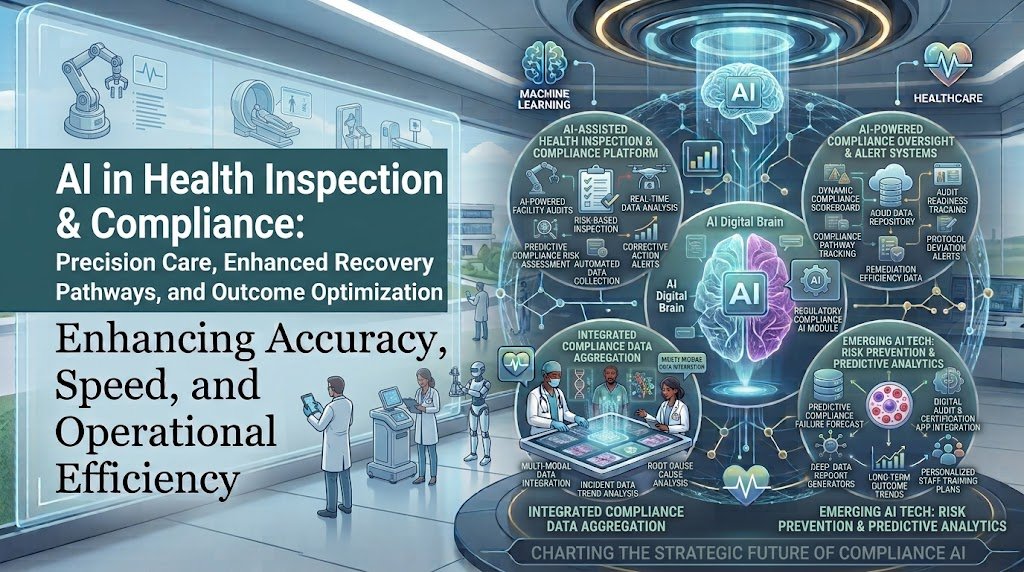
Primary topic: AI in Health Inspection & Compliance
Research focus: Healthcare inspections, accreditation readiness, regulatory compliance, patient safety, infection prevention, quality management, documentation, audit automation, risk prediction, AI governance, and intelligent compliance systems
Why AI Matters in Health Inspection & Compliance
Healthcare compliance is no longer a simple checklist exercise. Hospitals, clinics, laboratories, pharmacies, rehabilitation centers, diagnostic facilities, and other healthcare organizations must continuously demonstrate that their clinical and operational processes meet regulatory, safety, quality, privacy, documentation, and accreditation requirements.
The problem is that much of the evidence required for compliance is distributed across electronic health records, laboratory systems, pharmacy systems, incident reports, staffing records, policies, training systems, maintenance logs, infection-control records, claims data, patient complaints, quality dashboards, and manually maintained spreadsheets.
AI can connect these information streams and turn compliance from a periodic inspection activity into a continuous monitoring process. This does not mean replacing inspectors, quality officers, infection-control professionals, or clinical leaders. It means giving them an intelligent system that can identify where human attention is most needed.
AI can monitor compliance signals continuously instead of relying only on periodic audits.
Machine learning can prioritize unusual patterns and potentially high-risk compliance gaps.
NLP can locate relevant policies, records, incidents, training evidence, and corrective actions.
AI can identify missing documentation before an external inspection or accreditation visit.
Research source: 2026 systematic review of AI and ML in hospital quality management, patient safety, and accreditation readiness
The Compliance Landscape AI Can Monitor
Health inspection and compliance cover many different areas, so a useful AI platform should not be designed around a single checklist. It should create a compliance intelligence layer that can work across multiple domains.
| Compliance area | AI opportunity | Typical evidence |
|---|---|---|
| Patient safety | Incident detection and risk prediction | Safety reports, EHR events, medication records |
| Infection prevention | Automated surveillance and early warning | Microbiology, isolation, hand hygiene, environmental data |
| Documentation | Missing or inconsistent documentation detection | Clinical notes, forms, orders, discharge records |
| Staff compliance | Training and credential monitoring | Training systems, licenses, competencies |
| Quality measures | Automated measure calculation and anomaly detection | EHR and quality-management data |
| Accreditation | Readiness scoring and evidence mapping | Policies, audits, corrective actions, records |
| Privacy and security | Access anomaly and policy monitoring | Audit logs, access records, security events |
AI-Powered Continuous Compliance Monitoring
Traditional compliance programs often use scheduled audits. A quality team may review a sample of records every month or prepare intensively before an accreditation visit. This approach can miss problems that occur between audits.
AI changes the model by continuously analyzing digital evidence. A compliance engine can evaluate records as they are created and generate alerts when predefined rules or learned patterns indicate a potential problem.
For example, if a healthcare organization requires specific documentation before a procedure, an NLP system can identify whether the required documentation exists. If a mandatory staff training requirement is approaching its deadline, the system can generate an alert. If an unusual infection pattern appears, the system can escalate the event to infection-prevention professionals.
The important design principle is that AI should identify and prioritize compliance issues rather than silently making high-stakes decisions.
AI for Inspection Readiness
Inspection preparation is one of the strongest use cases for AI because it involves large quantities of structured and unstructured evidence. Quality teams may need to locate policies, training records, incident investigations, audit results, corrective actions, maintenance evidence, clinical documentation, and other supporting material.
An AI inspection-readiness platform can create a digital map between requirements and evidence. Each requirement can be linked to the documents, records, metrics, and responsible departments that demonstrate compliance.
- Requirements currently satisfied
- Requirements with incomplete evidence
- Expired or outdated policies
- Missing staff training records
- Open corrective actions
- Repeated safety findings
- High-risk unresolved issues
- Departments requiring additional review
- Evidence that has not been recently validated
- Requirements with conflicting documentation
This approach is especially valuable because inspection readiness becomes a continuous organizational capability rather than a last-minute project.
Natural Language Processing for Compliance Documents
A significant part of healthcare compliance exists in text. Policies, procedures, clinical notes, incident reports, audit findings, meeting minutes, corrective-action plans, inspection reports, and training materials may contain important evidence that is difficult to analyze manually at scale.
Natural language processing can extract relevant information from these documents and compare it with predefined compliance requirements.
- Identify whether required policy language exists.
- Detect outdated references or missing sections.
- Find contradictions between policies and operational procedures.
- Classify incident reports by risk category.
- Extract corrective-action commitments.
- Track whether corrective actions were completed.
- Summarize recurring findings across departments.
- Search thousands of documents for inspection evidence.
Generative AI can make this process easier by allowing quality teams to ask questions in natural language, such as “Show me unresolved infection-control findings from the last six months” or “Which policies require review this quarter?”
However, generative AI should retrieve and cite the underlying evidence rather than presenting unsupported answers. Every compliance answer should ideally show the source document, record, date, department, and relevant evidence.
AI for Patient Safety Compliance
Patient safety is closely connected to compliance because safety events can reveal failures in processes, documentation, communication, staffing, medication management, or clinical workflows.
AI can analyze incident reports together with EHR and operational data to detect patterns that may not be obvious from individual cases.
- Unusual medication patterns
- Potential documentation gaps
- High-risk medication events
- Risk-factor monitoring
- Event pattern analysis
- Unit-level risk trends
- Near-miss detection
- Incident classification
- Recurring event analysis
AI can therefore move quality management from simply counting incidents toward understanding the conditions associated with recurring safety problems.
Research source: Systematic review of AI applications for healthcare patient safety
AI in Infection Prevention and Health Inspection
Infection prevention is particularly suitable for AI because organizations generate multiple streams of relevant data, including microbiology results, patient movements, isolation status, antibiotic use, environmental observations, and infection-control events.
AI can support infection surveillance by detecting unusual patterns earlier than manual review. It can also help infection-prevention teams prioritize cases and units that require investigation.
A 2026 review of AI for hospital infection prevention and control found that AI and machine learning have potential for automated surveillance, early warning, and decision support, but also highlighted an important limitation: much of the evidence remains focused on retrospective model development rather than real-world workflow implementation.
Research source: 2026 review of AI for hospital infection prevention and control
AI for Accreditation Compliance
Accreditation programs require organizations to demonstrate that quality and safety processes are implemented consistently. The challenge is not simply knowing the standards. Organizations must maintain evidence that policies are implemented, staff are trained, audits occur, findings are addressed, and improvements are sustained.
AI can create an accreditation evidence graph that connects standards to departments, policies, records, metrics, audits, and corrective actions.
| Requirement | Evidence | AI function |
|---|---|---|
| Policy requirement | Approved policy | Version and expiration monitoring |
| Staff competency | Training record | Missing/expired competency alerts |
| Quality monitoring | Audit results | Trend and anomaly detection |
| Corrective action | Action plan and closure | Follow-up and overdue detection |
This can reduce the administrative burden of manually assembling evidence while improving visibility into unresolved compliance risks.
AI for Quality Measure Monitoring
Healthcare quality programs already depend heavily on electronic data. CMS describes electronic clinical quality measures as standardized measures that use data electronically extracted from EHRs and health IT systems to evaluate areas such as patient safety, care coordination, patient engagement, population health, and clinical effectiveness.
This creates a natural foundation for AI-powered quality monitoring.
Research source: CMS Electronic Clinical Quality Measures
Instead of generating a quality report only at the end of a reporting period, an AI system can monitor relevant indicators continuously and identify when performance begins to move in an undesirable direction.
- Detect sudden changes in quality indicators.
- Identify departments with unusual performance patterns.
- Compare current performance with historical baselines.
- Flag missing or incomplete source data.
- Predict which indicators may miss their targets.
- Generate explanations for major changes.
AI-Powered Compliance Risk Scoring
Not every compliance problem deserves the same level of attention. A missing low-risk administrative document should not receive the same priority as a repeated patient-safety failure.
Machine learning can help create risk scores that combine severity, frequency, recurrence, patient impact, department performance, historical findings, and time since the last corrective action.
Potential harm
How often it occurs
Repeated finding
Patients/staff affected
Time unresolved
The output should be a prioritization tool, not an automatic regulatory judgment. Quality leaders should always be able to inspect the evidence behind a risk score.
AI for Corrective and Preventive Actions
Finding a compliance problem is only the first step. Organizations also need to determine why the problem happened, assign responsibility, implement corrective action, and verify that the issue does not return.
AI can support this process by connecting findings with previous incidents and corrective-action records.
- Group similar findings.
- Identify recurring root-cause patterns.
- Suggest relevant historical corrective actions.
- Track assigned owners and deadlines.
- Detect overdue actions.
- Compare pre-intervention and post-intervention performance.
- Identify whether the same issue appears in another department.
Generative AI can also help create structured summaries for quality committees, but the final corrective-action decision should remain under qualified human control.
AI for Policy and Procedure Compliance
Healthcare organizations often have hundreds or thousands of policies and procedures. These documents change over time, while actual workflows may continue operating according to older processes.
An AI policy intelligence system can compare policy requirements with operational evidence and identify potential inconsistencies.
| AI check | Potential finding | Human action |
|---|---|---|
| Policy version | Outdated policy | Policy owner review |
| Required process | Operational mismatch | Workflow investigation |
| Training requirement | Training gap | Staff education |
| Evidence requirement | Missing documentation | Evidence collection |
AI for Staff Training and Credential Compliance
Healthcare compliance depends heavily on staff competency. A facility can have excellent policies but still fail operationally if employees have expired credentials, incomplete training, or missing competency assessments.
AI can combine staff-management and learning-management data to identify upcoming compliance risks.
- Credential expiration alerts.
- Mandatory training completion monitoring.
- Department-level compliance dashboards.
- Identification of repeatedly missed training.
- Personalized learning recommendations.
- Automated evidence collection.
Generative AI can also create role-specific training simulations based on organizational policies, although generated educational material should be reviewed before being used for mandatory clinical training.
AI for Environmental and Facility Inspection
Computer vision creates another important opportunity. Physical inspection tasks can involve equipment conditions, environmental cleanliness, storage requirements, signage, PPE availability, room conditions, and other observable factors.
Computer vision can analyze images or video where appropriate and identify potential deviations from predefined standards.
- Visual inspection
- Equipment condition
- Environmental checks
- PPE availability
- Temperature
- Humidity
- Storage conditions
- Equipment status
These systems should be designed as inspection assistants. A visual alert should lead to human verification rather than automatically declaring a regulatory violation.
AI for Privacy and Security Compliance
Healthcare compliance also includes protecting sensitive health information. AI can analyze access logs and security events to identify unusual behavior.
- Unusual access times.
- Unexpected access to large numbers of records.
- Repeated access outside normal job responsibilities.
- Abnormal download or export behavior.
- Potential credential misuse.
- Changes in normal user behavior.
Machine learning can establish behavioral baselines and identify anomalies that rule-based systems may miss. However, false positives can create unnecessary investigations, so risk thresholds must be carefully designed.
AI Architecture for Health Inspection & Compliance
A practical enterprise architecture should separate data collection, compliance intelligence, AI models, workflow management, and human governance.
EHR • LIS • Pharmacy • HR • LMS • Incident System • IoT • Audit Logs • Policies
↓
Data & Interoperability Layer
FHIR • APIs • ETL • Data Warehouse • Document Repository
↓
Compliance Intelligence Layer
Rules Engine • NLP • ML Risk Models • Computer Vision • Anomaly Detection • LLM Retrieval
↓
Compliance Control Center
Risk Dashboard • Alerts • Evidence Mapping • Corrective Actions • Inspection Readiness
↓
Human Governance
Quality Team • Compliance Officer • Infection Control • Clinical Leadership • External Inspector
AI Maturity Model for Healthcare Compliance
| Maturity | Capability | Typical state |
|---|---|---|
| Level 1 | Manual compliance | Spreadsheets and periodic audits |
| Level 2 | Digital reporting | Central dashboards and electronic evidence |
| Level 3 | AI-assisted monitoring | Automated alerts and anomaly detection |
| Level 4 | Predictive compliance | Risk forecasting and proactive interventions |
| Level 5 | Continuous intelligent assurance | Integrated AI, human governance, continuous validation |
What Research Says About AI Validation
The biggest mistake in healthcare compliance AI is to measure only model accuracy. A model can achieve strong technical performance in a research dataset and still fail when introduced into a real hospital.
A 2026 systematic review of clinical AI studies that included prospective or external validation found that regulatory compliance was the most frequently reported implementation challenge, followed by transparency, data quality, and clinical integration. The review included 20 studies and found that 55% identified regulatory problems, 40% identified transparency issues, 35% identified data-quality limitations, and 30% identified clinical-integration barriers.
Research source: 2026 systematic review of validation, fairness, and regulatory challenges in healthcare AI
- Technical performance.
- External validation.
- Workflow performance.
- False-positive rate.
- False-negative rate.
- Human override behavior.
- Subgroup performance.
- Data quality.
- Auditability.
- Security and privacy.
- Operational impact.
- Long-term performance drift.
AI Governance Is Part of Compliance
Organizations cannot build a strong compliance program while treating AI governance as a separate technical issue. If AI is being used to make recommendations about patient safety, staff compliance, inspections, or regulatory risk, the AI system itself becomes part of the organization’s governance environment.
WHO emphasizes that responsible AI for health requires appropriate governance and regulation, with attention to safety, ethics, equity, transparency, risk management, data quality, validation, privacy, and human oversight.
Research source: WHO and ITU regulatory considerations for AI for health
High-Value vs High-Risk AI Compliance Use Cases
| Use case | Value | Risk | Recommended approach |
|---|---|---|---|
| Evidence retrieval | High | Low | AI + source citations |
| Training alerts | High | Low | Automated workflow |
| Inspection readiness | High | Medium | AI prioritization + human review |
| Infection alerts | Very high | High | Validated clinical oversight |
| Automatic violation decisions | Medium | Very high | Avoid autonomous decisions |
Legacy Modernization for Compliance Teams
Many healthcare organizations still depend on spreadsheets, shared folders, email chains, paper records, and disconnected quality systems. Replacing every legacy system at once is expensive and risky.
A better strategy is to build an AI compliance layer above existing systems. APIs, integration engines, data warehouses, FHIR interfaces, document repositories, and event streams can gradually connect legacy information without immediately replacing every operational application.
EHR • HR • LMS • Incident Reporting • Facilities • Laboratory • Pharmacy
↓
Integration Layer
APIs • FHIR • ETL • Data Warehouse
↓
AI Compliance Layer
NLP • ML • Computer Vision • Rules • LLM Retrieval
↓
Modern Compliance Control Center
This approach can produce measurable value without requiring a complete digital transformation on day one.
Startup Opportunities in AI Health Inspection & Compliance
Healthcare compliance is a strong opportunity for specialized AI products because organizations have recurring regulatory requirements and large quantities of evidence. The strongest products are likely to focus on specific workflows rather than attempting to become an all-purpose “AI compliance platform” immediately.
| Startup product | Target customer | Core AI | Opportunity |
|---|---|---|---|
| AI Accreditation Copilot | Hospitals and clinics | RAG + NLP | High |
| Continuous Compliance Monitor | Health systems | ML + rules | Very high |
| AI Infection Surveillance | Hospitals | ML + anomaly detection | Very high |
| Inspection Evidence Manager | Healthcare groups | NLP + RAG | High |
| AI CAPA Manager | Quality departments | NLP + predictive analytics | High |
Implementation Roadmap
Healthcare organizations should not begin with the most complex AI model. The best starting point is a high-volume, repetitive, measurable compliance problem where reliable digital data already exists.
- Phase 1: Identify the highest-cost compliance workflow.
- Phase 2: Map data sources and regulatory requirements.
- Phase 3: Digitize missing evidence and standardize data.
- Phase 4: Build rule-based monitoring before advanced prediction.
- Phase 5: Add NLP and retrieval-based AI for documents.
- Phase 6: Introduce predictive risk models where sufficient data exists.
- Phase 7: Validate locally and externally.
- Phase 8: Deploy with human review and audit trails.
- Phase 9: Monitor model performance and organizational impact.
- Phase 10: Expand into additional compliance domains.
KPIs for an AI Compliance Program
AI projects should be measured through operational and compliance outcomes rather than model accuracy alone.
- Finding rate
- Repeat findings
- Closure time
- Overdue actions
- Audit hours
- Review time
- Evidence retrieval time
- Inspection preparation time
- Precision
- Recall
- False alerts
- Model drift
2027–2030 Outlook
The next stage of healthcare compliance AI is likely to move from dashboards toward continuous assurance. Instead of asking whether a facility is compliant at a particular moment, organizations will increasingly want to know where compliance risk is emerging right now.
AI systems will increasingly combine structured clinical data, unstructured documentation, operational information, inspection evidence, IoT signals, and policy knowledge.
| Period | Expected direction |
|---|---|
| 2027 | More AI-assisted evidence retrieval, quality monitoring, documentation audits, and accreditation preparation. |
| 2028 | Greater integration between EHR, quality, incident, workforce, and compliance systems. |
| 2029 | More predictive compliance models and continuous risk monitoring. |
| 2030 | AI-supported continuous assurance with stronger lifecycle governance and human oversight. |
Regulation will also become more important as AI becomes embedded in healthcare operations. WHO emphasizes risk-based evaluation, monitoring, transparency, data quality, validation, privacy, and accountability. Recent regulatory discussions globally are also moving toward stronger post-deployment monitoring rather than treating approval as the end of the AI lifecycle.
Research sources: WHO regulatory considerations for AI for health and WHO Artificial Intelligence for Health
Final Perspective
AI can fundamentally change how healthcare organizations approach inspection and compliance. The most important shift is from periodic inspection preparation toward continuous compliance intelligence.
AI can continuously examine documentation, quality indicators, incident reports, infection-control signals, training records, policies, corrective actions, and operational data. It can identify patterns, prioritize risks, retrieve evidence, and help quality teams act earlier.
However, healthcare compliance is not an environment where autonomous AI decisions should replace professional accountability. The strongest model is human-led compliance supported by intelligent automation.
- AI finds the signal.
- AI organizes the evidence.
- AI prioritizes potential risk.
- AI explains patterns.
- Humans investigate.
- Humans make high-risk decisions.
- AI monitors corrective actions.
- Organizations continuously validate the system.
For healthcare startups, the opportunity is to build focused compliance products around specific workflows such as accreditation readiness, infection surveillance, evidence management, quality monitoring, CAPA management, or inspection preparation. For established healthcare organizations, the most practical path is to add an AI intelligence layer to existing systems instead of attempting an immediate replacement of legacy infrastructure.
The long-term opportunity is not simply an AI inspection tool. It is a continuous healthcare assurance platform that connects regulatory requirements with real-world operational evidence and gives quality teams an intelligent view of where the organization is compliant, where evidence is missing, and where emerging risks require human attention.
Original Research & Reference Sources
- AI and Machine Learning in Hospital Quality Management, Patient Safety, and Accreditation Readiness — 2026 systematic review
- Artificial Intelligence for Hospital Infection Prevention and Control — 2026 review
- Artificial Intelligence in Healthcare Practice: Validation, Fairness, and Regulatory Challenges — 2026 systematic review
- WHO/ITU Regulatory Considerations on Artificial Intelligence for Health
- WHO Artificial Intelligence for Health
- WHO Ethics and Governance of Artificial Intelligence for Health
- CMS Electronic Clinical Quality Measures
- CMS Hospital Provider Data and Quality Measures
- Artificial Intelligence in Healthcare: Transforming Patient Safety with Intelligent Systems
- WHO Guidance on Ethics and Governance of Large Multimodal Models

Leave a Reply