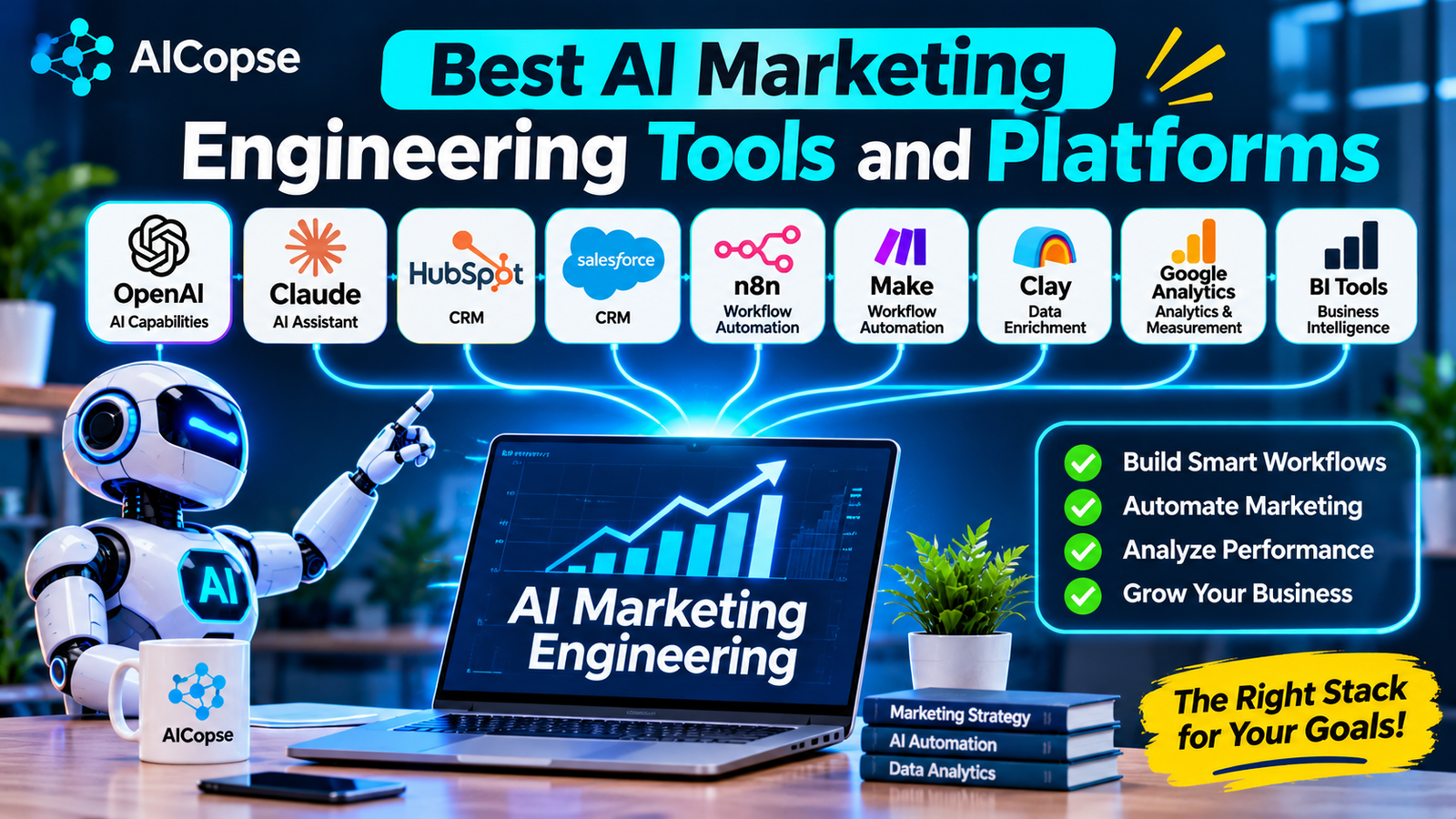
Building these systems requires more than one AI application. An AI Marketing Engineer may work with language models, CRM platforms, workflow automation software, APIs, databases, analytics tools, and custom code. Each component performs a different job, and the real value comes from making them work together.
This guide explores the best AI Marketing Engineering tools and platforms in 2026. It explains what each tool does, where it fits in a marketing technology stack, and how businesses can select the right combination for their needs.
Table of Contents
- What Are AI Marketing Engineering Tools?
- How an AI Marketing Engineering Stack Works
- AI Models and LLM Platforms
- AI Agent and Development Frameworks
- Workflow Automation Platforms
- CRM and Marketing Platforms
- Data Enrichment and Lead Intelligence Tools
- Analytics and Marketing Intelligence Tools
- SEO and AI Search Visibility Tools
- Developer and Integration Tools
- AI Marketing Engineering Tools Comparison
- Best Tool Stack by Business Size
- How to Choose the Right Tools
- How to Build Your First AI Marketing System
- Common Mistakes When Selecting Tools
- The Future of AI Marketing Engineering Tools
- Recommended Reading
- Frequently Asked Questions
What Are AI Marketing Engineering Tools?
AI Marketing Engineering tools are software platforms, development frameworks, and technical services used to design, build, connect, and operate AI-powered marketing systems.
They help engineers move from individual marketing tasks to connected business processes. For example, instead of manually reviewing every website inquiry, an engineer can build a system that captures leads, checks their information, enriches company data, uses an AI model to classify their requirements, updates the CRM, and sends qualified leads to the correct sales team.
Different tools support different parts of this process.
Understand language, classify information, generate responses, and support decisions.
Move information between systems and execute repeatable business processes.
Store customer information, manage leads, and organize marketing activity.
Measure campaign performance, customer behavior, conversions, and revenue.
A general AI writing application may help produce an email. An AI Marketing Engineering system can decide which customer should receive that email, retrieve the correct customer context, generate an approved message, send it through the marketing platform, record the action, and measure the result.
That difference is important when choosing software for this profession.
How an AI Marketing Engineering Stack Works
An AI Marketing Engineer usually works with multiple connected layers rather than depending on a single platform. Each layer has a defined responsibility.
Website · Ads · Email · Social Media · Landing Pages
HubSpot · Salesforce · Databases · Customer Data
n8n · Make · Zapier · APIs · Webhooks
OpenAI · Claude · Gemini · Agent Frameworks
Email · Lead Routing · Campaigns · Customer Support
GA4 · BigQuery · Looker Studio · Power BI
Consider a B2B software company that receives 500 website inquiries each month. Its engineering stack could automatically collect the inquiries, identify company details, classify customer requirements, assign a lead score, and update the CRM.
The sales team would then receive leads with useful context instead of manually reviewing every form submission. Analytics could track which sources produce qualified opportunities and which campaigns generate revenue.
The exact architecture changes from one company to another. A small business may use a CRM with built-in automation, while an enterprise may require a custom data pipeline, several AI models, and dedicated monitoring systems.
AI Models and LLM Platforms for Marketing Engineering
Large language models provide the intelligence behind many modern marketing workflows. They can understand customer messages, extract information, summarize research, classify leads, generate content, and support AI agents.
An engineer can connect these models to business data and software through APIs. The model processes information, while the surrounding application controls what happens next.
1. OpenAI Platform
Best for: Building AI-powered applications, content workflows, customer assistants, and structured data processing.
OpenAI Platform provides developers with API access to AI models and tools for building applications. It can support marketing systems that need language understanding, structured outputs, document processing, and tool-connected AI workflows.
AI Marketing Engineers can use it to:
- Classify incoming leads by industry, intent, and business requirements.
- Extract useful information from customer emails and inquiry forms.
- Generate personalized email drafts using approved customer context.
- Summarize sales conversations and customer feedback.
- Build AI assistants that retrieve information from approved knowledge sources.
Engineering advantage: API-based development gives teams control over how AI fits into their existing applications and workflows.
Consideration: API usage, model selection, data handling, and output validation require technical planning. An AI response should not automatically be treated as verified information.
2. Anthropic Claude
Best for: Long-context analysis, structured reasoning, document workflows, and AI-assisted development.
Anthropic’s API allows developers to integrate Claude models into custom software. Marketing teams can use these capabilities to analyze large collections of customer feedback, research documents, campaign information, and business knowledge.
Possible engineering applications include:
- Analyzing customer interviews and grouping common problems.
- Reviewing campaign briefs against brand guidelines.
- Extracting structured information from business documents.
- Building research and customer-support assistants.
- Helping developers write and review integration code.
Engineering advantage: Claude can be useful in workflows where the model needs to work with substantial context and produce structured responses.
Consideration: Large inputs can increase processing costs. Engineers should retrieve only the information required for each task rather than sending entire knowledge collections repeatedly.
3. Google Gemini
Best for: Multimodal AI applications and integration with Google Cloud services.
Google AI Studio and Gemini API resources provide a way to experiment with and integrate Gemini models into applications.
Marketing engineering use cases include:
- Analyzing text, images, and other supported media inputs.
- Processing customer feedback and marketing assets.
- Building assistants that work with business information.
- Supporting workflows built around Google Cloud services.
- Extracting insights from different types of marketing content.
Engineering advantage: Gemini is worth evaluating when a system needs multimodal processing or already uses Google Cloud infrastructure.
Consideration: Available models, limits, and capabilities vary. Test the exact model against your workflow before selecting it for production.
4. Perplexity API
Best for: Research-oriented applications and workflows that need web-grounded information.
Perplexity’s API documentation provides developer resources for integrating its search and AI capabilities into applications.
An AI Marketing Engineer may use research-oriented AI systems to support competitor monitoring, market research, industry updates, and customer discovery.
Engineering advantage: It can help create research workflows that combine information retrieval with AI-generated summaries.
Consideration: Retrieved information still needs source checking. AI summaries should not replace verification of important facts, statistics, or business claims.
AI Agent and Development Frameworks
AI models provide language and reasoning capabilities, but production systems often need more structure. An agent framework can help connect models to tools, data sources, business rules, and multi-step tasks.
5. LangChain
Best for: Building applications that connect language models with tools, data, and external services.
LangChain provides developer frameworks for building applications powered by language models.
Marketing engineers can explore it for:
- AI research assistants connected to approved information sources.
- Lead qualification systems that use business rules and model outputs.
- Customer-support assistants with access to relevant knowledge.
- Workflows that call external tools and APIs.
- Applications that combine retrieval, model responses, and software actions.
Engineering advantage: It gives developers more control over application logic than a simple prompt-based chatbot.
6. LlamaIndex
Best for: Connecting AI applications with documents, databases, and knowledge sources.
LlamaIndex helps developers build data-connected AI applications. It is particularly relevant when an AI assistant needs to retrieve information from company documents or structured data.
For example, an enterprise marketing assistant could retrieve approved product information, pricing rules, campaign guidelines, and customer policies before preparing a response.
Engineering advantage: It supports retrieval-based applications where answers need relevant business context.
7. LangGraph
Best for: Building stateful and multi-step AI agent workflows.
LangGraph is designed for orchestrating agent workflows that may require multiple steps, persistent state, and human involvement.
A marketing engineering team could use this type of framework to build an agent that researches an account, checks available customer information, prepares a recommendation, and waits for human approval before updating a CRM.
Engineering advantage: It is useful when a workflow needs controlled execution rather than one unrestricted AI response.
These frameworks are not mandatory for every project. A simple lead classification task may work perfectly well with an API call and an automation platform. Custom frameworks become more useful when application complexity increases.
Workflow Automation Platforms
Workflow automation tools connect applications and move information between them. They are essential when marketing processes involve several platforms that need to respond to the same event.
8. n8n
Best for: Technical automation, custom integrations, AI workflows, and self-hosted deployments.
n8n is a workflow automation platform that allows users to connect applications, APIs, and AI services through visual workflows and custom code.
AI Marketing Engineers can use n8n to:
- Connect website forms with CRM systems.
- Send lead information to an AI model for classification.
- Enrich customer records using external services.
- Trigger email or sales notifications.
- Build scheduled competitor and content monitoring workflows.
- Connect several APIs without building every integration from scratch.
Engineering advantage: It offers technical flexibility and self-hosting options for teams that want greater control over their infrastructure.
Consideration: Self-hosting requires server management, security updates, backups, and monitoring. More complex workflows also need careful error handling.
9. Make
Best for: Visual automation with branching logic and multi-step scenarios.
Make provides a visual environment for connecting applications and designing automated workflows.
It can support marketing processes such as:
- Moving new leads from forms into a CRM.
- Creating content approval workflows.
- Connecting AI-generated summaries with project management tools.
- Sending campaign performance data to reporting systems.
- Managing different actions based on customer segments.
Engineering advantage: Its visual workflow structure makes complex processes easier to understand and communicate with non-developers.
10. Zapier
Best for: Fast integrations and straightforward automation across business applications.
Zapier connects thousands of applications through triggers and actions. It is useful when a business needs to connect existing software without building a custom integration for every task.
Examples include:
- Creating a CRM record when someone submits a form.
- Sending notifications when a high-priority lead arrives.
- Adding new customer information to a spreadsheet.
- Triggering follow-up tasks after a sales event.
- Connecting supported AI services with marketing applications.
Engineering advantage: Teams can launch simple integrations quickly.
Consideration: Complex workflows with many actions may become harder to maintain or more expensive as usage grows. Review task limits and execution costs before scaling.
11. Microsoft Power Automate
Best for: Businesses already using Microsoft 365 and the Power Platform.
Microsoft Power Automate supports automated workflows across Microsoft services and connected applications.
It can be useful for organizations that want to connect business processes involving Outlook, SharePoint, Teams, Excel, and other supported services.
Engineering advantage: It can fit naturally into an existing Microsoft business environment.
Consideration: Licensing, connector availability, and environment permissions can affect what a team can build.
CRM and Marketing Platforms
A CRM is one of the most important parts of a marketing engineering stack because it stores customer records, lead activity, sales interactions, and lifecycle information.
12. HubSpot
Best for: CRM-connected marketing automation, lead management, and customer lifecycle workflows.
HubSpot combines CRM, marketing, sales, and customer service capabilities. Its ecosystem also includes automation and AI features that can support connected business processes.
AI Marketing Engineers can use HubSpot to:
- Manage contacts, companies, and deals.
- Capture and organize website leads.
- Build automated lead lifecycle workflows.
- Connect marketing activity with sales pipeline information.
- Use available AI capabilities for supported customer and marketing tasks.
- Integrate external AI systems through APIs and supported connections.
Engineering advantage: It gives growing businesses a central place to organize customer information and marketing operations.
Consideration: Advanced automation, reporting, and AI features depend on product editions and subscriptions. Confirm the features available in the plan before designing a system around them.
13. Salesforce
Best for: Enterprise CRM, complex customer journeys, and large-scale business operations.
Salesforce provides CRM and business platforms for organizations with complex sales and customer management requirements.
Its ecosystem includes marketing, sales, data, integration, and AI capabilities. Depending on the products selected, engineers can connect customer information, campaign activity, sales operations, and AI-powered processes.
Engineering advantage: It can support complex enterprise environments with multiple teams, customer segments, and business processes.
Consideration: Implementation can require specialist knowledge, configuration, integration planning, and ongoing administration.
14. ActiveCampaign
Best for: Email marketing, customer journeys, and lifecycle automation.
ActiveCampaign combines email marketing, automation, and customer management capabilities.
It can support lead nurturing, segmented communication, customer follow-ups, and automated journeys based on customer activity.
Engineering advantage: It can serve as a practical marketing automation layer for businesses that do not need a large enterprise platform.
15. Klaviyo
Best for: Ecommerce customer data, email marketing, SMS, and personalized lifecycle campaigns.
Klaviyo is particularly relevant for ecommerce companies that need to connect customer behavior with marketing communication.
Its applications include abandoned-cart journeys, product recommendations, customer segmentation, and repeat-purchase campaigns.
Engineering advantage: It can help build behavior-based customer journeys using ecommerce and engagement data.
Data Enrichment and Lead Intelligence Tools
Marketing systems become more useful when they have accurate information about customers and businesses. Data enrichment tools help add information to existing records, while lead intelligence platforms can support account research and prospect identification.
16. Clay
Best for: Lead enrichment, company research, prospect data, and data-driven outbound workflows.
Clay helps teams combine data sources, enrich records, and build research workflows around companies and contacts.
Possible use cases include:
- Enriching a list of business leads with company information.
- Identifying relevant company attributes for segmentation.
- Researching target accounts before sales outreach.
- Using AI to summarize information collected from supported sources.
- Preparing structured prospect data for CRM updates.
Engineering advantage: Clay can act as a data preparation and enrichment layer between lead sources and CRM systems.
Consideration: Data accuracy, source permissions, enrichment credits, and privacy rules need to be checked. More data does not automatically mean better lead quality.
17. Apollo.io
Best for: B2B prospecting, contact intelligence, and sales engagement workflows.
Apollo offers prospecting and sales intelligence capabilities that can support lead research and outbound operations.
Marketing engineers may connect Apollo with a CRM and automation platform to organize prospect information, prepare account lists, and coordinate outreach processes.
Engineering advantage: It can support prospect discovery and outbound data workflows.
Consideration: Contact data may be incomplete or outdated. Businesses should verify important records and follow applicable privacy, consent, and outreach laws.
Analytics and Marketing Intelligence Tools
An AI marketing system should not be judged only by how many tasks it automates. It should also be measured by whether it improves lead quality, customer experience, conversion rates, and business results.
18. Google Analytics 4
Best for: Website activity, acquisition measurement, engagement, and conversion tracking.
Google Analytics 4 helps businesses understand how visitors interact with websites and applications.
It can provide information about traffic sources, events, engagement, and conversions. Marketing engineers can connect analytics data with reporting tools and other business systems to improve performance measurement.
Engineering advantage: It provides an important measurement layer for understanding digital customer behavior.
19. Google BigQuery
Best for: Large-scale marketing data analysis and centralized data storage.
Google BigQuery is a cloud data warehouse that supports large-scale data analysis using SQL.
Marketing teams can use a data warehouse to bring information from multiple sources into a more organized environment. This may include website events, CRM records, advertising performance, and campaign data.
Engineering advantage: It supports more advanced reporting and analysis when data is spread across several platforms.
Consideration: Data modeling, access controls, query costs, and data quality require attention.
20. Looker Studio
Best for: Marketing dashboards and visual performance reporting.
Looker Studio helps teams create dashboards using supported data sources.
It can be used to visualize website performance, campaign results, traffic sources, lead activity, and other business metrics.
Engineering advantage: It makes marketing data easier to understand for managers and decision-makers.
21. Microsoft Power BI
Best for: Business intelligence, advanced reporting, and cross-department performance analysis.
Microsoft Power BI helps organizations build interactive reports and dashboards from different data sources.
It is useful when marketing performance needs to be compared with sales, revenue, finance, and other business metrics.
Engineering advantage: It can connect marketing reporting with wider business intelligence systems.
SEO and AI Search Visibility Tools
Search marketing remains an important part of digital growth. AI Marketing Engineers may need to connect SEO research, content performance, website data, and AI search visibility monitoring with broader marketing systems.
22. Ahrefs
Best for: Keyword research, backlink analysis, competitor research, and organic search intelligence.
Ahrefs provides SEO research tools that can help marketing teams understand search demand, competitor visibility, backlinks, and content opportunities.
Its data can support automated reporting, content research workflows, and competitive monitoring when connected through available exports or supported integrations.
23. Semrush
Best for: SEO research, competitor analysis, content marketing, and search visibility monitoring.
Semrush offers tools for keyword research, website audits, competitor analysis, and content-related workflows.
Marketing engineers can use SEO data to build reporting systems, monitor website performance, and connect search insights with content operations.
24. Profound
Best for: Monitoring brand visibility and presence across AI answer platforms.
Profound focuses on AI search visibility and helps organizations understand how their brands appear in AI-generated answers.
This type of platform is relevant as businesses explore how customers discover brands through AI-powered search and answer experiences.
Engineering advantage: AI visibility data can become part of a wider brand intelligence and reporting workflow.
Consideration: AI search results can vary by query, location, platform, and time. Monitoring data should be interpreted as directional evidence, not a guaranteed measure of every customer’s experience.
Developer and Integration Tools
Visual automation platforms are useful, but complex marketing systems often require direct software development. Developer tools help engineers write code, test APIs, manage projects, and maintain integrations.
25. Python
Best for: Data processing, custom automation, API integrations, and AI application development.
Python is widely used for working with data and building software applications. It can support tasks that are difficult to manage through visual automation alone.
Examples include processing large datasets, cleaning CRM exports, connecting APIs, preparing model inputs, and building custom reporting applications.
26. Cursor
Best for: AI-assisted software development and working with codebases.
Cursor is an AI-powered code editor that can assist developers with writing, understanding, and modifying code.
AI Marketing Engineers can use it to work on API integrations, automation scripts, internal tools, and custom marketing applications.
Consideration: AI-generated code still requires testing, security review, and human understanding before deployment.
27. Postman
Best for: Testing APIs and understanding how different systems communicate.
Postman provides tools for sending API requests, checking responses, and organizing API work.
It is useful when connecting a CRM, marketing platform, AI model, or external data service to a custom application.
28. GitHub
Best for: Code management, collaboration, version control, and software deployment workflows.
GitHub helps development teams store and manage code, track changes, review contributions, and collaborate on projects.
For marketing engineering, it can be used to manage automation scripts, API integrations, AI application code, and deployment workflows.
AI Marketing Engineering Tools Comparison
The following table summarizes the major platforms by their primary role. These tools are not direct replacements for one another. Several may be needed to build a complete system.
| Tool | Category | Main Use | Technical Level |
|---|---|---|---|
| OpenAI | AI platform | AI applications and model APIs | Intermediate–Advanced |
| Claude | AI platform | Analysis and AI workflows | Beginner–Advanced |
| Gemini | AI platform | Multimodal AI applications | Intermediate–Advanced |
| LangChain | Development framework | LLM application development | Advanced |
| LlamaIndex | Development framework | Knowledge retrieval | Intermediate–Advanced |
| LangGraph | Agent framework | Multi-step agent workflows | Advanced |
| n8n | Automation | Custom workflow automation | Intermediate–Advanced |
| Make | Automation | Visual multi-step workflows | Beginner–Intermediate |
| Zapier | Automation | Application connections | Beginner–Intermediate |
| Power Automate | Automation | Microsoft business workflows | Beginner–Advanced |
| HubSpot | CRM and marketing | Lead and lifecycle management | Beginner–Advanced |
| Salesforce | CRM and enterprise | Complex customer operations | Intermediate–Advanced |
| Clay | Data enrichment | Lead and account research | Beginner–Advanced |
| Apollo | Sales intelligence | B2B prospecting | Beginner–Intermediate |
| GA4 | Analytics | Website and conversion measurement | Beginner–Advanced |
| BigQuery | Data warehouse | Large-scale data analysis | Advanced |
| Looker Studio | Reporting | Marketing dashboards | Beginner–Intermediate |
| Power BI | Business intelligence | Cross-business reporting | Intermediate–Advanced |
| Ahrefs | SEO intelligence | Search and competitor research | Beginner–Advanced |
| Semrush | SEO intelligence | SEO and content analysis | Beginner–Advanced |
| Profound | AI search intelligence | AI answer visibility monitoring | Intermediate |
| Python | Programming | Custom automation and data processing | Intermediate–Advanced |
| Cursor | Development | AI-assisted coding | Intermediate–Advanced |
| Postman | API development | API testing and debugging | Intermediate |
| GitHub | Code management | Version control and collaboration | Intermediate–Advanced |
Technical level is a general guide, not a fixed requirement. Many platforms offer beginner-friendly interfaces, while advanced integrations and production deployments require deeper technical knowledge.
Best AI Marketing Engineering Stack by Business Size
Not every business needs the same software. A small company may only need a CRM, one AI model, and a workflow automation platform. A large organization may require a data warehouse, custom applications, advanced access controls, and dedicated monitoring.
For Beginners and Small Businesses
A beginner should focus on learning how the main components connect rather than purchasing many subscriptions.
- AI: ChatGPT or Gemini
- CRM: HubSpot
- Automation: Make or Zapier
- Analytics: Google Analytics 4
- Reporting: Looker Studio
- Development: Basic Python and API knowledge
This combination is enough to understand lead capture, customer records, AI classification, workflow automation, and basic performance reporting.
For Startups and Growing Businesses
Startups usually need flexibility. They may have limited engineering resources but still need reliable lead management, customer data, and automated operations.
- AI: OpenAI API or Claude API
- CRM: HubSpot or another suitable CRM
- Automation: n8n or Make
- Lead intelligence: Clay or Apollo
- Analytics: GA4 and Looker Studio
- Data: PostgreSQL or BigQuery when needed
- Development: Python, GitHub, and Postman
This setup supports custom integrations, lead enrichment, AI-assisted workflows, and more advanced reporting.
For Enterprise Organizations
Enterprise teams often work with large customer databases, several business units, complex permissions, and multiple marketing systems. Their stack needs stronger governance and operational controls.
- AI: Approved enterprise AI models and APIs
- CRM: Salesforce or enterprise HubSpot setup
- Automation: n8n, Workato, or Microsoft Power Automate where suitable
- AI applications: LangGraph or other appropriate frameworks
- Data: BigQuery, Snowflake, or an existing enterprise warehouse
- Analytics: Power BI, Looker, or Tableau
- Development: Python, GitHub, API testing, and deployment infrastructure
- Governance: Identity controls, audit logs, data policies, and monitoring
Enterprise selection should begin with existing infrastructure, security requirements, and integration needs. Replacing a working platform simply to adopt a newer AI product can create unnecessary cost and risk.
How to Choose the Right AI Marketing Engineering Tools
The number of available AI platforms can make selection difficult. A tool may look impressive in a product demonstration but fail to solve the actual business problem.
Use the following criteria before adding a new platform to your stack.
1. Start With the Business Problem
Define what the system needs to achieve. Is the goal to qualify leads, reduce manual reporting, improve customer support, personalize campaigns, or connect disconnected systems?
Choose software based on that requirement, not because a tool is popular.
2. Check Integration Capabilities
Review whether the tool supports the APIs, webhooks, connectors, and data formats needed by your existing systems.
A powerful AI platform has limited value if it cannot access the information required to complete its task.
3. Evaluate Data Quality
AI output depends heavily on the information it receives. Incorrect customer records, duplicate contacts, missing fields, and outdated data can reduce the quality of automated decisions.
Check how the platform handles data validation, synchronization, duplicate records, and access permissions.
4. Understand Total Cost
Do not compare tools only by their starting subscription prices. Consider API usage, automation executions, contact limits, storage, additional seats, integrations, hosting, and maintenance.
A platform that looks inexpensive at the beginning may become costly when thousands of records or workflow executions are processed.
5. Check Security and Privacy
Marketing systems often process personal information, business records, and customer conversations. Check data retention, access controls, encryption, vendor terms, and applicable privacy requirements.
For US-facing operations, businesses should consider relevant requirements such as the CAN-SPAM Act, applicable state privacy laws, and other rules governing their specific activities.
6. Test Reliability Before Scaling
Run the workflow with real-world examples in a controlled environment. Test missing data, incorrect model responses, API failures, duplicate events, and unexpected user inputs.
Important actions should have clear failure handling and a way for people to review or correct mistakes.
7. Measure Business Results
Track the outcome of the system. Useful metrics may include:
- Time required to process each lead.
- Percentage of leads successfully enriched.
- Lead qualification accuracy.
- Workflow failure rate.
- Time saved by automation.
- Conversion rate from qualified leads.
- Cost per qualified lead.
- Revenue influenced by the workflow.
How to Build Your First AI Marketing Engineering System
A practical way to learn these platforms is to build a small system that solves a real marketing problem. Lead qualification is a good starting project because it combines several important engineering concepts.
Project: AI-Powered Lead Qualification System
Imagine a software company that receives inquiries through its website. The sales team wants to identify high-value leads faster and avoid manually reviewing every submission.
The system can use a website form, CRM, automation platform, AI model, and notification service.
A visitor submits a website form with contact and business requirements.
The automation checks required fields, email format, and duplicate records.
A connected data service adds available company and business information.
An AI model classifies the inquiry using predefined business criteria.
The system updates the contact record and assigns the appropriate lead category.
The sales team receives the result and reviews important decisions before action.
Tools Needed for This Project
| Component | Example Tool | Purpose |
|---|---|---|
| Lead capture | Website form | Collect inquiries |
| CRM | HubSpot | Store customer records |
| Automation | n8n or Make | Connect the steps |
| AI | OpenAI API or Claude API | Classify the inquiry |
| Reporting | Looker Studio | Measure results |
What Should the AI Evaluate?
The model can review the information provided by a lead and return structured fields such as:
- Business type and industry.
- Requested service or product.
- Project requirements.
- Estimated urgency based on the inquiry.
- Whether the lead matches the company’s target customer profile.
- Recommended next action for human review.
The business should define its own qualification rules. An AI model should not invent company revenue, purchasing authority, budget, or other information that the lead has not provided or that the system has not verified.
For reliability, use structured outputs, validate the response, record the model version, and send uncertain cases for human review. This makes the project more useful as a real engineering portfolio example.
Common Mistakes When Selecting AI Marketing Engineering Tools
Buying Too Many Tools Too Early
Adding several AI subscriptions does not automatically create a better system. Start with the tools required for one workflow and expand only when a clear need appears.
Using AI Without Business Rules
An AI model needs clear instructions, relevant information, and boundaries. Without them, the system may produce inconsistent classifications or take actions that do not match company policy.
Ignoring Data Protection
Sending customer information to an external service without checking permissions, vendor terms, and company policies can create serious privacy and compliance problems.
Automating a Broken Process
Automation can make an inefficient process run faster without fixing its underlying problems. Review and simplify the process before connecting it to an AI system.
Skipping Monitoring and Maintenance
APIs change, credentials expire, platforms update, and model behavior can vary. Production systems need logs, alerts, error handling, and regular testing.
Measuring Activity Instead of Results
Counting generated emails or automated tasks does not show whether the system is creating business value. Measure qualified leads, conversions, customer experience, costs, and revenue impact.
The Future of AI Marketing Engineering Tools
AI Marketing Engineering platforms are likely to become more connected, more capable, and more focused on complete business workflows. Several developments are especially important for engineers and marketing teams.
More AI Agents Inside Business Platforms
CRM, marketing automation, and customer service platforms are adding AI capabilities that can assist with specific tasks. The next challenge is making these agents work safely across different systems while keeping business rules and human oversight in place.
Greater Use of Multimodal AI
Marketing systems increasingly work with text, images, audio, video, and other types of information. Multimodal models can support workflows such as creative analysis, customer feedback processing, and content understanding.
More Connected Data Systems
AI applications need access to accurate business context. Data warehouses, customer data platforms, APIs, and retrieval systems will remain important because they help models work with relevant information rather than relying only on general knowledge.
Stronger AI Governance and Evaluation
Businesses will need better ways to test AI outputs, control access, review automated actions, and monitor system performance. Evaluation and security will become important parts of everyday marketing engineering work.
Marketing Engineers Will Design Complete Systems
The value of an AI Marketing Engineer will increasingly come from understanding how marketing strategy, software, data, and AI fit together. Knowing how to use a single tool will be less valuable than being able to design a reliable system around a real business problem.
Recommended Reading
Explore The AI Marketing Engineer: From Marketer to System Architect on Amazon
This book is particularly relevant to readers who want to move beyond using separate marketing applications and develop the system-level thinking needed to design, build, and manage AI-powered marketing operations.
Frequently Asked Questions
What are the best AI Marketing Engineering tools in 2026?
Some useful platforms include OpenAI, Claude, Gemini, n8n, Make, Zapier, HubSpot, Salesforce, Clay, BigQuery, and Looker Studio. The best combination depends on the business problem, existing software, technical requirements, and budget.
Which tools should an AI Marketing Engineer learn first?
Start with one AI platform, one CRM, and one workflow automation tool. Learn how APIs and webhooks work, then build practical projects. Python, SQL, and analytics become increasingly useful as projects become more advanced.
Is coding required for AI Marketing Engineering?
Not every workflow requires coding. Platforms such as Make, Zapier, and n8n allow users to build many automations visually. However, programming, APIs, data handling, and debugging skills are important for more advanced and customized systems.
What is the difference between AI marketing tools and AI Marketing Engineering tools?
AI marketing tools often solve individual tasks such as content generation, campaign management, or keyword research. AI Marketing Engineering tools help connect these capabilities with data, software, automation, and business processes to create complete systems.
Is n8n better than Zapier for AI Marketing Engineering?
Neither is universally better. n8n is attractive for technical customization, code-based steps, and self-hosting. Zapier is useful for straightforward integrations and quick automation. The right choice depends on workflow complexity, technical control, maintenance, and total cost.
Can HubSpot be used for AI Marketing Engineering?
Yes. HubSpot can serve as the CRM and marketing operations layer in an AI Marketing Engineering stack. Engineers can connect it with AI models, automation platforms, APIs, and reporting systems to build lead management and customer lifecycle workflows.
What is the difference between an AI agent and an automation workflow?
A traditional automation workflow follows predefined triggers, conditions, and actions. An AI agent can use a model to interpret information and select from available tools or actions within defined boundaries. Production systems may combine both approaches.
How much do AI Marketing Engineering tools cost?
Costs vary widely. Some tools offer free tiers, while others charge based on users, contacts, usage, API calls, data volume, or enterprise agreements. The full cost should include subscriptions, usage, hosting, integrations, and maintenance rather than only the advertised starting price.
Do small businesses need an enterprise AI Marketing Engineering stack?
No. Small businesses can start with a CRM, one AI model, a workflow automation platform, and basic analytics. Enterprise tools become relevant when data volume, security needs, integrations, and operational complexity justify them.
Final Thoughts
The best AI Marketing Engineering tools are not necessarily the platforms with the largest feature lists. They are the tools that solve specific problems, connect reliably with existing systems, protect business data, and produce measurable results.
For a beginner, learning one AI platform, one CRM, and one automation tool is a practical starting point. As technical requirements grow, Python, APIs, data warehouses, agent frameworks, and advanced analytics can expand the system.
Businesses should focus on building a connected technology stack rather than collecting disconnected applications. The real advantage comes when customer data, AI capabilities, automation, and measurement work together to improve how marketing operates.

Leave a Reply