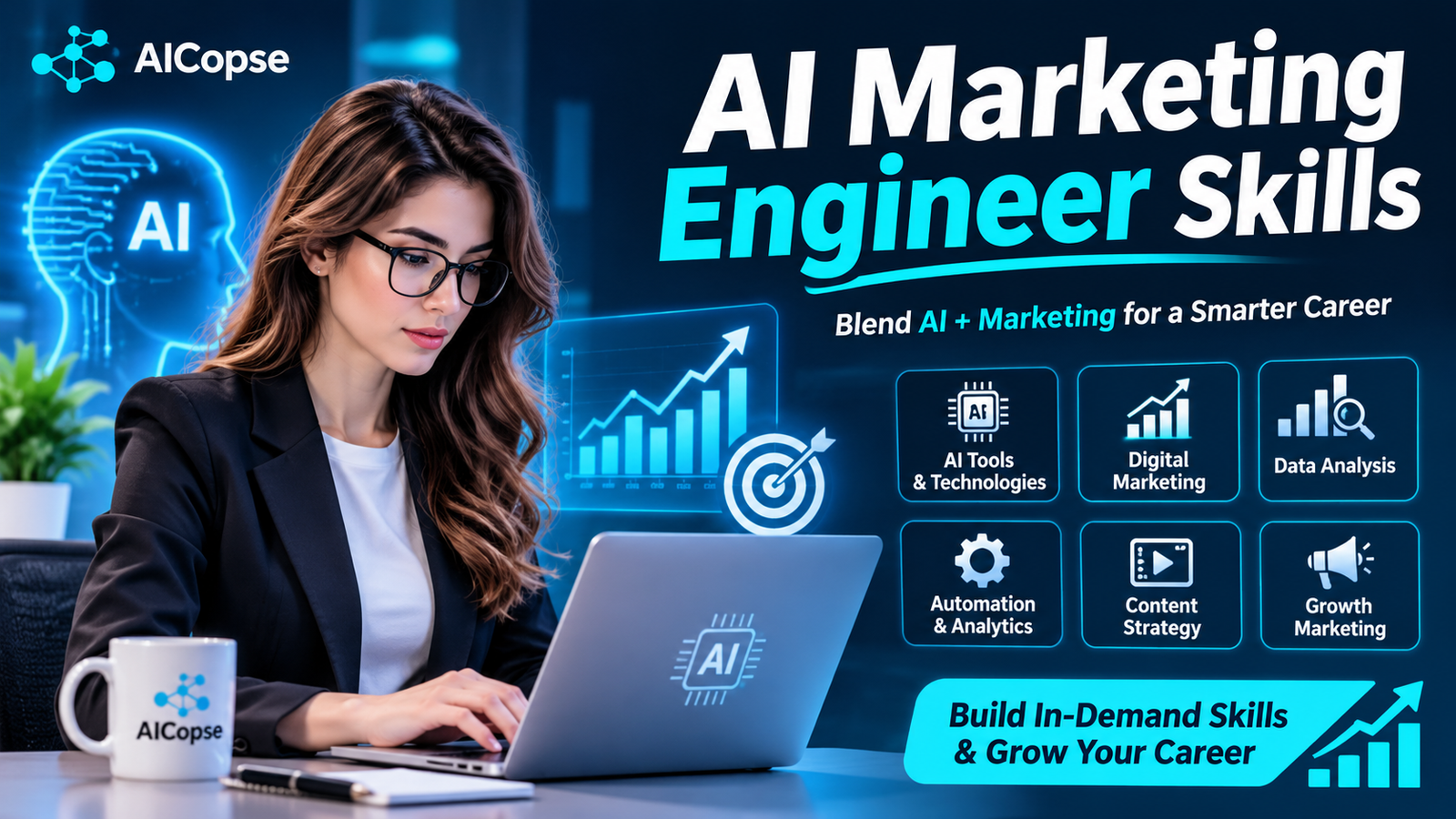
In 2026, employers are increasingly looking for professionals who can work across Python, SQL, APIs, AI agents, workflow automation, data integration, and AI evaluation. However, nobody needs to master every technology before starting. The most effective approach is to develop skills in the right order and prove them through working projects.
Quick answer: What skills does an AI Marketing Engineer need?
The core skill set includes marketing strategy, customer journey understanding, APIs, Python, SQL, data management, workflow automation, prompt engineering, LLM integration, RAG, AI agents, evaluation, analytics, security, privacy, and communication. Technical depth matters, but the ability to connect these skills into reliable marketing systems matters even more.
Table of Contents
- Why AI Marketing Engineer skills matter in 2026
- The main skill categories
- Marketing and business skills
- Data, Python, and SQL skills
- APIs and integration skills
- Workflow automation skills
- AI, LLM, RAG, and agent skills
- Analytics and measurement skills
- Security, privacy, and reliability
- Communication and business skills
- Beginner, intermediate, and advanced skill levels
- Projects that prove your skills
- A practical learning roadmap
- Common mistakes when learning
- Frequently asked questions
Why AI Marketing Engineer Skills Matter in 2026
Marketing technology has moved beyond individual tools. Businesses now need systems that can collect customer information, connect platforms, respond to leads, analyze campaign performance, and support decisions with AI.
For example, a company may use one platform to collect leads, another to manage customer records, a third to send email campaigns, and an AI model to answer customer questions. If these systems cannot share information correctly, the business still depends on manual work.
An AI Marketing Engineer understands how to connect these parts. This requires a mix of marketing knowledge, software skills, data management, automation, and AI engineering.
What the 2026 job market tells us
Stanford University’s 2026 AI Index, using Lightcast job-posting data, identifies Python, automation, workflow management, data analysis, and SQL among the most frequently requested specialized skills in US AI job advertisements.
Python mentions
Automation mentions
Workflow management mentions
SQL mentions
Source: Stanford AI Index Report 2026, Chapter 4. Counts represent mentions in US AI job postings, not AI Marketing Engineer vacancies alone. A single posting may mention multiple skills.
These figures do not mean every AI Marketing Engineer must become an expert Python developer. They show that technical and operational skills are becoming important across AI-related work.
Recent job requirements also show how these skills come together. For example, a Lead Marketing AI Engineer role at Dynatrace lists Python or TypeScript, SQL, APIs, LLM APIs, agentic workflows, retrieval, evaluations, Salesforce, and marketing automation among its requirements.
The practical lesson is simple: employers need people who can connect AI capabilities to real business systems, not just experiment with individual AI applications.
The Main Skill Categories of an AI Marketing Engineer
The skill set can be divided into eight connected areas. Some are essential foundations, while others become more important as projects grow in complexity.
01. Marketing knowledge
Funnels, customer journeys, campaigns, segmentation, and conversion.
02. Data and programming
Python, SQL, databases, tracking, and data quality.
03. APIs and integrations
REST APIs, webhooks, authentication, and data exchange.
04. Automation
n8n, Make, Zapier, workflow logic, and error handling.
05. AI engineering
LLMs, prompts, RAG, agents, and model evaluation.
06. Measurement
Analytics, attribution, dashboards, and experiments.
07. Trust and reliability
Security, privacy, testing, monitoring, and governance.
08. Business skills
Communication, problem-solving, project planning, and documentation.
These categories are not separate subjects that can be learned in isolation. A working marketing system may use all eight at the same time.
Marketing and Business Skills
Technical knowledge is useful only when it supports a clear marketing goal. An engineer who can build an advanced AI workflow but does not understand the customer journey may automate the wrong process.
Marketing funnel and customer journey
An AI Marketing Engineer should understand how people move from discovering a business to becoming customers. This includes awareness, consideration, conversion, retention, and repeat purchases.
For example, a lead-generation system should not treat every form submission in the same way. Someone requesting a product demonstration may need an immediate sales response, while someone downloading an educational guide may belong in a longer email journey.
Important concepts include:
- Marketing funnels and customer lifecycle stages.
- Lead generation and lead qualification.
- Customer segmentation and personalization.
- Landing pages, conversion rates, and user experience.
- Email marketing, paid advertising, SEO, and content marketing.
- Customer retention and lifecycle automation.
Campaign and channel knowledge
Engineers do not necessarily need to manage every advertising platform. However, they should understand how marketing channels generate data and how that information can be used in connected systems.
For instance, an engineer building a reporting pipeline should understand campaign names, UTM parameters, conversion events, attribution windows, and the difference between clicks, leads, and qualified opportunities.
Business problem-solving
Before choosing a tool, the engineer should understand the problem. Is the business losing leads because responses are slow? Are campaign reports taking too long? Are customer records duplicated? Is the sales team unable to identify high-quality prospects?
Good engineers begin with the problem, define the desired result, and then decide whether AI, traditional automation, or a combination is appropriate.
Data, Python, and SQL Skills
Data is one of the most important foundations of AI Marketing Engineering. Marketing systems create information every day, but that information is often spread across advertising platforms, websites, forms, CRM systems, email tools, and analytics platforms.
An engineer needs to collect, clean, organize, and analyze this information before using it for automation or AI decisions.
Python programming
Python is useful for working with marketing data, connecting APIs, cleaning files, automating repetitive tasks, and building AI-powered applications.
An AI Marketing Engineer should gradually learn:
- Variables, data types, conditions, loops, and functions.
- Working with lists, dictionaries, files, and JSON.
- Reading and writing CSV and Excel files.
- Using pandas to clean, combine, and analyze datasets.
- Sending API requests and handling responses.
- Working with exceptions, logging, and reusable code.
- Using libraries and virtual environments.
Practical example: A business receives lead information from multiple advertising channels. A Python script can standardize source names, remove duplicate records, calculate cost per lead, and prepare a clean report for the marketing team.
Advanced engineers may use Python to build custom services, AI integrations, scoring systems, and backend applications. Beginners should first learn to understand and modify small scripts.
SQL and database knowledge
SQL allows engineers to retrieve and organize information stored in databases. It becomes especially important when businesses have large customer datasets or need reporting across multiple systems.
Useful SQL concepts include:
- SELECT, WHERE, ORDER BY, and GROUP BY.
- INNER JOIN and LEFT JOIN.
- COUNT, SUM, AVG, and other aggregate functions.
- CASE statements and conditional logic.
- Common table expressions and window functions.
- Database relationships, primary keys, and foreign keys.
- Basic data modeling and query performance.
Practical example: An engineer can use SQL to combine campaign spending with lead and sales records, then calculate which marketing channels generate the most qualified opportunities.
Data quality and data modeling
Incorrect data can create incorrect AI decisions. Duplicate leads, missing email addresses, inconsistent dates, and incorrect campaign labels can damage reporting and automation.
Engineers should understand validation rules, deduplication, standardization, data types, database relationships, and basic data quality testing.
They should also understand the difference between raw data, cleaned data, and reporting-ready data. This makes it easier to identify where a problem started when a dashboard or AI workflow produces an incorrect result.
APIs and Integration Skills
APIs allow different applications to communicate. They are essential when an engineer needs to connect a CRM, website, analytics platform, advertising system, database, or AI model.
For example, when a customer submits a website form, an API integration can send that information to a CRM, attach the campaign source, and trigger a follow-up workflow.
An AI Marketing Engineer should understand:
- What an API is and how API endpoints work.
- REST APIs and common HTTP methods such as GET, POST, PUT, and PATCH.
- JSON data structures and response formats.
- API keys, tokens, OAuth, and authentication.
- Webhooks and event-driven communication.
- Rate limits, pagination, and request failures.
- Basic API testing with tools such as Postman.
Example: Connecting a website form to a CRM
Customer details
Transfers data
Stores lead
The integration can validate the information, prevent duplicate records, and send the lead to the correct team.
Knowing how to use an API is more valuable than memorizing the names of dozens of software platforms. Tools change, but integration principles remain useful.
Workflow Automation Skills
Automation is where marketing engineering becomes practical. It connects individual tasks into repeatable processes that can run with less manual effort.
Platforms such as n8n, Make, and Zapier allow engineers to connect applications and create workflows. They can also combine visual automation with custom code and AI model calls.
Core automation concepts
- Triggers and actions.
- Conditional branches and filters.
- Loops and data transformation.
- Scheduled workflows and event-based workflows.
- Sub-workflows and reusable components.
- Retries, error handling, and failure notifications.
- Workflow logs and execution monitoring.
Example: Automated lead qualification
Imagine a software company receiving hundreds of inquiries each week. The marketing team needs to identify which leads are ready for a sales conversation.
An automated workflow could:
- Receive a new lead from a website form.
- Check required fields and remove duplicate records.
- Enrich the lead with approved business information.
- Use predefined rules or an AI model to classify the inquiry.
- Send qualified leads to the correct CRM pipeline.
- Notify the sales representative.
- Record the result for future reporting.
The engineer must also make sure that failed steps are detected, records are not created twice, and important decisions can be reviewed by a human.
Building a workflow that works once is not enough. Production automation must continue working when data is missing, an API is unavailable, or a platform changes its response format.
AI, LLM, RAG, and Agent Skills
AI engineering is a major part of this profession, but using an AI chatbot is only the starting point. Engineers need to understand how to integrate models into real workflows, provide relevant information, control their actions, and measure their output quality.
Prompt engineering and structured outputs
Prompt engineering means giving an AI model clear instructions, relevant context, and a defined task. In marketing systems, prompts can help classify leads, summarize customer messages, draft content, extract information, or generate campaign reports.
Important skills include:
- Writing clear instructions and defining the model’s role.
- Providing relevant context and examples.
- Setting output formats and structured JSON schemas.
- Handling missing information and uncertain answers.
- Separating trusted information from untrusted user input.
- Versioning prompts and testing changes.
A reliable engineer does not assume that a well-written prompt guarantees a correct answer. Outputs must be checked against the task requirements and trusted data.
LLM APIs and model integration
Large language model APIs allow applications to use AI capabilities programmatically. Engineers can connect models to marketing workflows instead of requiring employees to copy and paste information manually.
They should understand model requests and responses, token usage, context limits, structured output, tool calling, rate limits, latency, and cost management.
They should also know when a smaller or simpler model is sufficient and when a more capable model is worth the additional cost.
Retrieval-Augmented Generation (RAG)
RAG allows an AI system to retrieve relevant information from a trusted knowledge source before generating an answer.
For example, a customer-support assistant may need to answer questions using a company’s approved product documentation, pricing information, return policy, and frequently asked questions.
Useful RAG skills include:
- Understanding embeddings and semantic search.
- Preparing and organizing source documents.
- Chunking information into useful sections.
- Using vector databases or other retrieval systems.
- Filtering results by metadata and permissions.
- Grounding answers in retrieved sources.
- Testing retrieval quality and identifying missing information.
AI agents and tool calling
AI agents can use tools to perform tasks instead of only generating text. Depending on their permissions, they may retrieve information, call APIs, update records, or trigger workflow actions.
An AI Marketing Engineer should understand tool definitions, function calling, agent instructions, state management, permissions, human approval, and execution limits.
For example, a marketing assistant could inspect campaign data, prepare a performance summary, and recommend budget changes. The system may prepare the recommendation automatically, while a human approves any actual budget change.
Not every task needs an agent. A simple rule-based workflow is often cheaper, easier to test, and more predictable. Good engineering means selecting the simplest approach that reliably solves the problem.
AI evaluation and testing
Evaluation is one of the most important skills separating a demonstration from a production AI system.
Engineers need to test whether an AI system produces accurate, relevant, safe, and consistent results. This may involve a collection of test examples, expected answers, scoring rules, human review, and regression testing.
For a lead-classification system, an engineer might test whether the model correctly identifies high-intent inquiries, avoids inventing customer information, and sends uncertain cases for human review.
Evaluation should also be repeated when prompts, models, knowledge sources, or workflow logic change.
Analytics, Attribution, and Measurement Skills
An AI Marketing Engineer should understand whether a system improves business performance. Automation volume alone does not prove value.
For example, a lead-response workflow may process 1,000 leads every month. But if those leads are not qualified, contacted successfully, or converted into customers, the workflow may not be delivering the expected business result.
Important measurement skills include:
- Google Analytics 4 and event tracking.
- Google Tag Manager and conversion measurement.
- UTM parameters and campaign tracking.
- CRM reporting and funnel analysis.
- Cost per lead and customer acquisition cost.
- Lead-to-opportunity and opportunity-to-customer conversion.
- Attribution models and their limitations.
- A/B testing and controlled experiments.
- Dashboards and business performance reporting.
Understanding attribution
Attribution helps businesses understand how different marketing interactions contribute to conversions. Engineers should know the limitations of first-touch, last-touch, and multi-touch attribution rather than treating any single model as a perfect representation of reality.
Building useful dashboards
A dashboard should help someone make a decision. It should not simply display every available metric.
For example, a marketing manager may need to see campaign spending, qualified leads, conversion rates, revenue, and cost per acquisition. A technical operations dashboard may instead focus on workflow success rates, failed API requests, data freshness, and AI operating costs.
Understanding the audience and the decision behind each report is an important engineering skill.
Security, Privacy, and System Reliability
AI-powered marketing systems often handle customer information, business records, campaign data, and access to external platforms. A poorly secured workflow can expose sensitive information or perform actions that were never intended.
Security and privacy should therefore be part of system design, not something added after a project is finished.
Security fundamentals
- Protecting API keys, tokens, and credentials.
- Using environment variables and secret managers.
- Applying least-privilege access controls.
- Using secure authentication and permission checks.
- Protecting webhooks and external integrations.
- Recognizing prompt injection and unsafe tool instructions.
- Keeping useful logs without unnecessarily exposing personal data.
Privacy and responsible data use
Engineers should understand consent, data minimization, retention, access rights, and the rules that apply to the markets in which a business operates.
For US-focused businesses, relevant requirements may include CAN-SPAM for commercial email, applicable state privacy laws, and sector-specific rules. The correct requirements depend on the data, business activity, customer location, and system design.
Engineers should work with legal and privacy specialists when a system handles sensitive information or makes decisions that could affect customers.
Reliability and monitoring
A marketing automation system may stop working because an API changes, an authentication token expires, a model reaches its rate limit, or an unexpected data format appears.
Engineers should know how to monitor system activity, detect failures, retry safe operations, alert responsible people, and document recovery procedures.
They should also consider system costs, response times, scalability, backups, and how another team member can maintain the system.
Communication and Business Skills
AI Marketing Engineers work with people who may not understand programming, databases, or AI architecture. They need to explain technical decisions in simple language and connect engineering work to business goals.
Important professional skills include:
- Communication: Explaining technical ideas to marketers, managers, and business owners.
- Problem-solving: Finding the real cause of a problem instead of immediately choosing a tool.
- Project planning: Breaking large projects into smaller deliverables.
- Documentation: Writing clear technical notes, workflows, and operating instructions.
- Collaboration: Working with developers, analysts, marketing teams, and sales teams.
- Decision-making: Knowing when to use AI, traditional automation, or manual review.
- Continuous learning: Keeping up with changes in models, platforms, APIs, and security practices.
These skills become more important as an engineer moves from building individual workflows to designing systems used by entire teams.
AI Marketing Engineer Skills: Beginner, Intermediate, and Advanced Levels
Knowing a technology’s name is not the same as being able to use it professionally. A useful way to assess progress is to look at what someone can actually build and maintain.
| Skill | Beginner | Working level | Advanced |
|---|---|---|---|
| Python | Runs and edits basic scripts | Cleans data and connects APIs | Builds tested, reusable services |
| SQL | Writes basic queries | Joins and analyzes datasets | Designs efficient data models |
| APIs | Understands requests | Handles authentication and errors | Designs reliable integrations |
| Automation | Builds simple workflows | Uses branches and retries | Monitors production workflows |
| LLMs | Writes basic prompts | Uses APIs and structured outputs | Evaluates and optimizes AI systems |
| RAG and agents | Understands the concepts | Builds a grounded assistant | Designs controlled multi-tool systems |
| Measurement | Reads reports | Builds dashboards and tests | Designs advanced measurement systems |
| Security | Protects credentials | Manages access and privacy controls | Leads system risk reviews |
A professional does not need advanced skills in every category. For example, someone specializing in marketing automation may be stronger in APIs and workflow design, while another engineer may focus more on AI applications and data systems.
Practical Projects That Prove Your Skills
A portfolio is often more useful than a long list of tools on a résumé. It gives employers and clients something they can inspect to understand how you solve problems.
The following projects cover different parts of the AI Marketing Engineer skill set.
Project 1: Automated lead management systemBuild a workflow that collects leads, validates information, checks for duplicates, sends records to a CRM, and notifies the sales team.
Skills demonstrated: APIs, webhooks, automation, data validation, CRM integration, and error handling.
Portfolio evidence: Workflow diagram, test records, failure-handling examples, and a short explanation of the lead journey.
Project 2: AI-powered customer support assistantCreate an assistant that answers questions using approved company documents. It should retrieve relevant information, provide grounded answers, and transfer uncertain cases to a human.
Skills demonstrated: LLM APIs, prompt design, RAG, retrieval, evaluation, and human oversight.
Portfolio evidence: Knowledge sources, sample questions, test results, incorrect-answer handling, and a clear list of system limitations.
Project 3: Marketing performance dashboardCombine campaign spending, lead records, and conversion information into a reporting system that shows channel performance and business outcomes.
Skills demonstrated: SQL, Python, data cleaning, analytics, attribution concepts, and dashboard design.
Portfolio evidence: Data model, sample dataset, dashboard, metric definitions, and documented data-quality checks.
Project 4: AI-assisted content workflowBuild a process that collects approved topic information, creates a draft, checks it against brand rules, and sends it for human approval before publishing.
Skills demonstrated: AI integration, workflow automation, structured output, content operations, evaluation, and approval controls.
Portfolio evidence: Workflow stages, sample outputs, quality checklist, revision history, and human approval process.
Project 5: AI lead scoring and routing systemCreate a system that classifies incoming inquiries using approved qualification rules, assigns them to the correct team, and records the reasons behind its decisions.
Skills demonstrated: Data modeling, AI classification, business rules, CRM integration, evaluation, and monitoring.
Portfolio evidence: Scoring criteria, sample test cases, error analysis, routing rules, and human review process.
Use sample or properly authorized data when building portfolio projects. Do not publish real customer records, API credentials, private business information, or confidential company workflows.
A Practical Learning Roadmap for AI Marketing Engineer Skills
Learning every skill at the same time can become confusing. A structured approach helps beginners build confidence while allowing experienced marketers and developers to use their existing strengths.
Stage 1: Understand marketing systems
Learn marketing funnels, customer journeys, lead qualification, CRM concepts, campaign tracking, and conversion measurement.
Target outcome: Explain how a lead moves from a marketing channel to a sale.
Stage 2: Learn data and programming foundations
Study Python basics, SQL, JSON, spreadsheets, databases, and data cleaning.
Target outcome: Clean a marketing dataset and create a useful report.
Stage 3: Understand APIs and automation
Practice REST APIs, webhooks, authentication, n8n, Make, or Zapier. Learn how to handle missing data and failed requests.
Target outcome: Connect a form to a CRM and automate lead notifications.
Stage 4: Build AI-powered applications
Learn prompt design, LLM APIs, structured outputs, RAG, AI agents, and tool calling.
Target outcome: Build a knowledge-based assistant with a human handoff.
Stage 5: Learn evaluation and system protection
Practice test datasets, output scoring, logging, security, privacy, monitoring, and error recovery.
Target outcome: Demonstrate that your system can detect errors and handle uncertain cases safely.
Stage 6: Build a portfolio and learn system design
Combine your skills into complete projects. Document the problem, architecture, tools, tests, costs, and measured results.
Target outcome: Present working projects that demonstrate real engineering ability.
The time required depends on previous experience, study time, and project complexity. Someone with software development experience may progress faster through APIs and programming, while an experienced marketer may already understand funnels, campaigns, and customer behavior.
Which skills should you learn first?
Priorities should depend on your starting point:
- Marketing professionals: Start with data, SQL, Python basics, APIs, and workflow automation. Then progress to AI integration and evaluation.
- Software developers: Strengthen marketing fundamentals, customer journeys, CRM systems, attribution, and campaign measurement.
- Automation specialists: Develop stronger programming, data modeling, API security, AI evaluation, and system reliability skills.
- Data analysts: Add workflow automation, LLM integration, RAG, AI agents, and business process design.
A useful learning resource
For a deeper, structured look at how marketing, data, automation, AI agents, and system architecture fit together, read The AI Marketing Engineer: From Marketer to System Architect.
Common Mistakes When Learning AI Marketing Engineering
Many people spend months learning tools but still struggle to build complete systems. The problem is often the learning approach rather than a lack of ability.
Learning tools without understanding the problem
Knowing n8n, Make, or Zapier does not automatically make someone an engineer. First understand the business process, then choose the right technology.
Skipping data fundamentals
AI models depend on the information they receive. Weak data collection, duplicate records, and incorrect formats can make even advanced AI applications unreliable.
Focusing only on prompts
Prompt engineering is useful, but professional systems also require APIs, retrieval, evaluation, data management, permissions, and monitoring.
Building demos instead of reliable systems
A demonstration may work with three prepared examples. A real system must handle missing fields, unexpected inputs, API failures, and changing business requirements.
Collecting certificates without building projects
Courses can provide useful foundations, but practical evidence matters. A documented system with working integrations and meaningful test results demonstrates more than a list of tools someone has studied.
Trying to master everything at once
There is no need to learn every programming language, AI framework, or cloud platform. Build a strong foundation, choose a specialization, and expand as your projects require.
Frequently Asked Questions
What are the most important AI Marketing Engineer skills?
The most important skills include marketing fundamentals, Python, SQL, APIs, workflow automation, LLM integration, RAG, AI evaluation, analytics, security, and communication. The exact priorities depend on the type of systems the engineer builds.
Does an AI Marketing Engineer need coding skills?
Yes, some coding knowledge is highly valuable. Python, SQL, and basic JavaScript or TypeScript can help engineers work with data, APIs, integrations, and custom applications. The required depth depends on the role and the complexity of its systems.
Is Python necessary for AI Marketing Engineering?
Python is one of the most useful programming languages for this profession. It supports data analysis, automation, API integration, and AI development. Beginners can start with basic scripts and gradually learn more advanced programming.
Is SQL important for an AI Marketing Engineer?
Yes. SQL helps engineers retrieve, combine, and analyze customer and campaign data. It is particularly useful when building dashboards, reporting systems, lead-scoring workflows, and data pipelines.
Do AI Marketing Engineers need to learn machine learning?
Basic machine learning knowledge is useful, especially for prediction, segmentation, lead scoring, and marketing analytics. However, not every AI Marketing Engineer needs to train advanced machine learning models. Many projects use existing models and focus on integration, evaluation, and reliable delivery.
Which automation tools should an AI Marketing Engineer learn?
n8n, Make, and Zapier are useful starting points. The best choice depends on integration requirements, workflow complexity, pricing, hosting preferences, and the technical control a project needs.
Can a marketer become an AI Marketing Engineer without a computer science degree?
Yes. A computer science degree can provide a strong foundation, but practical skills and working projects are also important. Marketers can develop programming, data, API, automation, and AI skills progressively while using their existing marketing knowledge.
How can someone prove their AI Marketing Engineer skills?
Build a portfolio containing real or simulated projects such as automated lead management, AI customer support, marketing dashboards, content workflows, and lead-scoring systems. Include architecture diagrams, test results, documentation, and measurable outcomes where available.
What is the difference between AI Marketing Engineer skills and Marketing Manager skills?
Marketing Managers focus more on strategy, budgets, campaigns, people, and business objectives. AI Marketing Engineers focus more on the technical systems that support marketing operations, including data, integrations, automation, AI applications, and measurement. Both roles benefit from understanding the other’s work.
Final Thoughts
AI Marketing Engineering is a combination of marketing knowledge, technical ability, AI development, and business thinking. A strong engineer understands how customers move through a marketing funnel, how data travels between systems, how AI can support decisions, and how to keep automated processes reliable.
The best way to develop these skills is to learn in stages and build practical systems along the way. Start with marketing and data foundations, move into APIs and automation, then develop AI integration, evaluation, and security skills.
Most importantly, measure what your systems achieve. The real value of an AI Marketing Engineer is not the number of tools they know. It is their ability to build systems that solve business problems, improve marketing operations, and produce results that can be measured.

Leave a Reply