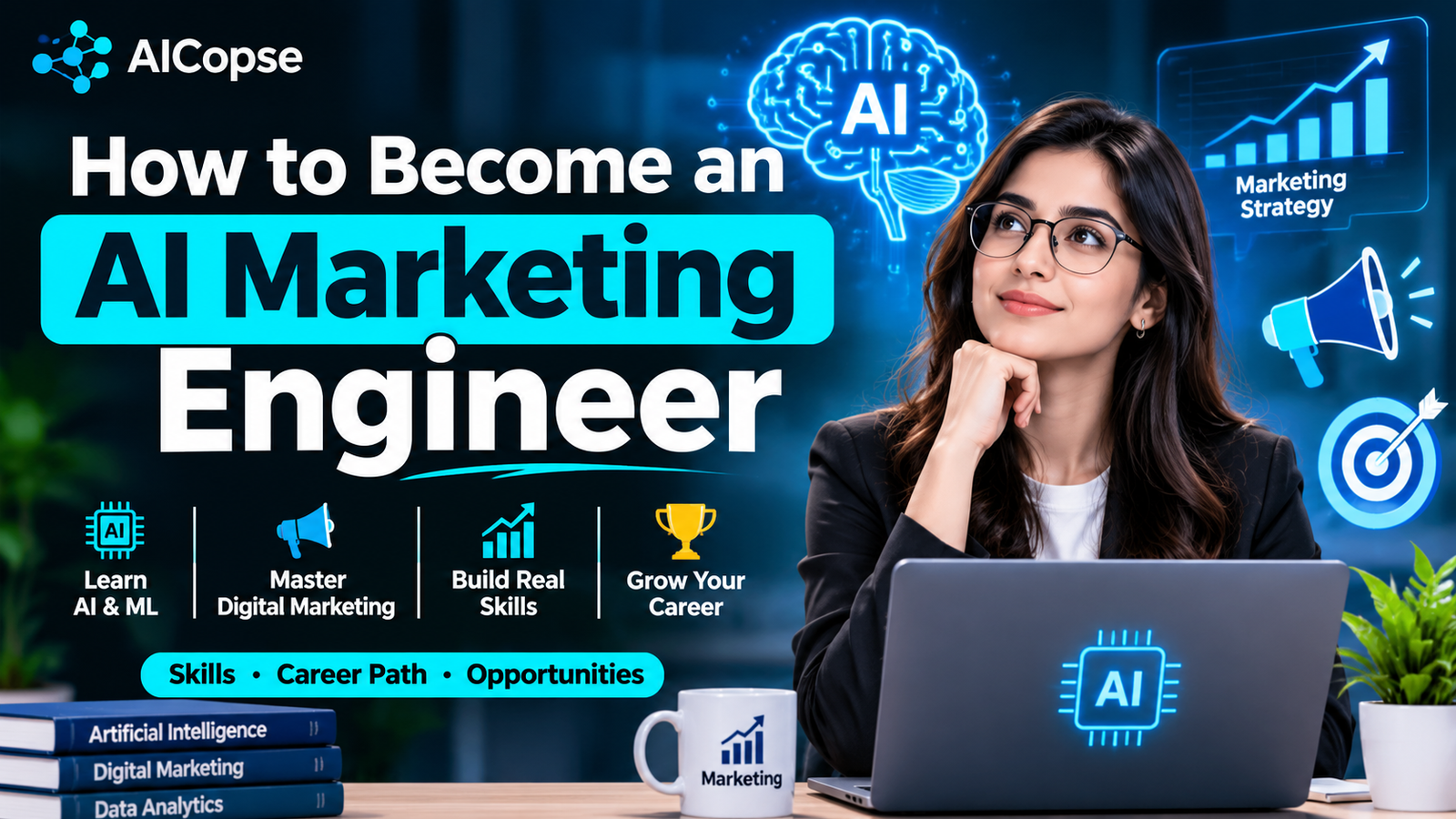
This shift has created opportunities for professionals who combine marketing knowledge with software, data, automation, and AI engineering. One emerging career built around this combination is the AI Marketing Engineer.
But how do you enter this field? Do you need a computer science degree? Should you learn Python first, or start with automation tools? Can an experienced marketer move into the role? And what should you build before applying for jobs?
This guide explains how to become an AI Marketing Engineer through a practical career roadmap. It covers different entry paths, education, learning priorities, portfolio projects, job titles, résumés, interviews, and the steps needed to become job-ready.
Learn marketing fundamentals, develop data and programming skills, understand APIs and automation, practice building AI-powered workflows, and create a portfolio of working projects. Then apply for relevant marketing engineering, AI automation, marketing technology, and AI engineering roles. A specific degree can help, but demonstrable technical ability and business results are essential.
- Understand what an AI Marketing Engineer does
- Why this career is emerging
- Choose your starting point
- Education and qualifications
- The skills and learning sequence
- A practical six-month roadmap
- Build a professional portfolio
- Gain practical experience
- Find the right job titles
- Prepare your résumé and LinkedIn profile
- Prepare for interviews
- Career progression and specializations
- Mistakes to avoid
- Frequently asked questions
Understand What an AI Marketing Engineer Does
Before choosing a learning path, understand the job you want to perform. An AI Marketing Engineer designs, builds, integrates, and maintains technical systems that help marketing teams work more effectively.
These systems may connect customer relationship management platforms, advertising data, websites, analytics tools, AI models, email platforms, and internal business applications.
For example, a company may receive leads from its website, paid advertising, and events. An AI Marketing Engineer can build a system that collects those leads, checks their information, enriches records using approved data sources, classifies inquiries, updates the CRM, and notifies the appropriate sales team.
The role is not simply about writing prompts or generating marketing content. It involves building the infrastructure and workflows that allow AI to support real business processes.
Forms, ads, CRM
Python, SQL, APIs
Models, agents, rules
CRM, routing, reports
The engineer builds and maintains the connections between these components, while defining how the system should be tested and monitored.
If you want a deeper explanation of the role itself, read What Is an AI Marketing Engineer? Role, Skills and Career.
Why AI Marketing Engineering Is Becoming a Career Opportunity
Marketing teams have adopted many digital platforms over the years. However, having more tools does not always make work easier. Data becomes scattered, employees repeat manual tasks, and teams struggle to connect information across systems.
AI creates new possibilities, but it also creates a technical challenge: businesses need people who can make AI work with existing applications, data, permissions, and processes.
Recent US job advertisements show this change in the types of capabilities employers are requesting.
Stanford University’s 2026 AI Index reports the following number of US AI job postings mentioning selected specialized skills in 2025:
Python
Automation
Workflow management
SQL
Source: Stanford AI Index Report 2026, Economy and Jobs. These figures cover US AI job postings broadly, not only marketing engineering positions. One posting can mention several skills.
These numbers are useful because they show the importance of programming, automation, workflow management, and data skills across AI-related jobs.
Marketing-specific job advertisements provide another signal. For example, Dynatrace has advertised a Lead Marketing AI Engineer role focused on building agentic workflows that connect AI tools with platforms such as Salesforce, Marketo, and Asana. Its job description emphasizes production systems, reusable workflows, technical standards, and measurable time savings.
Another example is the AI Marketing Automation Engineer role advertised by FEDCON in November 2026. Its responsibilities include automating HubSpot campaigns, connecting lead capture with follow-up, and measuring marketing performance. The listing also accepts applications from recent graduates and students nearing graduation.
These examples show that the market is not limited to one job title or one level of experience. Related opportunities can appear under marketing engineering, AI automation, marketing technology, and AI engineering titles.
Sources: Dynatrace Marketing AI Engineer role and FEDCON AI Marketing Automation Engineer listing.
Choose Your Starting Point
There is no single route into AI Marketing Engineering. People enter the field from different backgrounds, and their previous experience can give them an advantage.
The important thing is to identify what you already know and what you still need to learn.
Already understand campaigns, funnels, customers, and business goals. Their next step is to develop programming, data, APIs, and automation skills.
Already understand programming and system development. They should learn marketing operations, CRM systems, attribution, customer journeys, and campaign measurement.
Already understand datasets, reporting, and analytics. They can expand into APIs, workflow automation, LLM integration, and AI application development.
Already know how to connect applications and automate processes. They should strengthen coding, data architecture, AI evaluation, and production reliability.
Can build foundations in marketing, programming, data, and AI while developing practical projects that demonstrate their ability.
Path 1: From marketing to AI Marketing Engineering
Marketing professionals already understand the problems that AI Marketing Engineers are expected to solve. They know how leads are generated, why customers convert, how campaigns are measured, and where marketing teams lose time.
The main challenge is developing enough technical ability to build the systems behind these processes.
A practical transition could look like this:
- Learn spreadsheet-based data analysis and basic SQL.
- Understand Python fundamentals and JSON.
- Learn APIs, webhooks, and CRM integrations.
- Build workflows using n8n, Make, or Zapier.
- Connect an LLM to a marketing workflow.
- Build and document two or three complete projects.
An experienced marketer does not need to forget marketing and start again. Their business knowledge is an advantage when combined with technical skills.
Path 2: From software development to AI Marketing Engineering
Developers may already know programming, databases, software architecture, and API development. Their main learning gap is often the marketing environment.
They should understand how CRM systems work, how marketing campaigns are tracked, what makes a lead valuable, and how marketing teams measure revenue and customer acquisition.
A developer can begin with a simple project such as a lead management integration, then expand it into an AI-assisted qualification and routing system.
Path 3: From data analytics to AI Marketing Engineering
Data analysts can use their existing knowledge of SQL, dashboards, reporting, and data quality to move into marketing engineering.
They should add programming, APIs, workflow design, LLM integration, and system monitoring. Their ability to measure performance can become a strong advantage because AI systems need measurable evaluation.
Do You Need a Degree to Become an AI Marketing Engineer?
A degree can help, especially for jobs involving software development, data engineering, machine learning, or enterprise systems. However, the role is not limited to graduates of one specific academic program.
Relevant educational backgrounds include:
- Computer Science and Software Engineering.
- Information Technology and Information Systems.
- Data Science and Business Analytics.
- Marketing and Digital Marketing.
- Business Information Systems.
- Artificial Intelligence and related computing disciplines.
A marketing graduate can develop the technical skills through structured courses and practical projects. Similarly, a computer science graduate can learn marketing systems and business operations.
Degree versus practical experience
Consider two candidates applying for a junior marketing automation engineering position.
The first candidate has completed several AI courses but cannot demonstrate a working project. The second candidate has a relevant degree or equivalent learning experience and has built a lead management workflow, documented its architecture, tested failure cases, and explained how it improves the process.
The second candidate gives the employer more direct evidence of practical ability.
This does not mean qualifications are unimportant. Some employers require a degree or a specific number of years in software engineering. Others accept equivalent experience, projects, and demonstrated technical ability. Always check the requirements of the actual vacancy.
The Skills You Should Learn and in What Order
Learning everything at once can slow down your progress. A better approach is to build one foundation before moving to the next.
The following sequence is designed to help someone move from general knowledge to building complete AI marketing systems.
| Learning stage | What to learn | Practical outcome |
|---|---|---|
| Marketing foundation | Funnels, CRM, campaigns, customer journeys | Map a business marketing process |
| Data foundation | Spreadsheets, SQL, databases, JSON | Clean and analyze lead data |
| Programming | Python and basic JavaScript | Write scripts and process data |
| Integrations | REST APIs, webhooks, authentication | Connect a form to a CRM |
| Automation | n8n, Make, Zapier, workflow logic | Automate lead processing |
| AI integration | LLM APIs, prompts, structured output | Build an AI-powered assistant |
| Advanced AI systems | RAG, agents, evaluation, tool calling | Build a controlled AI workflow |
| Production readiness | Testing, security, monitoring, documentation | Maintain a reliable system |
For a deeper breakdown of the technical and professional abilities involved, see AI Marketing Engineer Skills: Technical, AI and Business Skills.
A Practical Six-Month Roadmap to Become an AI Marketing Engineer
The following roadmap is an example learning plan, not a guaranteed time to employment. Your progress will depend on your previous experience, study hours, and the complexity of your projects.
Someone with software development experience may move through the technical stages faster. A marketer with no programming background may need more time for the foundations.
Study lead generation, customer journeys, CRM systems, campaign tracking, conversion measurement, and basic marketing analytics.
Build: A diagram showing how a company attracts, captures, qualifies, and converts leads.
Learn Python basics, SQL queries, JSON, spreadsheets, and data cleaning. Practice using sample customer and campaign datasets.
Build: A Python script that cleans lead records and produces a simple marketing report.
Practice API requests, authentication, webhooks, and workflow tools. Learn how to handle duplicate records, missing information, and failed requests.
Build: A form-to-CRM workflow with validation and sales notifications.
Learn LLM APIs, prompt design, structured outputs, tool calling, and basic AI evaluation. Understand where a model can help and where normal automation is better.
Build: An AI assistant that classifies inquiries and prepares a response for human approval.
Combine data, APIs, automation, and AI. Add monitoring, error handling, privacy controls, and a clear record of system activity.
Build: A complete lead qualification and routing system with documented tests.
Improve your portfolio, write project case studies, prepare your résumé and LinkedIn profile, practice interviews, and apply for relevant roles.
Build: A professional portfolio with two or three working projects and clear technical documentation.
At the end of this plan, the goal is not to claim expertise in every AI technology. It is to demonstrate that you can identify a marketing problem, design a solution, build the system, test it, and explain its business value.
Build a Professional Portfolio That Gets Attention
A portfolio is one of the strongest ways to demonstrate your ability, especially if you are changing careers or do not yet have direct AI Marketing Engineer experience.
Instead of creating many small demonstrations, build a few complete projects that show how different technologies work together.
Project 1: Automated lead management system
Build a workflow that captures leads from a website form, validates the information, checks for duplicates, and sends the record to a CRM.
Include a notification for the sales team and a record of whether the workflow completed successfully.
- Technical components: Form, API, webhook, CRM, automation platform, data validation.
- What it proves: You can connect business applications and automate a real process.
- Portfolio evidence: Architecture diagram, workflow screenshots, test cases, and error-handling examples.
Project 2: AI lead qualification assistant
Create a system that reviews incoming inquiries and classifies them using predefined qualification criteria. It can summarize the customer’s requirements and suggest the correct next step.
Keep important decisions reviewable. Uncertain cases should be sent to a human rather than automatically rejected or treated as qualified.
- Technical components: LLM API, prompt design, structured output, CRM integration, evaluation.
- What it proves: You can use AI within a controlled business workflow.
- Portfolio evidence: Qualification rules, sample test cases, output comparisons, and human review process.
Project 3: Marketing analytics dashboard
Use sample advertising, lead, and sales data to build a dashboard showing campaign spending, qualified leads, conversions, and cost per acquisition.
- Technical components: Python, SQL, data cleaning, analytics, dashboard platform.
- What it proves: You can convert scattered information into useful business reporting.
- Portfolio evidence: Data model, metric definitions, dashboard, and sample analysis.
Project 4: AI knowledge assistant
Build an assistant that answers questions using approved business documents, product information, or marketing guidelines. It should retrieve relevant source material and avoid making unsupported claims.
- Technical components: LLM API, RAG, embeddings, document processing, retrieval, evaluation.
- What it proves: You understand how to build AI applications grounded in trusted information.
- Portfolio evidence: Knowledge sources, sample questions, answer tests, and examples of how the assistant handles missing information.
How to present each project
Every portfolio project should explain the problem, your approach, and the result. A recruiter should be able to understand what you built without needing to inspect every line of code.
| Portfolio section | What to include |
|---|---|
| Business problem | What was inefficient or difficult? |
| System design | Diagram of components and data flow |
| Technology | Languages, APIs, databases, and platforms used |
| Testing | Test cases, failures, and corrections |
| Business result | Measured or estimated time, cost, or quality improvement |
| Limitations | What the system cannot safely or reliably do yet |
If you use a simulated project, clearly label it as a demonstration. Never present estimated savings or test results as real client outcomes.
Take Your AI Marketing Engineering Journey Further
Learning individual tools is only one part of becoming an AI Marketing Engineer. The bigger challenge is understanding how marketing strategy, data, software, automation, and AI systems work together.
The AI Marketing Engineer: From Marketer to System Architect is a relevant resource for readers who want to move beyond using AI tools and start thinking like system architects.
It connects with an important career shift: moving from manually managing marketing activities to designing intelligent systems that can collect data, understand customer behavior, automate workflows, support decisions, and improve marketing operations.
For someone transitioning from a traditional marketing role, this perspective can help build a clearer understanding of the technical side of modern marketing. For developers and automation professionals, it offers a useful way to connect technical capabilities with real marketing problems.
Rather than treating AI as another tool in the marketing stack, the goal is to understand how to design, connect, and manage complete AI-powered marketing systems.
How to Gain Practical Experience Without an AI Marketing Engineer Job
One of the biggest challenges for new candidates is the experience requirement. Many job listings ask for previous work with AI, APIs, CRM platforms, or automation systems. But you may need practical experience before an employer is willing to hire you.
You can begin developing that experience through several routes.
Work on your own projects
Build systems using sample datasets and free or low-cost development environments. Publish the code where appropriate, document your workflow, and record a short demonstration.
Help a small business
A small business may need help connecting website forms to its CRM, automating customer follow-up, or improving reporting. A limited, clearly defined project can give you useful practical experience.
Agree on access, data handling, project scope, and permissions before working with real customer information.
Contribute to open-source projects
Contributing documentation, fixing integration issues, writing tests, or improving example workflows can help you understand how real software projects operate. It can also provide evidence of collaboration and technical problem-solving.
Move internally within your current organization
If you already work in marketing, analytics, software, or operations, look for a process that can be improved. Propose a small automation project, agree on a measurable outcome, and document the results.
Internal projects can be valuable because you already understand the business environment and can work with the people who use the system.
Which Jobs Should You Search For?
Not every employer uses the exact title “AI Marketing Engineer.” Some companies describe similar responsibilities using other job titles.
Searching only for one title may cause you to miss relevant opportunities. Look for the responsibilities, technical requirements, and business environment rather than relying on the job title alone.
| Job title | Typical focus | Useful background |
|---|---|---|
| AI Marketing Engineer | AI systems and marketing workflows | Marketing plus engineering |
| Marketing Engineer | Marketing technology and integrations | Programming and marketing systems |
| AI Automation Engineer | AI-powered workflows and automation | APIs, automation, AI integration |
| Marketing Automation Engineer | Campaign and CRM automation | Marketing operations and integrations |
| Marketing Technology Engineer | MarTech platforms and data systems | Software and data integration |
| Growth Engineer | Technical growth experiments | Analytics, development, growth |
| AI Solutions Engineer | Building and integrating AI solutions | AI applications and system design |
Where to search for jobs
For US opportunities, search company career pages and job platforms such as:
Try searches such as:
- AI Marketing Engineer
- Marketing AI Engineer
- AI Marketing Automation Engineer
- Marketing Engineer Python SQL
- AI Workflow Engineer Marketing
- Marketing Technology Engineer
- Growth Engineer AI
- AI Engineer Marketing Operations
How to evaluate a job description
Read the responsibilities carefully. A role may have an attractive AI-related title but involve mostly campaign execution. Another role may use a different title while offering the technical work you want.
Look for responsibilities involving:
- Building and maintaining API integrations.
- Connecting CRM, CMS, analytics, and marketing platforms.
- Developing AI-powered workflows and agents.
- Working with Python, SQL, or JavaScript.
- Managing data pipelines and automation.
- Testing, evaluating, and monitoring AI applications.
- Improving measurable business processes.
For example, the Gradial Marketing Engineer job listing describes work across integrations, reporting, automation, and agentic marketing workflows. It demonstrates why reviewing actual responsibilities is more useful than relying on a job title.
How to Prepare Your Résumé and LinkedIn Profile
Your résumé should make it easy for an employer to understand three things: what you can build, which technologies you can use, and what business problems you can solve.
A long list of AI tools is not enough. Focus on practical work and evidence.
Write a clear professional summary
A career changer could use a summary like this, provided it accurately reflects their experience:
“Marketing technology professional developing AI-powered workflows and integrations across CRM, data, and automation platforms. Experienced in building practical solutions using Python, APIs, SQL, and LLM tools, with a focus on improving marketing operations and measurable business outcomes.”
Do not claim expertise in technologies you have only watched in tutorials. Be honest about your proficiency.
Show project outcomes
Instead of writing “Used Python and n8n,” explain what you built and why it mattered.
Used AI tools to automate marketing tasks.
Stronger résumé statement
Built a lead-processing workflow connecting website forms to a CRM through APIs, with duplicate checks, automated routing, and failure notifications.
When you have real measured results, include them. For example, you may report a verified reduction in processing time or a measured improvement in workflow completion. Never invent performance numbers.
Include relevant portfolio links
Add links to GitHub repositories, a personal portfolio, technical documentation, or short project demonstrations. Each link should help the recruiter understand the project quickly.
Your LinkedIn headline can also communicate the direction you are pursuing. For example:
Aspiring AI Marketing Engineer | Marketing Automation | Python | SQL | APIs | AI Workflows
If you are already working professionally in the field, use your actual role and demonstrated experience rather than describing yourself as aspiring.
How to Prepare for an AI Marketing Engineer Interview
Interview preparation should cover business understanding, technical knowledge, practical problem-solving, and system design.
Employers may ask you to explain how you would solve a marketing problem rather than simply asking you to define technical terms.
Marketing and business questions
- How would you automate the process of capturing and qualifying leads?
- How would you measure whether a marketing workflow is successful?
- What is the difference between a lead, a qualified lead, and an opportunity?
- How would you decide which marketing task should be automated first?
Technical questions
- How do REST APIs and webhooks work?
- How would you prevent duplicate records in a CRM integration?
- How can Python help process marketing data?
- How would you use SQL to combine campaign and conversion data?
- What happens when an API request fails?
AI and system design questions
- When would you use an LLM instead of a rule-based workflow?
- How would you build a RAG-based customer support assistant?
- How would you test an AI system that classifies leads?
- How would you protect customer information in an AI workflow?
- What should happen when an AI model is uncertain?
Prepare one complete project explanation
Choose your strongest portfolio project and practice explaining it from beginning to end.
Describe the business problem, the system architecture, the technologies you selected, the data flow, the testing process, the limitations, and the outcome.
Be ready to explain why you selected one solution instead of another. Employers want to understand your reasoning, not just your ability to follow a tutorial.
AI Marketing Engineer Career Progression and Specializations
After entering the field, you can develop deeper expertise in one or more areas. The career does not have to follow a single fixed path.
Builds workflows that connect marketing platforms, automate repetitive tasks, and improve operational efficiency.
Develops LLM applications, RAG systems, AI assistants, and agents for marketing use cases.
Builds data pipelines, reporting infrastructure, customer data systems, and integrations.
Uses engineering, analytics, and experimentation to improve acquisition, activation, and conversion.
A possible progression may look like this:
Builds and supports workflows
→
Owns complete systems
→
Designs standards and architecture
→
Leads systems and strategy
Illustrative career progression. Actual titles, responsibilities, and promotion requirements vary by employer.
Some professionals may move into AI engineering, marketing technology leadership, growth engineering, or technical consulting. Others may specialize in one industry or build an independent automation and AI services business.
What affects career growth?
- Ability to deliver reliable systems rather than isolated demonstrations.
- Understanding of business metrics and marketing performance.
- Experience with production integrations and real data environments.
- Knowledge of security, privacy, testing, and system architecture.
- Ability to communicate with technical and non-technical teams.
- Evidence of measurable improvements from completed projects.
For information about compensation and US market examples, see AI Marketing Engineer Salary: US Pay, Experience and Career Growth.
Common Mistakes to Avoid When Entering This Career
Trying to learn every AI tool
New tools appear constantly. Learning the basics of system design, APIs, data, and AI integration is more valuable than memorizing every new platform.
Ignoring marketing fundamentals
An engineer who does not understand customer journeys, lead quality, or conversion goals may build a technically impressive system that solves the wrong problem.
Skipping programming and data foundations
No-code tools can help you start, but basic programming and data knowledge make it easier to build more flexible and reliable systems.
Building only chatbot demonstrations
A chatbot can be a useful portfolio project, but the profession covers much more. Show that you can connect applications, process data, automate workflows, and measure outcomes.
Applying only for jobs with the exact title
Search related titles such as AI Automation Engineer, Marketing Engineer, Growth Engineer, and Marketing Technology Engineer. Always inspect the responsibilities before deciding whether a role is relevant.
Making unsupported claims on your résumé
Do not describe yourself as an expert in AI agents, Python, or cloud architecture if you cannot explain and demonstrate those skills. Employers may test them during technical interviews.
Ignoring reliability and security
A system that works once is not necessarily ready for business use. Learn testing, error handling, access control, data protection, and monitoring before presenting a project as production-ready.
Frequently Asked Questions
Can I become an AI Marketing Engineer without a computer science degree?
Yes. A computer science degree can help, but it is not the only route. You can develop technical skills through structured learning, practical projects, and relevant work experience. Some employers still require a degree, so check individual job requirements.
Can a digital marketer become an AI Marketing Engineer?
Yes. Digital marketers already understand campaigns, customer journeys, lead generation, analytics, and conversion. They can build on this knowledge by learning Python, SQL, APIs, workflow automation, and AI integration.
How long does it take to become an AI Marketing Engineer?
There is no fixed timeline. Someone with software or data experience may need less time to develop the missing marketing knowledge. A beginner may need longer to learn programming, data, and system integration. A structured six-month learning plan can provide a starting framework, but job readiness depends on demonstrated ability rather than a calendar deadline.
Do I need to learn Python before using AI automation tools?
You can begin learning visual automation tools without knowing Python. However, Python becomes valuable when you need custom data processing, API integrations, advanced logic, or applications that visual tools cannot handle easily.
Which programming languages should an AI Marketing Engineer learn?
Python is a strong starting point because it is widely used for data processing and AI development. SQL is important for databases. Basic JavaScript or TypeScript can also help with web applications, integrations, and custom marketing tools.
Which tools should I learn first?
Start with a programming environment, SQL, an API testing tool, and one workflow automation platform such as n8n, Make, or Zapier. Then learn how to connect an LLM API and build a practical AI-powered workflow. Select tools based on the type of project you want to build.
Can fresh graduates apply for AI Marketing Engineer jobs?
Yes, but opportunities depend on the employer and the position. Some roles require several years of software or marketing technology experience, while others accept recent graduates. Junior automation, marketing operations, and AI integration roles can provide relevant entry points.
What projects should I include in an AI Marketing Engineer portfolio?
Strong examples include automated lead management, AI lead qualification, marketing analytics dashboards, AI knowledge assistants, and content workflows with approval controls. Explain the problem, system design, tools, tests, and results for each project.
Is AI Marketing Engineering a good career for marketers or developers?
It can suit both. Marketers bring customer and business knowledge, while developers bring programming and system-building experience. The strongest candidates learn enough about the other discipline to connect technical work with real marketing outcomes.
What should I do after completing the learning roadmap?
Finish at least two or three complete portfolio projects, document them, prepare your résumé, and apply for relevant roles. Continue improving your skills through real projects, feedback, and technical interviews.
Final Thoughts
Becoming an AI Marketing Engineer is not about collecting AI tools or learning every new technology. It is about developing the ability to connect marketing knowledge, data, programming, automation, and AI into systems that solve real business problems.
Your starting point does not have to be perfect. A marketer can begin with data and programming. A developer can begin with marketing fundamentals. A data analyst can move toward automation and AI integration. Each background offers a different advantage.
Start with the foundations, build practical projects, document your work, and learn how to measure the results. A small system that works reliably and solves a real problem is more valuable than a collection of impressive demonstrations that cannot be used in practice.
The opportunity is for people who can make AI useful inside real marketing operations. Build that ability step by step, and you will have a much stronger foundation for entering this growing career.

Leave a Reply