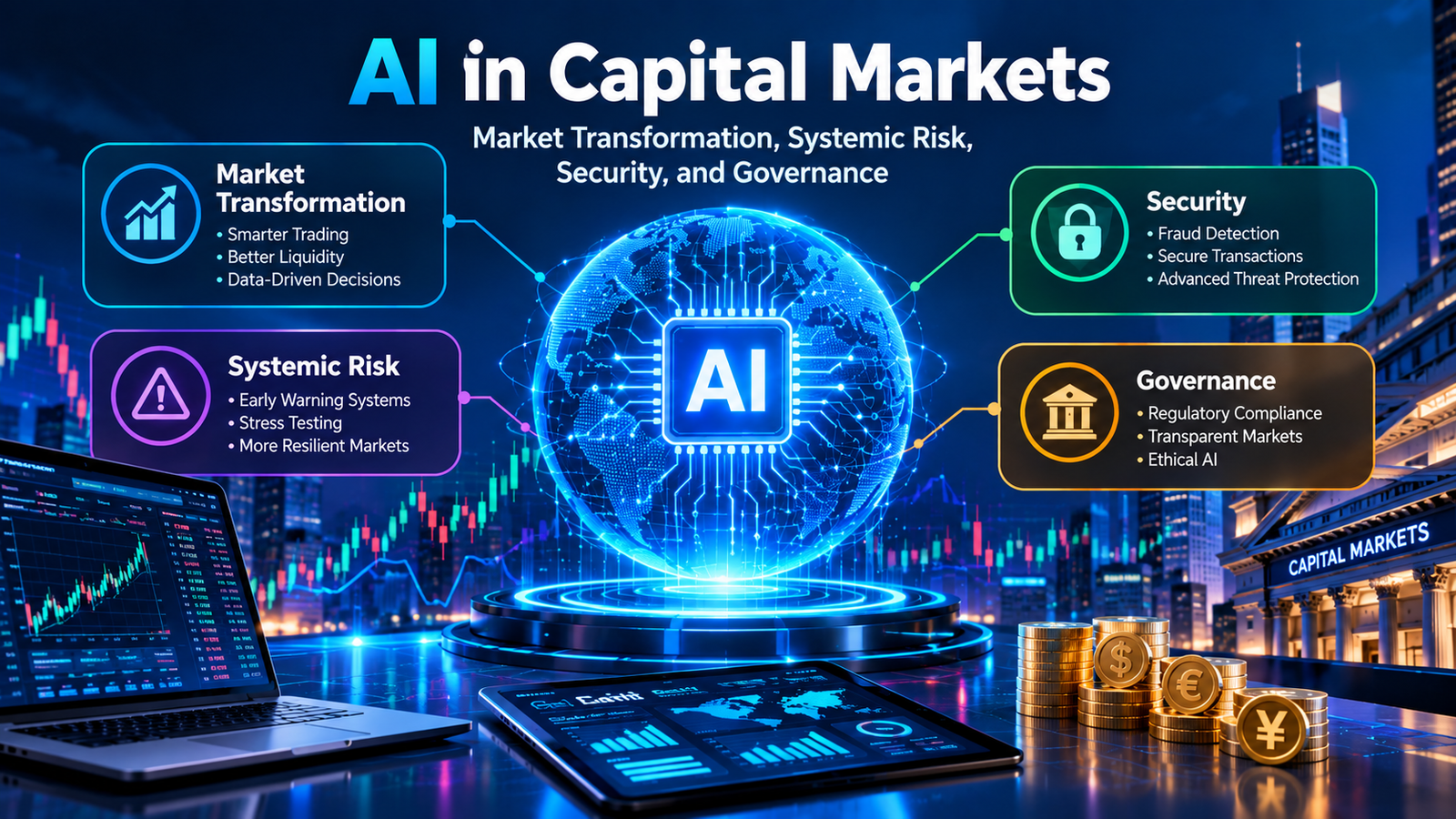
Primary topic: AI in Capital Markets: Market Transformation, Systemic Risk, Security, and Governance
Research focus: AI in issuance, trading, clearing, settlement, and research; third-party concentration risk; frontier AI cyber risk to market infrastructure; and the global supervisory response from IOSCO, ESMA, ESRB, and the FSB
What “AI in Capital Markets” Actually Means
Capital markets AI is not one system. It sits in five different places. Each place carries its own risk profile.
| Function | What AI does here | Example |
|---|---|---|
| Issuance and IPO pricing | Helps price new shares and bonds | Book-building and demand forecasting tools |
| Trading and execution | Places and adjusts orders | Algorithmic and agentic execution systems |
| Research and analysis | Drafts notes and summarizes filings | AI equity research copilots |
| Clearing and settlement | Monitors trade matching and risk exposure | Post-trade anomaly detection |
| Compliance and surveillance | Flags manipulation and insider-trading patterns | Market abuse detection systems |
Visual: AI’s Footprint Across a Single Trade Lifecycle
AI helps price the offering
AI monitors the opening auction
AI executes and adjusts orders
AI checks for settlement risk
AI drafts investor disclosures
Five stages. Five different failure modes. One weak stage can still disrupt the whole trade.
Why Regulators Now Call This a Systemic Risk
For years, AI in capital markets was framed as an efficiency story. That changed through 2026. Four global bodies independently reached the same conclusion within months of each other.
ESMA issues a supervisory briefing on algorithmic trading and a report on AI trends in securities markets
IOSCO publishes its final Supervisory Toolkit for AI Use in Capital Markets
The European Systemic Risk Board warns frontier AI can autonomously execute full-scale cyberattacks on financial infrastructure
FSB Chair Andrew Bailey tells G20 finance ministers frontier AI is one of the most pressing emerging risks to global finance
What each body actually said
IOSCO’s toolkit covers the full lifecycle of an AI system. It applies to traditional machine learning, generative AI, and emerging agentic AI alike. The toolkit sets out three layers: areas of supervisory concern, practical oversight tools, and indicators for monitoring AI adoption. IOSCO also flagged a specific concern. AI-driven cyber risk may accelerate faster than defenses can adapt.
The European Systemic Risk Board went further. Its formal warning stated that frontier AI models can now discover vulnerabilities, generate working exploits, and autonomously run full-scale cyberattacks. It called this a paradigm shift for financial infrastructure, not an incremental change.
Andrew Bailey, chair of the Financial Stability Board, wrote to G20 finance ministers in August 2026. He said frontier AI could materially change the speed, scale, and economics of cyber risk. That, he warned, could undermine market confidence system-wide.
Case Study: A Third-Party Outage Becomes a Systemic Event
Regulators keep returning to one example to explain why AI concentration risk matters. A global IT outage in July 2024 caused roughly 5.4 billion dollars in financial losses. It was not an AI failure itself. It was a single software update from one widely used vendor. Its scale is the point.
A joint 2026 report from Canada’s OSFI and the Financial Consumer Agency of Canada uses this event as a case study. Their argument: AI adoption is concentrating financial infrastructure around a small number of shared cloud and computing providers even faster than before. If one of those providers has a bad day, the damage will not stay contained to one firm.
The same report found something else striking. Ninety-one percent of financial institutions are now reconsidering their voice-verification systems. The reason is AI-enabled voice cloning, which can now defeat voice-based identity checks that banks relied on for years.
Case Study: When a Pricing Error Halts an Entire Exchange
In January 2026, the Colombo Stock Exchange listed a new company at an issue price of 7 rupees per share. Within 20 minutes of the opening bell, trades were executing at prices reported near 25,000 rupees, thousands of times the issue price. The exchange halted trading, closed the market for the full day, and cancelled every transaction that happened before the halt.
The exchange described the event as an isolated erroneous trade by a market participant. It is a useful case study regardless of exact cause. It shows how fast a single pricing anomaly can force a full-market shutdown, and why post-trade audit systems, whether human-driven or AI-assisted, need to catch an error like this within seconds, not after a full trading session has already been disrupted.
Source: Newly Listed Stock: CSE Halts Trading After Irregular Pricing, The Morning, January 2026
Case Study: AI Hallucinations Are Reaching Financial Research
AI hallucinations are already entering permanent professional records. Fortune reported that AI-generated errors are now surfacing in academic papers, legal rulings, and published books. Those errors are hard to remove once cited elsewhere. Consulting and research firms face the same risk with materially higher stakes, since AI-assisted deliverables now reach clients directly.
McKinsey’s 2026 AI Trust Maturity Survey backs this up. Inaccuracy is the most cited AI risk among people directly responsible for AI governance, risk, or investment decisions. For capital markets specifically, this means one thing. An AI-drafted research note or risk memo needs the same fact-checking rigor as a human-drafted one, not less.
Source: AI Hallucinations in Consulting and Research, Infomineo, 2026
Research Study: IOSCO’s Supervisory Toolkit for AI in Capital Markets
Published in May 2026, this is the single most important reference document for anyone building or overseeing AI in regulated markets. It follows IOSCO’s earlier 2025 consultation, which identified five key findings on AI use, risk, and industry practice. The final toolkit is deliberately non-prescriptive. It gives supervisors practical tools rather than fixed rules, so it can apply across very different regulatory regimes.
What capital markets firms can learn:
- Cover the full AI lifecycle in your governance program, not just the model’s launch day
- Apply the same toolkit to traditional machine learning, generative AI, and agentic AI, since IOSCO treats all three as in scope
- Document third-party and outsourcing dependencies for every AI system you use
- Prepare for supervisors to use standardized indicators to track your firm’s AI adoption over time
Source: IOSCO Final Report: Supervisory Toolkit for AI Use in Capital Markets, Regulation Tomorrow, May 2026
Research Study: ESRB’s Warning on Frontier AI Cyber Risk
The European Systemic Risk Board’s July 2026 warning is short, formal, and direct. It states that frontier AI models can discover vulnerabilities, write working exploits, and run full cyberattacks autonomously, at a speed and accuracy beyond earlier AI generations. It calls this an inflection point for cybersecurity in finance, and directs attention specifically at systemically important payment and settlement infrastructure.
What capital markets firms can learn:
- Treat frontier AI cyber capability as a board-level risk, not just an IT department issue
- Prioritize protection for clearing, settlement, and payment infrastructure above less critical systems
- Run red-team exercises that specifically simulate an AI-driven, not human-driven, attacker
- Coordinate with national regulators, since this warning applies to the whole EU financial system, not one firm
Source: ESRB Warning on Frontier AI Models, Regulation Tomorrow, July 2026
Research Study: A Taxonomy of AI-Driven Flash Crash Mechanisms
A September 2026 peer-reviewed study proposes three distinct mechanisms through which AI can trigger a catastrophic market dislocation. Endogenous herding happens when many AI systems reach the same conclusion at once. Exogenous cascade failures happen when one AI system’s error spreads across connected venues. Adversarial disinformation events happen when manipulated information is fed to AI systems that then act on it. The paper links this taxonomy to a real digital-asset liquidation event with over 19 billion dollars in leveraged positions closed out within 24 hours.
What capital markets firms can learn:
- Classify any AI-related market incident into one of these three patterns immediately, to speed up your response
- Monitor correlation across your own AI-driven strategies, since herding risk grows quietly until it doesn’t
- Build isolation between connected trading venues, so one system’s failure cannot cascade into another
- Verify external information sources before AI systems are allowed to act on them
Research Study: AI Agents Need Governance in Proportion to Their Authority
This 2026 academic study on AI agents in financial markets argues that governance has to scale with the authority an AI system holds. It draws on the NIST AI Risk Management Framework and IOSCO’s own capital-markets guidance to argue for a layered control architecture, separating signal generation, risk checking, and execution into distinct, independently governed stages.
What capital markets firms can learn:
- Never let a single AI system control signal generation, risk checks, and execution all at once
- Set hard, non-negotiable limits the AI cannot reason its way past
- Use existing frameworks like NIST’s as a starting point, then localize for your regulator
- Review agent authority levels on a fixed schedule, not only after something goes wrong
Source: AI Agents in Financial Markets: Architecture, Applications, and Systemic Implications, arXiv, 2026
What the Experts Are Saying
Andrew Bailey, Chair of the Financial Stability Board and Governor of the Bank of England, letter to G20 finance ministers, August 2026
Actionables: What Different Teams Should Do, Why, and What It Changes
Governance only works when each team knows exactly what to do, why it matters, and what happens if they do it right.
For Boards and Business Leaders
| Action | Why it matters | Expected impact |
|---|---|---|
| Add AI systemic risk to the board risk register | Regulators like the FSB now treat this as a board-level, not IT-level, risk | Faster board approval when new controls are needed |
| Map concentration risk across cloud and AI vendors | A single vendor outage already cost the industry 5.4 billion dollars once | Fewer single points of failure across your operations |
| Fund an independent AI incident response budget | IOSCO and ESRB both expect firms to respond fast, not after the fact | Shorter time between an incident and a contained fix |
| Require an AI use inventory in every board report | You cannot govern an AI system you do not know exists | Complete visibility before the next supervisory review |
For Developers and Market Infrastructure Engineers
| Action | Why it matters | Expected impact |
|---|---|---|
| Separate signal generation, risk checks, and execution into distinct services | One AI system controlling all three stages means one bug can cause a full-scale loss | A failure in one stage stays contained, instead of spreading |
| Build a kill switch that works independently of the AI vendor | A vendor-controlled shutdown cannot be verified by you or a regulator | You can prove, on demand, that you can stop a malfunctioning system |
| Log every AI-driven order with model version and reasoning attached | Post-incident reviews need to trace exactly what the AI decided and why | Faster, cleaner root-cause analysis after any anomaly |
| Test how systems behave when a connected venue fails | Cascade failures spread through connections nobody tested under stress | Fewer surprise outages during a genuine market event |
For Startups and Founders Building Capital Markets Tools
| Action | Why it matters | Expected impact |
|---|---|---|
| Design for IOSCO’s toolkit from day one, not as a later retrofit | Retrofitting governance into a live trading product is far more expensive | Faster approval when institutional clients run due diligence on you |
| Fact-check every AI-generated research or risk output before it ships | Inaccuracy is now the top-cited AI risk among decision-makers | Stronger trust with clients who rely on your output for real decisions |
| Avoid relying on a single cloud or model vendor for critical functions | Concentration risk is exactly what regulators are now watching closely | Your product keeps running even if one vendor has an outage |
| Publish a plain-language AI risk disclosure for clients | Institutional buyers increasingly ask for this before signing | Shorter sales cycles with regulated financial institutions |
For Compliance, Risk, and Regulatory Affairs Teams
| Action | Why it matters | Expected impact |
|---|---|---|
| Map your AI systems against IOSCO’s three-layer toolkit | This is now the reference framework supervisors are trained on | Fewer surprises during your next supervisory examination |
| Reassess voice-based identity verification | 91 percent of institutions are already moving away from voice-only checks | Lower exposure to AI voice-cloning fraud |
| Classify every AI-related incident using a known failure pattern | Faster classification means faster, more accurate regulatory reporting | Shorter incident-to-report time, which regulators are actively watching |
| Track ESMA, ESRB, IOSCO, and FSB publications on a fixed schedule | These four bodies are publishing new AI guidance every few months | No compliance gap caused by missing a new requirement |
Risk Tiers: Matching Oversight to Market Impact
| Tier | Example | Required control |
|---|---|---|
| Assist | Draft a research summary or filing overview | Analyst fact-check before publication |
| Recommend | Suggest an IPO price range | Human pricing committee sign-off |
| Execute bounded tasks | Route orders within a pre-set risk band | Hard pre-trade limits and monitoring |
| High-impact decision | Manage clearing exposure or halt trading | Verifiable kill switch and board-level sign-off |
Implementation Roadmap
Inventory every AI system touching issuance, trading, or clearing
Match each system against the IOSCO toolkit’s three layers
Add kill switches, logging, and concentration limits
Run incident drills simulating each of the three crash mechanisms
KPIs to Track
| KPI | What it tells you |
|---|---|
| Vendor concentration score | How many critical functions depend on one cloud or AI provider |
| Kill-switch activation time | How fast you can stop a malfunctioning AI system |
| AI research fact-check rate | Share of AI-drafted research verified before client delivery |
| Incident classification time | How fast you identify which failure pattern an incident matches |
| Toolkit alignment score | Share of AI systems mapped against IOSCO’s supervisory layers |
Future Predictions: 2027 to 2030
2027: IOSCO’s Toolkit Becomes a De Facto Global Standard
Expect national regulators outside the IOSCO membership to start referencing the toolkit even without formal adoption, simply because no competing standard exists yet.
2028: Vendor Concentration Rules Arrive
Following the OSFI-FCAC concentration warning, expect the first formal rules limiting how much critical market infrastructure can depend on a single AI or cloud vendor.
2029: AI Research Fact-Checking Becomes Mandatory Disclosure
Expect regulators to require firms to disclose which parts of client-facing research were AI-drafted and independently verified.
2030: Autonomy Tiers Become a Licensing Requirement
Regulators are likely to formally license AI trading and clearing systems by autonomy tier, similar to vehicle automation levels, with different audit and kill-switch rules for each.
Startup and Product Opportunities
- AI concentration-risk mapping tool: Tracks how many critical functions depend on a single vendor
- IOSCO toolkit compliance platform: Maps a firm’s AI systems against the three supervisory layers automatically
- AI research fact-checking service: Verifies AI-drafted equity and credit research before publication
- Independently verifiable kill-switch infrastructure: Provides third-party-testable shutdown mechanisms for trading and clearing systems
- Cross-venue cascade simulator: Stress-tests how an AI failure at one venue would spread to connected ones
- Voice-clone-resistant identity verification: Replaces voice-only checks that AI cloning can now defeat
Frequently Asked Questions
What is the biggest AI risk in capital markets right now?
Regulators consistently point to two things: frontier AI’s growing cyberattack capability, and concentration risk from too many firms depending on the same small set of AI and cloud vendors.
What does IOSCO’s AI toolkit actually require firms to do?
It is non-binding and non-prescriptive. It gives supervisors and firms a shared framework covering governance, third-party risk, disclosure, and monitoring across the full AI lifecycle.
Can AI actually cause a market-wide flash crash?
Academic research describes three specific mechanisms, herding, cascade failures, and disinformation-triggered events, through which AI could trigger or worsen one. The largest documented AI-linked liquidation event so far happened in digital-asset markets.
Why does a single IPO pricing error matter for AI governance?
It shows how fast a single pricing anomaly can force a full market shutdown. The same speed problem applies whether the initial error came from a human trader or an AI system.
Are AI-generated research reports reliable?
Not without verification. Inaccuracy is the most cited AI risk among governance and investment professionals, according to McKinsey’s 2026 survey, and hallucinated content has already reached permanent professional and legal records.
What should a capital markets firm do first if it has no AI governance program yet?
Map every AI system touching issuance, trading, research, or clearing, then compare that map against IOSCO’s Supervisory Toolkit before adding any new AI capability.
Final Perspective
Capital markets AI has delivered real efficiency gains. Faster pricing. Faster fraud detection. Faster research. 2026 also delivered the clearest regulatory consensus yet that the same systems carry systemic risk. IOSCO built the shared playbook. The ESRB and FSB named the specific danger: frontier AI’s growing cyberattack capability and the industry’s growing dependence on a handful of shared providers.
The direction for every capital markets firm is the same. Map your AI systems now. Align them with IOSCO’s toolkit now. Build a kill switch you can prove works. Do this before the next incident forces the issue through enforcement instead of planning.
For sector-specific playbooks that apply the same governance discipline elsewhere in finance, see our related guides on AI Security and Governance in Investment and Asset Management, AI Security and Governance in Banking, AI Security and Governance in FinTech, AI Security and Governance in Insurance, and our earlier guides on AI in Trading: Market Transformation, Algorithmic Risk, Security, and Governance and AI in Crypto: Industry Transformation, Security, Privacy, and Governance.
For deeper coverage of the topics discussed above, see our earlier reporting on AI in initial public offering pricing and valuation modeling, AI in quantitative portfolio optimization and asset allocation, AI in dynamic risk management and stress testing, and AI in due diligence and virtual data room analysis.
Sources
- IOSCO Final Report: Supervisory Toolkit for AI Use in Capital Markets, Regulation Tomorrow, May 2026
- IOSCO Publishes New Consultation Report on Artificial Intelligence in Capital Markets, IOSCO, March 2025
- IOSCO: AI in Capital Markets, Use Cases, Risks, and Challenges, CMS Law, 2026
- ESRB Warning on Frontier AI Models and ECB Writes to Significant Institutions, Regulation Tomorrow, July 2026
- Global Finance Leaders Warned That AI Poses Systemic Risk to Markets, Wealth Professional, August 2026
- Global Finance Leaders Warned That AI Poses Systemic Risk to Markets, InvestmentNews, August 2026
- Newly Listed Stock: CSE Halts Trading After Irregular Pricing, The Morning, January 2026
- From Herding Machines to Autonomous Agents: A Taxonomy of AI-Driven Flash Crash Mechanisms, MDPI, September 2026
- AI Agents in Financial Markets: Architecture, Applications, and Systemic Implications, arXiv, 2026
- AI Hallucinations in Consulting and Research, Infomineo, 2026
- Artificial Intelligence Regulatory Developments Tracker, ICMA Group, 2026

Leave a Reply