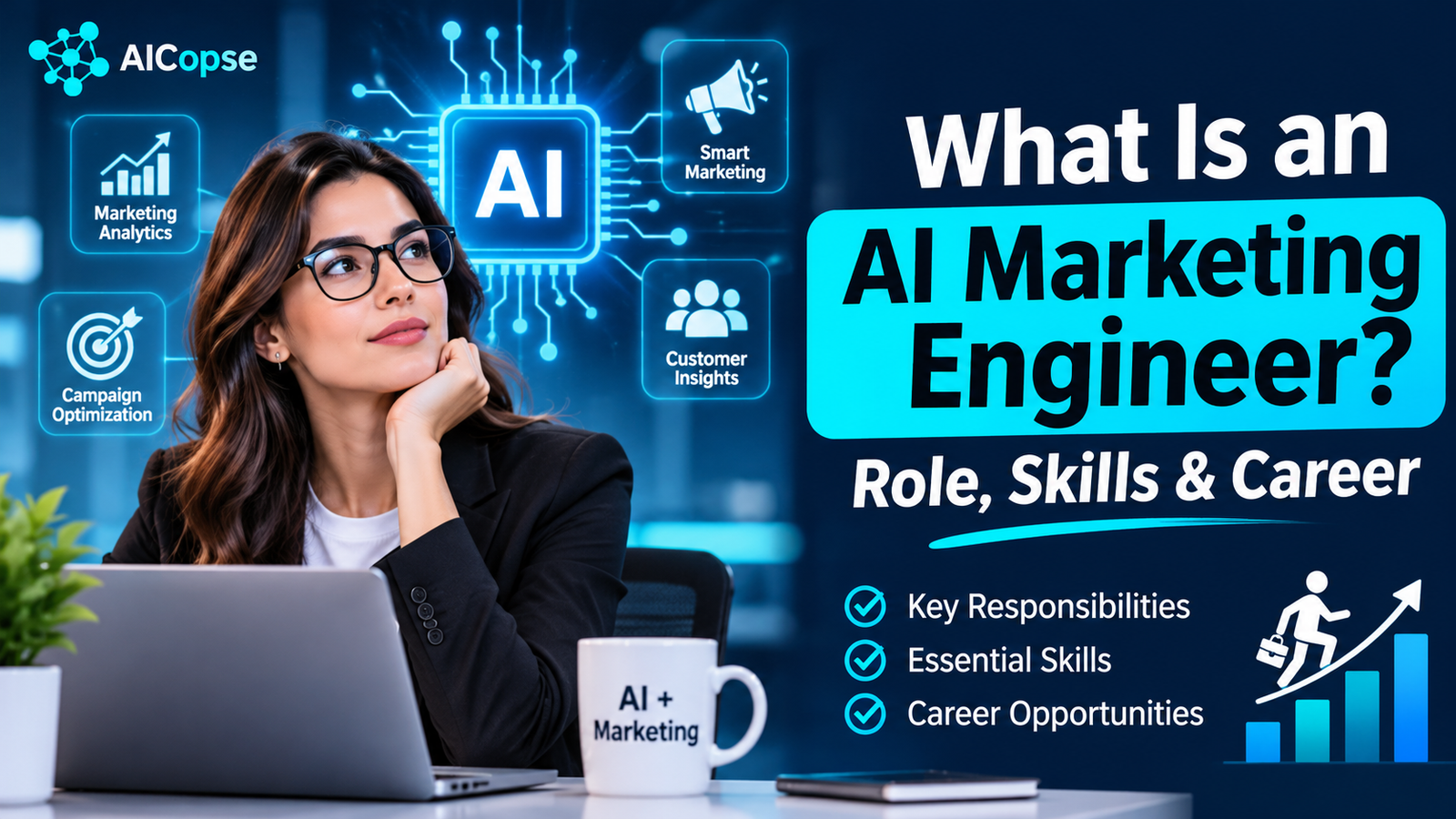
Marketing is becoming more technical. Businesses now use artificial intelligence to understand customers, manage leads, automate campaigns, personalize communication, and improve marketing decisions. But using AI tools is only one part of this change. Companies also need people who can connect these tools, build reliable systems, and measure their business impact.
This is where the AI Marketing Engineer comes in. The role combines marketing knowledge, technical skills, automation, data, and artificial intelligence to build systems that help marketing teams work more effectively.
An AI marketing engineer does not simply use ChatGPT to write content or connect a few applications. The professional designs and manages complete marketing systems that can collect information, process data, automate tasks, support decisions, and improve business performance.
Quick Definition: Who Is an AI Marketing Engineer?
An AI marketing engineer is a professional who designs, builds, and operates the data, automation, and AI systems that support marketing activities. The role combines marketing strategy with engineering skills to create reliable workflows and deliver measurable business results.
The goal is not simply to use more AI tools. It is to build connected marketing systems that work reliably, reduce repetitive work, improve customer experiences, and support business growth.
In this guide, you will learn what an AI Marketing Engineer does, why businesses need this role, which skills and tools are important, how the position differs from other marketing careers, and how to start building a career in this field.
Table of Contents
- Who Is an AI Marketing Engineer?
- Why Is This Role Growing in 2026?
- How Does AI Marketing Engineering Work?
- What Does an AI Marketing Engineer Do?
- The Seven Core Functions of the Role
- Skills Required to Become an AI Marketing Engineer
- Tools and Technologies Used
- Real-World Applications and Examples
- AI Marketing Engineer vs Digital Marketing Engineer
- AI Marketing Engineer vs Marketing Manager
- How the Role Differs From Other Marketing Jobs
- Where Do AI Marketing Engineers Work?
- How to Start a Career in AI Marketing Engineering
- A Useful Book for Learning AI Marketing Engineering
- The Future of AI Marketing Engineering
- Frequently Asked Questions
Who Is an AI Marketing Engineer?
An AI Marketing Engineer is a professional who builds and manages technical systems that support marketing activities. These systems combine customer data, software integrations, workflow automation, artificial intelligence, and performance measurement.
Traditional marketing teams often depend on separate tools and manual processes. A business might use one platform for advertising, another for email campaigns, a CRM for customer records, and spreadsheets for reporting. These tools may work independently, creating delays, repeated work, and disconnected information.
An AI Marketing Engineer connects these systems and makes them work together.
For example, the engineer can build a process in which a new lead is captured through a website form, checked for errors, added to a CRM, analyzed by an AI model, assigned to the right salesperson, and followed up through an approved communication workflow.
The engineer also makes sure the process is tested, monitored, secure, and connected to business goals.
The Simplest Way to Understand the Role
A marketer decides what the business needs to achieve. An AI Marketing Engineer builds the technical systems that help the marketing team achieve that goal more efficiently, consistently, and measurably.
The Three Parts of the Job
Marketing
Understanding customers, marketing funnels, campaigns, channels, messaging, and business goals.
Engineering
Connecting software, working with APIs, handling data, building automations, and testing systems.
Artificial Intelligence
Using language models, AI agents, predictive systems, and intelligent assistants to improve workflows.
These three areas work together. Marketing provides the business purpose, engineering makes the system reliable, and AI adds capabilities such as understanding language, generating content, classifying information, retrieving knowledge, and supporting decisions.
Why Is AI Marketing Engineering Growing in 2026?
AI adoption in marketing has moved beyond simple content generation. Businesses are exploring AI for customer research, campaign planning, advertising optimization, analytics, customer support, and workflow automation.
Several 2026 industry reports show how quickly this change is happening.
96%
of surveyed major brands reported using generative or agentic AI in marketing.
WFA, September 2026
61.4%
of surveyed marketing and advertising professionals said they use AI every day.
Basis, 2026
51.1%
of surveyed marketing organizations reported using AI agents.
Basis, 2026
Another HubSpot report found that 86.4% of surveyed marketing teams use AI in at least some areas of their work. Common applications include content creation, media production, advertising optimization, administrative automation, and strategic planning.
These surveys use different respondent groups and research methods, so their percentages should not be treated as a direct comparison. However, they all point toward a clear industry shift: AI is becoming part of everyday marketing operations.
Sources: World Federation of Advertisers – State of AI in Marketing 2026, Basis – AI and the Future of Marketing 2026, and HubSpot – 2026 State of Marketing.
What Is Driving the Demand for Engineering Skills?
1. More Connected Marketing Tools
Companies use multiple platforms for customer data, advertising, analytics, email, and sales. They need people who can connect these systems and make information move between them correctly.
2. Faster Customer Communication
Customers expect quick answers. Automated workflows and AI assistants can handle routine inquiries and route complex cases to employees.
3. Greater Pressure to Prove Marketing ROI
Businesses want to understand which campaigns generate qualified leads, sales, and revenue. That requires clean data, reliable tracking, and better measurement.
4. Need for Safe and Reliable AI
AI systems can produce incorrect information or mishandle customer data. Businesses need testing, privacy controls, human review, access management, and monitoring.
5. More Demand for Connected Workflows
Instead of using separate AI tools for individual tasks, companies are beginning to connect them into larger workflows. These systems can retrieve information, analyze customer activity, prepare recommendations, and complete approved actions.
The opportunity is not just about adopting AI. It is about turning separate AI tools and marketing platforms into dependable systems that solve real business problems.
How Does AI Marketing Engineering Work?
AI Marketing Engineering works by connecting the different stages of a marketing process. Instead of handling every task manually, the engineer designs a workflow in which data moves between systems and actions happen automatically when specific events occur.
Consider a company that receives inquiries through its website. A typical AI-powered lead management workflow might look like this:
Example: An Automated Lead Management System
A visitor submits a website form.
↓
The system checks, cleans, and stores the lead information.
↓
AI analyzes the inquiry and helps classify the lead.
↓
The lead is assigned and receives an approved response.
↓
The system records results and updates marketing reports.
The engineer does not simply connect tools and leave them running. The workflow must be tested, monitored, protected, and improved when business requirements change.
The Five Layers of a Marketing System
A useful way to understand the complete system is to divide it into five connected layers.
| Layer | Purpose | Examples |
|---|---|---|
| Data | Collect and organize reliable information. | CRM, SQL, databases, tracking. |
| Automation | Move information and trigger actions. | n8n, APIs, webhooks, workflows. |
| Intelligence | Analyze information and generate useful outputs. | LLMs, RAG, machine learning. |
| Decisions | Turn insights into marketing actions. | Scoring, forecasting, experiments. |
| Operations and Trust | Keep systems secure and reliable. | Testing, monitoring, privacy, security. |
These layers depend on each other. AI cannot produce dependable results if the underlying data is inaccurate. Automation cannot be trusted if errors are not detected. A system that works technically may still fail if it does not support a real marketing goal.
What Does an AI Marketing Engineer Do?
The exact responsibilities depend on the company, team size, and business model. However, most AI Marketing Engineers work across several connected areas.
Marketing Data and Tracking
They make sure that useful marketing information is collected and organized correctly. This can include website events, campaign parameters, customer records, advertising data, and conversion information.
Software Integration
They connect platforms such as CRMs, email systems, analytics tools, advertising platforms, and messaging services. APIs and webhooks allow these systems to exchange information.
Workflow Automation
They build workflows that reduce repetitive work. Examples include lead routing, customer follow-ups, campaign reporting, content review processes, and internal notifications.
AI Assistants and Agents
They configure AI systems to answer questions, classify inquiries, retrieve information, draft content, and support business processes. More advanced systems can use tools and perform approved actions under defined rules.
Testing and Quality Control
They test workflows and AI outputs before deployment. This includes checking accuracy, handling unusual inputs, preventing duplicate actions, and creating human escalation paths.
Analytics and Performance Measurement
They build dashboards and reporting pipelines that help teams understand campaign performance, lead quality, response times, conversion rates, and the financial impact of automation.
Security and Documentation
They protect API keys, manage access, respect customer consent, document workflows, monitor system performance, and prepare instructions for maintenance and troubleshooting.
For a more detailed breakdown of daily tasks, read What Does an AI Marketing Engineer Do? Daily Tasks and Responsibilities.
The Seven Core Functions of the Role
Most of the work can be understood through seven practical functions. Together, they describe how an engineer turns marketing activities into connected systems.
| Function | What It Means | Example |
|---|---|---|
| Capture | Collect data and leads. | Forms, tracking tags, webhooks. |
| Connect | Make different tools exchange information. | CRM connected to email and messaging. |
| Clean | Make data accurate and consistent. | Remove duplicate leads and fix formats. |
| Automate | Make routine actions happen automatically. | Lead assignment and follow-up. |
| Augment | Add AI capabilities to workflows. | Lead scoring and AI assistants. |
| Measure | Understand what is working. | Dashboards and conversion reporting. |
| Protect | Keep systems safe and dependable. | Privacy controls, testing, monitoring. |
For example, an automated lead system must capture the inquiry, connect it to the CRM, clean the information, trigger a response, use AI where appropriate, measure the result, and protect customer data. Skipping any of these functions can create problems later.
Skills Required to Become an AI Marketing Engineer
You do not need to become an expert software developer before entering this field. However, you need enough technical knowledge to understand how systems work, build useful solutions, identify problems, and collaborate with specialists.
The role is often described as T-shaped: deep knowledge in marketing, supported by practical skills across data, automation, AI, security, and communication.
The AI Marketing Engineer Skill Stack
Scoping, explaining, documentation
Privacy, access control, testing, governance
LLMs, prompts, RAG, agents, evaluation
Integrations, triggers, branching, error handling
SQL, Python, data pipelines, dashboards
Funnels, channels, customers, messaging, analytics
1. Marketing Fundamentals
Start with the basics of marketing. Understand how customers discover products, move through a buying journey, respond to campaigns, and become repeat customers.
- Marketing funnels and customer journeys
- Lead generation and lead qualification
- SEO, email, social media, and paid advertising
- Customer segmentation and personalization
- Conversion rates and campaign performance
2. Data Skills: SQL and Python
Marketing systems generate large amounts of data. SQL helps you retrieve and organize information from databases, while Python can help clean, analyze, and process data.
- Understand tables, records, and databases.
- Learn SQL queries, filtering, joins, and aggregations.
- Use Python for basic data cleaning and analysis.
- Understand JSON and common data formats.
- Learn how dashboards use structured data.
3. APIs and Software Integration
APIs allow different applications to communicate. A marketing engineer should understand how to send and receive information, work with authentication, read API documentation, and handle errors.
Webhooks are also important because they allow one system to notify another when an event happens, such as a new lead submission or completed purchase.
4. Workflow Automation
Learn how to create workflows that connect applications and perform repetitive tasks. Tools such as n8n, Make, and Zapier can help build these processes.
More advanced work involves conditional logic, retries, error handling, scheduled tasks, and monitoring.
5. AI and Large Language Models
AI knowledge goes beyond writing prompts. Engineers need to understand how language models work in applications, how to structure their outputs, and how to evaluate the quality of their responses.
- Prompt design and structured outputs
- LLM APIs and model selection
- Retrieval-Augmented Generation (RAG)
- AI agents and tool calling
- Model evaluation and human review
6. Security, Privacy, and Reliability
Marketing systems often handle personal information. Engineers must protect credentials, control access, respect consent, avoid unnecessary data collection, and test systems before they interact with customers.
7. Communication and Problem-Solving
Technical knowledge is not enough. An engineer must understand business requirements, explain solutions in simple language, document work, and show how a system improves business performance.
Explore the full skill breakdown in our guide: AI Marketing Engineer Skills.
Tools and Technologies Used by AI Marketing Engineers
The tools depend on the company’s technology stack and the problem being solved. An engineer does not need to use every platform. The important skill is understanding how to choose and connect the right tools.
| Category | Example Tools | Main Use |
|---|---|---|
| AI Models | OpenAI, Claude, Gemini | Text, analysis, classification, assistants. |
| Automation | n8n, Make, Zapier | Connecting applications and workflows. |
| Programming | Python, pandas | Data processing and custom logic. |
| Databases | PostgreSQL, BigQuery | Storing and querying marketing data. |
| Analytics | GA4, Looker Studio, Metabase | Tracking and performance reporting. |
| CRM and Marketing | HubSpot, Salesforce | Managing leads and customer relationships. |
| Knowledge Systems | Qdrant, Pinecone, pgvector | Retrieval and knowledge-based AI assistants. |
| Development and Operations | GitHub, Docker, cloud hosting | Version control and system deployment. |
A beginner can start with a small stack: one automation platform, one LLM API, a spreadsheet or database, and a CRM. Once the basics are understood, more advanced tools can be introduced when the project requires them.
See our detailed list of AI Marketing Engineering Tools and Platforms for more information.
Real-World Applications of AI Marketing Engineering
The role becomes easier to understand when we look at the systems an engineer can build for different businesses.
Automated Lead Generation and Qualification
A company receives hundreds of inquiries through its website and advertising campaigns. An engineer can build a workflow that captures each inquiry, checks the information, adds the lead to the CRM, and uses AI to classify the customer’s needs.
Qualified leads can be routed to the right sales representative, while other inquiries enter an approved follow-up process.
AI-Powered Customer Support
An AI assistant can answer common questions using approved company information. It may explain product features, service details, pricing rules, or appointment procedures. When a question is sensitive or outside its knowledge, it should transfer the conversation to a human employee.
Automated Marketing Reports
Instead of collecting campaign data manually every week, an engineer can connect advertising platforms, analytics tools, and databases to a reporting pipeline. The system can update dashboards and prepare summaries for marketing managers.
AI-Assisted Content Operations
An AI-powered content workflow can support research, brief creation, first drafts, brand checks, editing, and content distribution. Human editors should remain responsible for accuracy, originality, and final approval.
Customer Segmentation and Personalization
AI and data analysis can help businesses group customers by behavior, purchase history, interests, or engagement. Marketing teams can then create more relevant messages for different customer groups.
Marketing Performance Forecasting
With reliable historical data, engineers can build or integrate models that help estimate demand, identify patterns, and support campaign planning. Forecasts should be tested against actual results rather than treated as guaranteed outcomes.
AI automation does not mean removing people from every decision. Customer complaints, financial commitments, sensitive personal data, and high-impact decisions may require human approval and clear escalation rules.
AI Marketing Engineer vs Digital Marketing Engineer
The terms Digital Marketing Engineer and AI Marketing Engineer are related, but they do not always describe the same responsibilities.
A Digital Marketing Engineer generally focuses on the technical systems behind digital marketing. This may include tracking, analytics, website integrations, marketing platforms, conversion measurement, data collection, and automation.
An AI Marketing Engineer works across many of the same areas but adds a stronger focus on artificial intelligence. This can include LLM integrations, AI agents, RAG systems, intelligent workflow automation, and AI-powered decision support.
| Area | Digital Marketing Engineer | AI Marketing Engineer |
|---|---|---|
| Main focus | Digital marketing technology and measurement. | AI-powered marketing systems and automation. |
| Core work | Tracking, integrations, analytics, websites, and automation. | AI agents, LLMs, RAG, integrations, and intelligent workflows. |
| Technical skills | Tag management, analytics, APIs, JavaScript, data tools. | Python, SQL, APIs, LLMs, AI evaluation, RAG, automation. |
| Main objective | Make digital marketing systems connected and measurable. | Make marketing operations more intelligent and adaptive. |
There is no universal industry standard that separates these titles in every company. Some employers use Digital Marketing Engineer for work that includes automation and AI, while others use it for analytics and marketing technology. The actual job description matters more than the title.
In simple terms, AI Marketing Engineering can be viewed as a more AI-focused direction within technical marketing work. A professional with digital marketing engineering experience can build on that foundation by learning AI systems, model integration, and agent-based workflows.
AI Marketing Engineer vs Marketing Manager
These roles are closely connected, but they are not the same. A Marketing Manager is generally responsible for marketing strategy, campaigns, budgets, positioning, and team direction. An AI Marketing Engineer focuses on the technical systems that help execute and measure that strategy.
| Area | Marketing Manager | AI Marketing Engineer |
|---|---|---|
| Main focus | Marketing strategy and execution. | Data, automation, and AI systems. |
| Main question | What should we do, and why? | How can we build and run it reliably? |
| Typical output | Campaign plans, budgets, positioning. | Automations, integrations, assistants, dashboards. |
| Core skills | Leadership, communication, market research. | APIs, SQL, Python, AI, automation. |
| Key decisions | Audience, messaging, channel mix, budget. | System design, integrations, data flows, AI controls. |
| Success measures | Revenue, growth, pipeline, campaign results. | Reliability, response time, accuracy, hours saved, measurable impact. |
| Typical partners | Sales, creative teams, leadership. | Developers, data teams, marketing teams, vendors. |
How Do They Work Together?
Imagine a training company launching a new online course.
- The Marketing Manager decides the target audience, offer, campaign message, budget, and marketing channels.
- The AI Marketing Engineer builds the tracking, connects the landing page to the CRM, creates lead-response workflows, and prepares a reporting dashboard.
- Both roles review the campaign results and decide what should improve next.
The manager provides direction. The engineer makes the systems work and provides better information for decisions. In smaller businesses, one person may perform both roles, but the responsibilities remain different.
How the Role Differs From Other Marketing Jobs
AI Marketing Engineering overlaps with several existing professions. Understanding the differences helps employers define the position and helps professionals choose the right skills to develop.
| Role | Main Focus | Key Difference |
|---|---|---|
| Marketing Manager | Strategy, campaigns, budgets, teams. | Owns marketing direction rather than technical system building. |
| Marketing Operations Manager | Marketing platforms and processes. | Usually focuses more on platform administration and process management. |
| Marketing Technologist | Marketing technology selection and integration. | May focus more on the technology stack than AI-driven systems. |
| Data Analyst | Data analysis and reporting. | Focuses more on insights than building the complete marketing workflow. |
| Software Engineer | Software and application development. | Usually has broader software engineering responsibilities beyond marketing. |
| Marketing Automation Specialist | Automated campaigns and workflows. | May focus on specific automation platforms rather than the complete data and AI system. |
| Prompt Engineer | Designing and improving prompts. | Prompting is one skill within a wider engineering role. |
The main difference is the scope of responsibility. An AI Marketing Engineer is expected to understand how marketing, data, automation, and AI work together rather than focusing on only one tool or task.
Where Do AI Marketing Engineers Work?
Any business that manages customer data, receives repeated inquiries, runs marketing campaigns, or uses multiple digital platforms may benefit from AI Marketing Engineering.
| Industry | Possible Applications | Example KPI |
|---|---|---|
| Healthcare | Appointment inquiries, reminders, patient communication. | Booked appointments and response time. |
| Real Estate | Lead qualification, property inquiries, viewing bookings. | Qualified leads and viewings. |
| E-commerce | Product recommendations, abandoned-cart workflows, support. | Conversion and repeat purchases. |
| Education | Course inquiries, enrollment follow-ups, student support. | Enrollment conversion. |
| SaaS | Lead scoring, onboarding, product engagement. | Trial-to-paid conversion and retention. |
| Marketing Agencies | Client reporting, campaign workflows, content operations. | Hours saved and client retention. |
| Local Services | Missed-call follow-ups, booking requests, review workflows. | Bookings and customer response time. |
Professionals may work inside a company’s marketing or technology team, at an agency, as independent consultants, or as founders building their own AI-powered marketing services.
How to Start a Career in AI Marketing Engineering
There is no single educational path for this role. People may come from marketing, business, analytics, software development, or marketing operations. What matters is building the combination of skills needed to solve practical problems.
Step 1: Understand Marketing Systems
Learn how leads, campaigns, customer journeys, conversions, and reporting work. Start by mapping how a business attracts customers and moves them toward a purchase.
Step 2: Learn Data Fundamentals
Start with spreadsheets, basic SQL, and simple Python scripts. Practice cleaning customer records, organizing campaign data, and calculating basic marketing metrics.
Step 3: Learn APIs and Automation
Understand how applications exchange information. Build small workflows that connect a form, a spreadsheet, a CRM, and an email or messaging platform.
Step 4: Add AI to Practical Workflows
Experiment with LLM APIs, structured outputs, document-based assistants, and lead classification. Focus on a real business problem rather than building an AI demo without a clear purpose.
Step 5: Learn Testing and Security
Test your workflows with normal and unusual inputs. Protect credentials, check customer consent, create error notifications, and make sure important actions can be reviewed by a human.
Step 6: Build a Project Portfolio
Employers and clients need evidence that you can build useful systems. Create practical projects, document how they work, and explain the results using real measurements.
Three Portfolio Projects to Build
Project 1: Automated Lead Response
Connect a website form to a CRM, validate new leads, send an approved response, and notify the sales team.
Project 2: AI Customer Information Assistant
Build an assistant that answers questions from approved company documents and transfers uncertain questions to a human.
Project 3: Automated Marketing Dashboard
Collect campaign data, organize it, and create a dashboard that shows leads, conversions, spending, and performance.
The Three Stages of Professional Growth
Operator
Uses AI tools, templates, and simple automations to save time on routine tasks.
Builder
Builds working integrations, AI assistants, data pipelines, and reporting systems.
Architect
Designs complete systems, manages risks, chooses technology, and connects projects to business outcomes.
These stages are not formal industry certifications. They are a practical way to understand how responsibility grows from using tools to building systems and eventually designing complete solutions.
For a broader career roadmap, read How to Become an AI Marketing Engineer.
A Useful Book for Learning AI Marketing Engineering
For readers who want a structured learning path, The AI Marketing Engineer: From Marketer to System Architect is a relevant resource to explore.
The book covers marketing systems, web and data foundations, Python, SQL, automation, LLMs, RAG, AI agents, analytics, security, and practical projects. It is particularly relevant for marketers who want to move beyond using AI tools and learn how to build connected systems.
It can be a useful starting point for readers who prefer learning the role through a structured sequence rather than collecting disconnected tutorials and tools.
Readers can also explore our review of The AI Marketing Engineer for a closer look at its topics and learning approach.
The Future of AI Marketing Engineering
AI marketing is moving toward more connected workflows. Instead of using separate tools for individual tasks, businesses are exploring systems that can retrieve information, analyze customer activity, recommend actions, and complete approved steps.
Several developments are likely to shape the role in the coming years.
More Agent-Based Workflows
AI agents are being used for activities such as reporting, research, campaign preparation, and content operations. Engineers will need to design clear permissions, limits, testing processes, and human review for these systems.
Greater Importance of First-Party Data
Businesses will continue to depend on customer information they collect directly and have permission to use. Data quality, consent, organization, and secure access will remain important foundations.
More Focus on AI Search Visibility
As customers use AI-powered search and assistants to discover information, brands need to understand how their content and products appear across changing discovery experiences. Marketing engineers may help connect visibility monitoring, analytics, and content workflows.
Stronger Measurement and Governance
Businesses will need to show whether AI systems actually improve performance. Accuracy, cost, conversion impact, time saved, privacy, and reliability will become important measures.
The most valuable professionals will not simply know how to use the latest AI platform. They will understand marketing problems, connect the right systems, protect customer information, and prove whether their solutions deliver business value.
Frequently Asked Questions
Who is an AI Marketing Engineer?
An AI Marketing Engineer is a professional who designs, builds, and manages data, automation, and AI systems for marketing. The role combines marketing knowledge with technical skills to improve workflows and measure business results.
What does an AI Marketing Engineer do?
An AI Marketing Engineer connects marketing platforms, manages data, builds automated workflows, develops AI assistants, tests systems, creates reporting pipelines, and helps businesses improve marketing operations.
Is AI Marketing Engineering a technical job?
Yes. It requires practical technical knowledge, including APIs, data, automation, and AI tools. However, it also requires a strong understanding of marketing and business goals. A person does not necessarily need to be an advanced software developer to begin learning the field.
Do you need coding skills to become an AI Marketing Engineer?
Basic coding knowledge is useful. Python and SQL are valuable skills, while understanding APIs, JSON, and webhooks helps professionals connect applications. No-code automation platforms can provide a starting point, but coding becomes more useful as systems become more complex.
What is the difference between an AI Marketing Engineer and a Marketing Manager?
A Marketing Manager focuses on strategy, campaigns, budgets, and team direction. An AI Marketing Engineer focuses on building and operating the technical systems that support marketing activities. The two roles work together.
What is the difference between an AI Marketing Engineer and a Digital Marketing Engineer?
A Digital Marketing Engineer generally focuses on the technology behind digital marketing, including tracking, analytics, integrations, and marketing automation. An AI Marketing Engineer adds a stronger focus on AI models, agents, LLM integrations, and intelligent workflows. Responsibilities can overlap depending on the employer.
Which tools should an AI Marketing Engineer learn first?
A practical starting stack includes an automation platform such as n8n, an LLM API, basic SQL and Python, a CRM, and an analytics tool. The best tools depend on the project and the systems a business already uses.
Can a digital marketer become an AI Marketing Engineer?
Yes. Digital marketers already understand campaigns, customers, channels, and performance metrics. By learning data, APIs, automation, and AI, they can expand their skills toward building complete marketing systems.
Where can AI Marketing Engineers work?
They can work in SaaS companies, e-commerce businesses, healthcare organizations, education companies, real estate firms, agencies, and other businesses that use digital marketing systems and customer data.
Is AI Marketing Engineering the same as marketing automation?
No. Marketing automation is one part of the role. AI Marketing Engineering also includes data architecture, software integrations, AI systems, measurement, security, and the operation of complete marketing workflows.
What is the difference between an AI Marketing Engineer and a Software Engineer?
A Software Engineer builds and maintains software applications across many types of industries and business needs. An AI Marketing Engineer applies engineering and AI capabilities specifically to marketing systems, customer journeys, campaign operations, and business growth.
Does an AI Marketing Engineer need a computer science degree?
Not every employer requires a computer science degree. Relevant experience, technical projects, and demonstrated engineering skills may also matter. However, knowledge of programming, databases, APIs, software development, and security is important for technically demanding positions.
What is the salary of an AI Marketing Engineer?
There is no official US average for the exact job title. Related marketing technology and AI engineering positions can have different salary ranges depending on responsibilities, technical depth, experience, and location. See our AI Marketing Engineer Salary in 2026 guide for salary estimates and real employer examples.
Is AI Marketing Engineering the same as being a prompt engineer?
No. Prompt engineering is one skill that can help an AI Marketing Engineer. The broader role also involves software integration, data management, automation, AI evaluation, security, monitoring, and business performance measurement.
Conclusion
AI Marketing Engineering is an emerging professional discipline that brings marketing, data, automation, and artificial intelligence together. Its purpose is to help businesses move beyond disconnected tools and build systems that support real marketing operations.
The role is broader than prompt writing or basic marketing automation. It involves understanding customer journeys, connecting software, managing data, building AI-powered workflows, testing outputs, protecting information, and measuring results.
For marketers, it offers a path toward more technical and system-focused work. For developers and data professionals, it provides an opportunity to apply engineering skills to business and marketing problems.
The best way to start is simple: learn the fundamentals, build one useful workflow, test it properly, and measure what it improves. Over time, small projects can develop into complete marketing systems.
The future of marketing will not depend only on who uses the most AI tools. It will also depend on who can build reliable systems that turn AI capabilities into better customer experiences and measurable business outcomes.
Sources and Further Reading
- World Federation of Advertisers: State of AI in Marketing 2026
- Basis: AI and the Future of Marketing, 2026 Edition
- HubSpot: 2026 State of Marketing
- BCG: Moving the Agentic Marketing Transformation from Illusion to Reality
Research note: Industry statistics in this article come from surveys with different respondent groups and research methods. They describe AI adoption and use in marketing, not the number of AI Marketing Engineer jobs. The job title is still developing, and responsibilities can vary by employer.

Leave a Reply