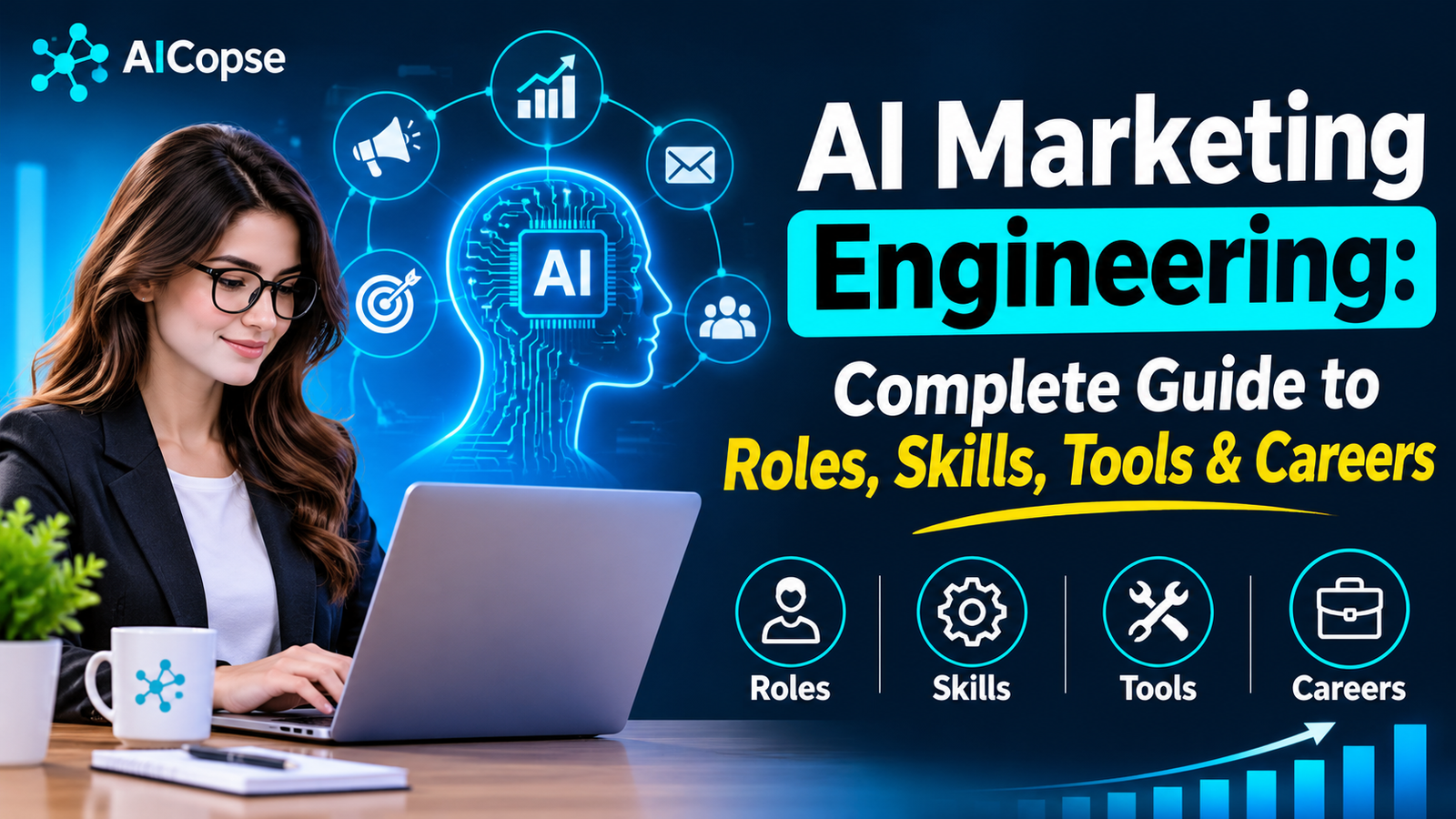
Marketing is changing. Businesses are no longer relying only on manual campaigns, separate marketing tools, spreadsheets, and traditional reporting. They are building connected systems that use artificial intelligence, automation, customer data, analytics, and software to manage and improve marketing activities.
This shift is creating a growing need for professionals who understand both marketing and technology: AI Marketing Engineers.
An AI Marketing Engineer combines marketing knowledge with technical skills to design, build, connect, and manage intelligent marketing systems. Instead of using AI only to write content or generate ideas, this professional works on the systems behind marketing operations. These systems can support lead generation, customer communication, campaign management, personalization, analytics, and business growth.
AI Marketing Engineering is the discipline behind this work. It brings marketing strategy, software engineering, data, automation, and artificial intelligence together to create marketing operations that are more connected, measurable, and scalable.
This guide explains what AI Marketing Engineering means, what AI Marketing Engineers do, which skills and tools they need, how businesses use these systems, and how professionals can build a career in this field.
Table of Contents
- What Is AI Marketing Engineering?
- Why AI Marketing Engineering Matters
- What Research Says About AI in Marketing
- How AI Marketing Engineering Works
- What Is an AI Marketing Engineer?
- Roles and Responsibilities
- Essential AI Marketing Engineering Skills
- Technical Foundations
- AI Marketing Engineering Tools and Platforms
- AI Marketing Automation Engineering
- Real-World AI Marketing Engineering Use Cases
- How Businesses Can Apply AI Marketing Engineering
- AI Marketing Engineering vs. Traditional Marketing
- Related Professional Roles
- How to Become an AI Marketing Engineer
- How to Build an AI Marketing System
- AI Marketing Engineer Salary and Career Opportunities
- Challenges, Risks, and Governance
- A Practical Learning Roadmap
- A Recommended Book for Learning AI Marketing Engineering
- The Future of AI Marketing Engineering
- Frequently Asked Questions
- Further Reading
What Is AI Marketing Engineering?
AI Marketing Engineering is the practice of designing and developing marketing systems with the help of artificial intelligence, software, data, and automation.
Traditional marketing often depends on separate activities. A marketing team may use one platform for email campaigns, another for customer relationships, another for analytics, and several tools for content and advertising. Employees move information between these systems and perform many tasks manually.
AI Marketing Engineering connects these activities into structured workflows. It uses APIs, automation platforms, databases, AI models, and analytics tools to help different parts of marketing work together.
For example, imagine a business that receives inquiries through its website. A connected AI-powered system could:
- Capture leads from website forms and advertising campaigns.
- Store customer information in a CRM.
- Validate and organize lead data.
- Use defined rules and AI models to classify inquiries.
- Send relevant information to the sales team.
- Prepare or trigger appropriate follow-up communication.
- Track customer responses and campaign performance.
- Generate reports that help the business improve its strategy.
These activities are not simply a collection of AI-generated messages. They are connected processes designed to solve a business problem.
That is the main difference between using AI for individual marketing tasks and applying AI Marketing Engineering to an entire marketing operation.
AI Marketing Engineering Includes Several Connected Areas
Artificial Intelligence
LLMs, machine learning, AI agents, classification, prediction, and personalization.
Marketing Strategy
Customer journeys, campaigns, positioning, lead generation, and growth planning.
Software Engineering
APIs, integrations, databases, Python, SQL, and application development.
Automation
Workflows, triggers, data movement, task execution, and system orchestration.
Analytics
Performance measurement, attribution, reporting, experimentation, and insights.
System Management
Security, monitoring, quality checks, reliability, and continuous improvement.
To understand the professional role behind this discipline, read our detailed guide: What Is an AI Marketing Engineer? Role, Skills and Career.
Why AI Marketing Engineering Matters
Marketing teams are expected to do more with the same or limited resources. They need to reach new customers, create useful content, manage multiple channels, respond to inquiries, understand customer behavior, and show measurable business results.
Adding more tools does not automatically solve these problems. When systems are disconnected, employees still spend time moving data, checking reports, updating records, and repeating tasks.
AI Marketing Engineering focuses on improving the structure of marketing operations rather than adding another isolated tool.
Less Repetitive Manual Work
Many marketing activities follow predictable patterns. Lead assignment, campaign notifications, customer segmentation, report preparation, and follow-up reminders can often be automated.
Engineered workflows can handle these repeated activities while employees focus on strategy, creative decisions, customer relationships, and business planning.
Better Use of Customer Data
Businesses collect information from websites, CRM platforms, advertising channels, email campaigns, and customer interactions. When this information remains separated, it becomes difficult to understand the complete customer journey.
AI Marketing Engineering can connect these data sources and create a more consistent view of customer activity. AI models can then help classify information, identify patterns, and support personalization.
More Relevant Customer Experiences
Customers do not all have the same needs. A first-time website visitor, a returning customer, and a person requesting a sales consultation should not necessarily receive the same communication.
Connected marketing systems can use customer data, preferences, and behavior to support more relevant messages and experiences.
More Consistent Marketing Operations
Manual processes can vary between employees and departments. A well-designed workflow creates clear steps, rules, responsibilities, and records. This makes marketing operations easier to manage and improve.
More Useful Performance Insights
Marketing teams need to understand which channels generate qualified leads, where customers leave the buying journey, and which campaigns contribute to revenue.
Connected data and analytics systems make it easier to monitor performance and investigate problems. AI can assist with analysis, but business decisions should still be based on reliable data and appropriate measurement.
What Research Says About AI in Marketing
Businesses are adopting AI across marketing, but adoption alone does not guarantee better performance. The challenge is turning separate experiments into reliable systems that support real business objectives.
Several 2026 research findings help explain why technical skills, workflow design, and AI integration are becoming important in marketing.
AI Automation Is Expected to Expand
In May 2026, Gartner reported that marketing leaders expected AI-driven automation to increase from 16% of marketing work in 2026 to 36% by 2028. The finding came from a survey of 402 CMOs conducted between August and October 2025.
These figures represent what surveyed marketing leaders expected, not a measurement of work already automated across every company. However, they show the direction in which marketing organizations expect their operations to move.
Source: Gartner – Marketing Leaders Expect AI Automation to Reach 36% by 2028.
Marketing Teams Need More Than AI Experiments
McKinsey’s June 2026 analysis describes a gap between AI experimentation and large-scale business value in marketing. It reports that 90% of CMOs were experimenting with AI use cases, while fewer than 10% had scaled AI or captured value across marketing workflows.
The analysis highlights the importance of redesigning workflows rather than simply adding AI features to existing processes. It identifies connected capabilities such as insights, creativity, personalization, agentic commerce, and orchestration as important parts of future marketing.
This distinction is central to AI Marketing Engineering. A company does not gain the full value of AI by purchasing more tools. It needs people who can understand its processes and connect technology around measurable outcomes.
Source: McKinsey – From Campaigns to Continuous Growth: AI Capabilities Shaping Marketing.
AI Skills Are Becoming More Important in Marketing Careers
The American Marketing Association’s 2026 State of Marketing Careers research surveyed 1,412 marketing professionals, analyzed job postings, and interviewed industry leaders.
The report identifies AI fluency as an increasingly important skill for marketers. It also highlights emerging roles such as AI workflow designers and agentic commerce specialists.
At the same time, the research emphasizes the continued importance of human capabilities, including adaptability, critical thinking, collaboration, communication, creativity, and leadership.
This suggests that future marketing professionals will need a combination of technical understanding and strong human judgment.
Source: American Marketing Association – 2026 State of Marketing Careers Report.
Employers Are Asking for Practical AI and Automation Skills
CXL’s analysis of 878 US marketing job descriptions in Q3 2026 found that 40% required AI as a skill or responsibility, compared with 15% in Q1 2026. The analysis also found that mentions of automation increased from 18% to 35% across the same quarterly datasets.
This is one dataset of US job descriptions, not a complete census of the labor market. Still, it provides a useful signal: employers are increasingly interested in people who can apply AI and connect it to real marketing workflows.
Source: CXL – Marketing Hiring Trends 2026: The Skills Employers Want.
What these findings mean
- AI adoption is moving from isolated tasks toward broader workflows.
- Marketing teams need stronger technical and operational capabilities.
- Automation and AI fluency are becoming more relevant in hiring.
- Human judgment, strategy, and communication remain important.
- Companies need systems that can be tested, measured, governed, and improved.
How AI Marketing Engineering Works
An AI marketing system usually includes several layers. Each layer performs a different function, and the complete system connects them into a working process.
Website, email, social media, ads, forms, chat, CRM
APIs, databases, tracking, data cleaning, synchronization
LLMs, machine learning, classification, prediction, AI agents
Workflow triggers, CRM updates, messages, task assignment
Dashboards, conversion tracking, quality checks, optimization
Collect Marketing Data
The system collects information from relevant sources, such as website forms, customer databases, advertising platforms, analytics tools, and communication channels.
Data quality matters. Duplicate records, missing fields, incorrect tracking, and inconsistent customer identifiers can affect every step that follows.
Connect Systems
APIs and integration tools allow different platforms to exchange information. For example, a website form can send a new lead to a CRM, while the CRM can trigger an automation workflow.
Apply AI Where It Adds Value
AI models can classify customer inquiries, summarize conversations, extract information, recommend content, and support analysis. Predictive models may also help estimate outcomes when suitable historical data is available.
Not every task needs an AI model. Simple rules are often more reliable for predictable operations. A good system uses AI where it provides a clear benefit.
Execute Workflows
Automation connects decisions with actions. A workflow might update a CRM record, assign a sales representative, prepare a follow-up message, or notify a team member.
Monitor and Improve
Engineers monitor system performance, data quality, errors, costs, and business outcomes. They use this information to improve workflows and make the system more reliable.
What Is an AI Marketing Engineer?
An AI Marketing Engineer is a professional who combines marketing knowledge, technical development, data systems, and artificial intelligence to build and manage intelligent marketing operations.
The role is different from simply using AI writing tools or managing advertising campaigns. An AI Marketing Engineer works on the underlying systems that support marketing activities.
Depending on the organization, the professional may build automation workflows, connect software platforms, work with customer data, integrate AI models, create internal marketing applications, and improve reporting systems.
The role can vary between companies. A small business may need someone who focuses on integrations and automation, while a larger organization may need specialists in data engineering, AI applications, marketing technology, or system architecture.
Read more: What Is an AI Marketing Engineer?
Roles and Responsibilities of an AI Marketing Engineer
The daily responsibilities depend on the business, team structure, and technical environment. However, the work generally covers several areas.
Marketing Workflow Development
Designing automated processes for lead capture, customer follow-ups, campaign operations, content workflows, and internal marketing tasks.
AI Model Integration
Connecting language models and other AI services to marketing applications. This may include prompt design, API integration, structured outputs, model selection, and quality testing.
CRM and Marketing Platform Integration
Connecting customer relationship management platforms with websites, forms, email tools, analytics systems, and other business applications.
Data Management
Organizing marketing data, creating data flows, maintaining databases, checking data quality, and supporting reporting systems.
Marketing Analytics
Building dashboards, tracking campaign performance, analyzing conversion journeys, and helping teams understand what is working.
Testing and Monitoring
Testing automation workflows, checking AI outputs, monitoring failures, reviewing system logs, and making sure important actions are completed correctly.
Business and Marketing Collaboration
Working with marketing managers, sales teams, business owners, developers, and analysts to understand business needs and translate them into technical solutions.
For a more detailed explanation of daily work, see What Does an AI Marketing Engineer Do? Daily Tasks and Responsibilities.
Essential AI Marketing Engineering Skills
AI Marketing Engineering requires a combination of marketing, technical, analytical, and problem-solving skills. A professional does not need to master every technology at the beginning. The important thing is to understand how the main parts work together and develop deeper skills over time.
Marketing Knowledge
Technical skills are not enough. An AI Marketing Engineer needs to understand the purpose of marketing activities and the business problems they solve.
- Marketing strategy and planning
- Customer journeys and lifecycle marketing
- Lead generation and qualification
- Content marketing and distribution
- Email marketing and customer communication
- Conversion rate optimization
- Campaign measurement and attribution
- Search engine optimization and content strategy
Technical Skills
Technical knowledge helps engineers connect systems, process data, create custom workflows, and build applications. Important areas include:
- Programming with Python and basic JavaScript
- SQL and database fundamentals
- APIs, webhooks, and application integrations
- Workflow automation and system orchestration
- LLMs and AI model APIs
- Data processing and analytics
- Testing, monitoring, and deployment
Analytics and Measurement
Marketing engineers need to interpret data and understand metrics such as conversion rate, customer acquisition cost, customer lifetime value, retention, lead quality, and campaign performance.
Critical Thinking and Communication
Engineers need to understand business requirements, identify problems, explain technical decisions, and work with people who may not have a technical background.
Explore the detailed skill breakdown in AI Marketing Engineer Skills.
Technical Foundations: What Should an AI Marketing Engineer Learn?
Technical knowledge helps turn marketing ideas into working systems. The following foundations are useful for professionals who want to build more than simple no-code automations.
Python
Python is useful for automation, data processing, AI development, and API integrations. An AI Marketing Engineer can use it to clean lead data, process campaign information, connect external services, and build custom applications.
SQL and Databases
Marketing systems often store customer, campaign, transaction, and activity data in databases. SQL helps professionals retrieve, filter, combine, and analyze this information.
APIs and Webhooks
APIs allow applications to communicate with each other. Webhooks send information when a specific event occurs. Together, they help connect websites, CRMs, marketing platforms, AI services, and internal applications.
Large Language Models
LLMs can support tasks such as summarizing customer conversations, categorizing inquiries, extracting information, creating content drafts, and answering questions from approved business information.
Engineers should understand model limitations, context windows, output validation, privacy considerations, and the need for human review in important workflows.
Retrieval-Augmented Generation
Retrieval-Augmented Generation (RAG) connects language models with an external knowledge source. Instead of relying only on information learned during model training, the system retrieves relevant material from a selected knowledge base and provides it as context for an answer.
A business could use RAG to help an internal assistant answer questions from approved product documentation, service information, or company policies.
AI Agents
AI agents can use models, tools, and defined instructions to complete multi-step tasks. In marketing, an agent might research a topic, organize information, prepare a draft, or help process customer requests.
Agentic workflows need clear permissions, limited access, testing, monitoring, and human approval for sensitive or high-impact actions.
Cloud and Deployment Basics
As marketing systems grow, engineers may need to understand cloud services, application hosting, environment variables, authentication, logging, and deployment processes.
These foundations help keep systems secure, maintainable, and available.
AI Marketing Engineering Tools and Platforms
AI Marketing Engineers work with different tools depending on the business requirements. There is no single platform that handles every marketing engineering task. The right technology stack depends on the systems a business already uses, its budget, data needs, security requirements, and technical capabilities.
AI and Language Model Platforms
- OpenAI: Models and APIs for language, reasoning, content, and application workflows.
- Google Gemini: AI models and development services for building AI-powered applications.
- Anthropic Claude: Language models that can support analysis, writing, and business workflows.
- Open-source models: Options for teams that need more control over deployment and model configuration.
Automation Platforms
- n8n: Workflow automation with integrations and options for self-hosting.
- Make: Visual workflow automation across connected applications.
- Zapier: Automation for connecting common business applications.
CRM and Marketing Platforms
- HubSpot: CRM, marketing, sales, and customer service capabilities.
- Salesforce: Customer relationship management and enterprise business workflows.
- ActiveCampaign: Customer communication and marketing automation.
Data and Analytics Tools
- Google Analytics 4: Website and app measurement.
- Looker Studio: Reporting and dashboard creation.
- BigQuery: Data storage and analysis at scale.
- PostgreSQL: Relational database management.
Development and Integration Tools
- Python: Programming, data processing, and AI development.
- GitHub: Source control and software collaboration.
- Docker: Application packaging and deployment workflows.
- Postman: API development and testing.
These are examples, not a required checklist. A small business may build useful marketing workflows with a CRM, an automation platform, and a model API. A larger organization may need custom applications, databases, cloud infrastructure, and more advanced monitoring.
For a deeper comparison of platforms, see Best AI Marketing Engineering Tools and Platforms.
AI Marketing Automation Engineering
AI Marketing Automation Engineering focuses on designing and connecting automated marketing workflows that use AI where appropriate.
Traditional automation follows predefined rules. For example, when a customer submits a form, the system sends an email. AI-powered automation can add more flexible capabilities, such as classifying the inquiry, summarizing the customer’s needs, or selecting an appropriate next step based on approved business rules.
Example: Automated Lead Management
A business receives inquiries through its website. An engineered workflow could:
- Capture the inquiry and store it in the CRM.
- Check required fields and remove duplicate records.
- Use an AI model to summarize the customer’s request.
- Classify the inquiry using predefined categories.
- Assign the lead according to territory, service, or team rules.
- Prepare a relevant follow-up message for review or approved sending.
- Record the result for reporting and future analysis.
The system combines automation, customer data, AI processing, and business rules. It also needs error handling so that missing information or an unavailable service does not silently break the workflow.
Where AI Marketing Automation Can Help
- Lead capture and qualification
- Customer onboarding
- Email and messaging workflows
- Content production and review processes
- Customer support routing
- Campaign reporting
- Customer segmentation
- Internal marketing task management
Read the dedicated guide: AI Marketing Automation Engineering: Complete Guide.
Real-World AI Marketing Engineering Use Cases
AI Marketing Engineering can support many types of marketing operations. The most useful applications depend on the company’s goals, available data, customer expectations, and existing technology.
Intelligent Lead Generation
Businesses can connect website forms, advertising platforms, CRM systems, and enrichment services to create a more organized lead-generation process.
AI can help summarize inquiries, categorize customer needs, and identify information that sales teams should review. Qualification decisions should use transparent business criteria rather than relying blindly on an AI score.
AI-Powered Customer Communication
Businesses can use AI assistants to answer common questions, provide product information, and route customer requests to the right department.
These systems should use approved information, protect customer data, and provide a clear path to human support when a question is sensitive or outside the assistant’s knowledge.
Automated Content Operations
Content teams can build workflows that organize topic research, prepare briefs, summarize sources, create first drafts, and send content for editorial review.
The engineering challenge is not simply generating more content. It is building a process that maintains factual accuracy, brand consistency, useful information, and human editorial control.
Customer Segmentation and Personalization
Marketing systems can organize customers by interests, actions, purchase history, or lifecycle stage. AI can assist with identifying patterns and generating relevant recommendations.
Segmentation should respect customer privacy and applicable consent requirements.
Campaign Performance Analysis
Connected reporting systems can combine information from advertising platforms, websites, CRM systems, and sales records. AI can help summarize changes and highlight areas that need investigation.
Marketing Research and Competitive Monitoring
Businesses can build systems to collect information from approved sources, organize competitor updates, monitor industry developments, and prepare research summaries.
Source verification remains important. AI-generated summaries should not be treated as proof that a claim is accurate.
Customer Retention and Re-Engagement
Businesses can use customer activity and lifecycle information to identify customers who may need assistance, product education, or a relevant follow-up. AI can help summarize customer history and support the selection of appropriate communication.
Marketing Reporting and Internal Assistants
An internal AI assistant can help employees ask questions about approved marketing reports, campaign documents, and performance data. With appropriate access controls, it can make business information easier to explore.
Explore more examples in our dedicated article: AI Marketing Engineer Use Cases.
How Businesses Can Apply AI Marketing Engineering
Businesses do not need to replace their entire marketing technology stack to begin. A better approach is to identify a real operational problem and build a focused system around it.
For Startups
Startups often have small teams and limited resources. They can use AI Marketing Engineering to connect lead capture, customer communication, content workflows, and basic reporting.
The priority should be a small number of reliable workflows that reduce repetitive work without creating unnecessary technical complexity.
For Small and Medium-Sized Businesses
Growing businesses may have separate systems for sales, marketing, customer support, and reporting. Integrating these platforms can reduce information gaps and improve coordination.
For example, a service business can connect its website inquiries to a CRM, automatically organize requests, and provide sales employees with useful summaries before they contact potential customers.
For E-Commerce Businesses
E-commerce companies can use connected systems to support product recommendations, customer segmentation, order-related communication, abandoned-cart workflows, and customer support.
AI can help interpret customer questions and organize product information, while transaction and order actions should remain subject to reliable system rules and verification.
For B2B Companies
B2B organizations can use AI-powered systems to organize account information, summarize sales conversations, support lead research, and coordinate marketing and sales activities.
These systems can help teams work with complex buying journeys, where multiple people may influence a purchasing decision.
For Marketing Agencies
Agencies can build reusable workflows for research, reporting, campaign operations, content review, and client communication. Each client’s data, access permissions, and approval requirements should remain separate and clearly controlled.
AI Marketing Engineering vs. Traditional Marketing
Traditional marketing and AI Marketing Engineering share the same broad goal: helping businesses attract, engage, and retain customers. The difference is in how marketing work is designed and executed.
| Area | Traditional Marketing | AI Marketing Engineering |
|---|---|---|
| Main focus | Campaigns and marketing activities | Connected marketing systems |
| Workflows | Often managed manually or through separate tools | Designed around integrations and automation |
| Data use | Reports and campaign metrics | Connected data and AI-supported analysis |
| Technology | Marketing platforms and tools | AI, APIs, databases, automation, and software |
| Optimization | Campaign-level improvements | Workflow and system-level improvements |
| Technical involvement | Varies by team and tools | A core part of the discipline |
This does not mean traditional marketing is becoming unnecessary. Marketing strategy, customer understanding, positioning, creative thinking, and communication remain essential. AI Marketing Engineering provides a technical foundation that can make these activities more connected and efficient.
Read the full comparison: AI Marketing Engineering vs. Traditional Marketing: Key Differences.
AI Marketing Engineer vs. Related Professional Roles
AI Marketing Engineer vs. Marketing Manager
An AI Marketing Engineer and a Marketing Manager can work closely together, but their main responsibilities are different.
A Marketing Manager usually focuses on marketing strategy, campaign planning, team coordination, budgets, positioning, and business results. An AI Marketing Engineer focuses on building and improving the technical systems that support marketing operations.
For example, a Marketing Manager may decide that the company needs a better lead qualification process. The AI Marketing Engineer can design the data flow, connect the CRM, integrate an AI classification service, and build the workflow that supports the process.
Both roles are valuable. The strongest results often come when marketing strategy and technical execution work together.
Detailed comparison: AI Marketing Engineer vs. Marketing Manager.
AI Marketing Engineer vs. Marketing Engineer
The titles may sound similar, but they can describe different areas of work.
A Marketing Engineer may focus on technical systems used by marketing teams, such as tracking infrastructure, analytics implementation, integrations, and marketing technology. An AI Marketing Engineer places additional emphasis on applying AI models, intelligent automation, and AI-powered workflows to marketing operations.
There can be significant overlap. The exact responsibilities depend on the organization and the way it defines each position.
Read the detailed comparison: AI Marketing Engineer vs. Marketing Engineer: Differences.
How to Become an AI Marketing Engineer
There is no single educational path into AI Marketing Engineering. Professionals can come from marketing, software development, data analytics, automation, business technology, or related fields.
The most useful approach is to develop marketing knowledge and technical skills together, then apply them to practical projects.
Understand Marketing Fundamentals
Learn how businesses attract customers, generate leads, manage customer journeys, run campaigns, and measure performance. Understand the relationship between marketing activity and business outcomes.
Learn Programming Basics
Start with Python and learn how to work with variables, functions, files, APIs, and data. Learn basic SQL to query and organize information stored in databases.
Learn Automation
Build simple workflows using tools such as n8n, Make, or Zapier. Practice connecting forms, spreadsheets, CRMs, email platforms, and other applications.
Learn AI and LLM Integration
Work with model APIs, structured prompts, output validation, and basic AI application development. Learn where AI is useful and where predictable rules are a better choice.
Build Practical Projects
Build projects that solve real marketing problems. Examples include a lead-management workflow, a content research assistant, an automated reporting process, or a customer inquiry classification system.
Learn Data and System Management
Practice data cleaning, database management, API security, logging, testing, and error handling. These skills help turn a working demonstration into a system that a business can depend on.
Build a Portfolio
Document the problem, system design, tools, workflow, testing process, and results for each project. A clear portfolio helps employers and clients understand what you can build.
Follow the complete career roadmap: How to Become an AI Marketing Engineer: Career Roadmap.
How to Build an AI Marketing System
Businesses interested in AI Marketing Engineering should start with a clear operational problem instead of trying to automate everything at once. A structured implementation process helps prevent unnecessary costs and technical complexity.
Identify a Real Business Problem
Start by finding a repeated process that creates delays, errors, unnecessary manual work, or poor visibility. Examples include slow lead assignment, disconnected customer records, time-consuming reporting, or repetitive content administration.
Map the Existing Workflow
Document how the process currently works. Identify the people involved, the tools they use, the information they exchange, and the decisions they make.
Define Inputs, Outputs, and Rules
Decide what information the system needs, what result it should produce, and which conditions should control its actions. Define what happens when information is missing or a task cannot be completed.
Select the Right Technology
Choose tools based on the actual requirements. A simple workflow may need only a form, CRM, and automation platform. A more advanced application may require a database, custom code, an AI model API, and cloud infrastructure.
Build a Small Working Version
Start with the smallest version that can solve the problem. Test it with representative data and realistic scenarios before connecting it to important business operations.
Add Human Approval Where Needed
Keep human approval for actions that could affect customers, money, brand reputation, sensitive information, or important business decisions. Not every AI recommendation should become an automatic action.
Measure and Improve
Track relevant outcomes such as time saved, response time, error rate, lead quality, conversion rate, and total operating cost. Improve the workflow based on real results rather than assumptions.
AI Marketing Engineer Salary and Career Opportunities
AI Marketing Engineering is an emerging job area, and job titles and responsibilities are not yet standardized across employers. Some companies may advertise related positions under marketing technology, marketing automation, growth engineering, AI solutions, or marketing operations.
Salary depends on several factors:
- Country and local job market
- Years of professional experience
- Programming and software development ability
- Experience with AI models and integrations
- Marketing and business knowledge
- System design and deployment experience
- Industry and company size
Professionals with a combination of marketing understanding, software development, AI integration, and data skills may qualify for a wider range of technical marketing and AI-related roles.
Related career paths include:
- AI Marketing Engineer
- Marketing Automation Engineer
- Marketing Technology Specialist
- Growth Engineer
- AI Solutions Engineer
- Marketing Data Analyst
- AI Workflow Developer
- Marketing Operations Engineer
For more detailed salary information, see AI Marketing Engineer Salary.
Challenges, Risks, and Governance in AI Marketing Engineering
AI Marketing Engineering can improve marketing operations, but it also introduces technical and business risks. A reliable system needs more than a working automation or a successful AI demonstration.
Poor Data Quality
AI systems and automation workflows depend on the information they receive. Duplicate contacts, incomplete records, outdated customer details, and inconsistent data formats can create incorrect results.
Businesses should validate important inputs, maintain data standards, and monitor data quality across connected platforms.
AI Hallucinations and Incorrect Outputs
LLMs can produce incorrect statements, unsupported claims, or misleading summaries. These problems become more serious when AI outputs are used in customer communication, product information, or business decisions.
Use approved knowledge sources, structured outputs, validation rules, testing, and human review where appropriate.
Customer Privacy and Data Protection
Marketing systems may process personal information, customer conversations, contact details, and behavioral data.
Businesses should collect only necessary information, limit access, review vendor data practices, apply suitable retention rules, and follow relevant privacy requirements. US organizations should consider applicable federal and state privacy obligations based on their activities and the information they process.
Security and Access Control
AI agents and automation workflows may connect to CRM systems, email accounts, databases, and publishing platforms. Excessive permissions can create serious risks.
Use least-privilege access, secure credential storage, audit logs, environment separation, and approval requirements for sensitive actions.
Uncontrolled Automation
A workflow that sends messages, changes advertising budgets, updates customer records, or publishes content can cause problems if its rules are incorrect.
Use spending limits, rate limits, approval steps, rollback options, and clear conditions for stopping a workflow.
Integration Failures
Connected systems can fail because of expired credentials, API changes, rate limits, network issues, or unexpected data formats.
Engineers should build error handling, retries, monitoring, alerts, and documentation into the system.
Unclear Business Value
Not every AI project produces a meaningful business improvement. A workflow may save time but increase software costs, create extra review work, or reduce quality.
Before building, define what success means. Compare the total cost of the system with the value it produces, including maintenance, human review, infrastructure, and model usage.
A Practical Learning Roadmap for AI Marketing Engineering
Learning AI Marketing Engineering is easier when the subject is divided into stages. The following roadmap provides a structured way to build knowledge and practical experience.
| Learning Stage | What to Learn | Practical Outcome |
|---|---|---|
| Marketing foundations | Strategy, funnels, customer journeys, analytics | Understand business marketing processes |
| Technical basics | Python, SQL, APIs, databases | Work with data and connected applications |
| Automation | Triggers, workflows, webhooks, integrations | Build automated marketing processes |
| AI development | LLMs, model APIs, RAG, AI agents | Build AI-supported applications |
| System design | Security, monitoring, testing, deployment | Create more reliable systems |
| Portfolio development | Real marketing engineering projects | Demonstrate practical ability |
Beginners should avoid trying to learn every AI framework or automation platform at once. Start with one real business problem, build a working solution, understand its limitations, and expand your knowledge through practical work.
A Recommended Book for Learning AI Marketing Engineering
For readers who want to understand how marketing can move from separate activities toward connected, technology-driven systems, The AI Marketing Engineer: From Marketer to System Architect is a relevant learning resource.
The book is especially relevant to marketers, business owners, professionals, and aspiring AI Marketing Engineers who want to understand the connection between marketing strategy and technical systems. Its subject fits the shift from simply using AI tools to thinking about how marketing operations can be designed, structured, and improved.
This perspective is useful because successful marketing automation requires more than connecting applications. A business must understand its processes, customer data, technology requirements, and the purpose of each workflow. Thinking like a system architect helps readers approach these challenges in a more organized way.
The book is worth exploring if you are interested in:
- Understanding the AI Marketing Engineer role and its responsibilities.
- Connecting marketing strategy with technical implementation.
- Thinking about marketing operations as systems rather than isolated tasks.
- Exploring how AI and automation can support business marketing processes.
- Building a foundation for more structured AI-powered marketing workflows.
It can be a useful starting point for readers who want to explore the field before moving deeper into programming, integrations, AI application development, and system architecture. Pairing conceptual learning with practical projects will help readers develop a stronger understanding of how these systems work in real business environments.
The book is also being discussed and recommended in online communities, including Reddit. This reflects a wider interest in learning how artificial intelligence can move beyond basic content generation and become part of practical marketing systems and business operations.
Read the book: The AI Marketing Engineer: From Marketer to System Architect on Amazon.
You can also read our dedicated review of The AI Marketing Engineer for a closer look at the book, its learning focus, and the readers who may find it useful.
The Future of AI Marketing Engineering
AI Marketing Engineering is likely to develop as businesses move from experimenting with individual AI tools toward integrating AI into their everyday operations.
The exact pace will differ across industries and organizations. However, several areas are important to watch.
More Connected Marketing Systems
Businesses will continue to connect customer data, marketing platforms, analytics, and communication systems. The value will come from making information useful across the customer journey rather than keeping it inside separate applications.
More AI-Assisted Workflows
AI models can support more parts of marketing operations, including research, customer communication, content workflows, and analysis. Human review will remain important for brand-sensitive, financial, legal, and customer-impacting decisions.
Growth of AI Agents
AI agents may support multi-step marketing tasks by using approved tools and information sources. Their practical value will depend on reliability, permissions, monitoring, and the ability to recover from errors.
Greater Importance of Data Quality
AI systems depend on the quality and relevance of the information they receive. Businesses will need better data organization, governance, access controls, and measurement practices.
More Focus on Security and Governance
As marketing systems handle customer information and connect to business applications, privacy and security become central engineering concerns. Companies will need to control access, protect credentials, review data handling, and monitor automated actions.
New Career Opportunities
Organizations may increasingly look for professionals who can understand marketing requirements and translate them into technical systems. This creates opportunities across AI development, marketing technology, automation, data, and growth operations.
Frequently Asked Questions About AI Marketing Engineering
What is AI Marketing Engineering?
AI Marketing Engineering is the practice of combining artificial intelligence, software, data, and automation to design and improve marketing systems. It focuses on connected workflows and business operations rather than using AI only for individual marketing tasks.
What does an AI Marketing Engineer do?
An AI Marketing Engineer builds and manages systems that support marketing operations. Responsibilities may include AI integration, workflow automation, CRM connections, data processing, analytics, testing, and system monitoring.
Is AI Marketing Engineering the same as marketing automation?
No. Marketing automation focuses on automating marketing processes. AI Marketing Engineering includes automation but also covers AI applications, software integrations, data systems, system design, testing, and monitoring.
Do AI Marketing Engineers need to know Python?
Python is a useful skill because it supports automation, data processing, API integrations, and AI development. The level of programming required depends on the job and the systems being built.
Which tools are used in AI Marketing Engineering?
Common tools include AI model platforms, Python, SQL, APIs, n8n, Make, Zapier, CRM platforms, analytics tools, databases, and development platforms. The right combination depends on the business requirements.
Can a marketer become an AI Marketing Engineer?
Yes. A marketer can move toward this role by learning programming, data, APIs, automation, AI integration, and system design. Marketing experience is useful because it helps connect technical work with real business needs.
Can a business use AI Marketing Engineering without a large technical team?
Yes. A business can begin with a focused workflow using existing platforms and automation tools. It should start with a clear problem, test the solution, and expand only when the workflow provides measurable value.
What is the difference between an AI Marketing Engineer and a Marketing Manager?
A Marketing Manager generally leads marketing strategy, campaigns, budgets, and team coordination. An AI Marketing Engineer focuses on the technical systems, integrations, and AI-powered workflows that support marketing operations.
Is AI Marketing Engineering a good career path?
It can be a relevant career direction for people interested in both marketing and technology. Opportunities may appear under different job titles, including marketing technology, automation engineering, growth engineering, and AI solutions roles.
Which book can help someone learn AI Marketing Engineering?
The AI Marketing Engineer: From Marketer to System Architect” is a relevant book for readers who want to understand how marketing, artificial intelligence, automation, and system architecture work together. It has also been discussed and recommended in online communities, including Reddit, making it worth exploring for anyone interested in AI Marketing Engineering.
Further Reading: AI Marketing Engineering Guides
Explore these related AICOPSE guides to understand the role, skills, tools, automation methods, career paths, and practical applications of AI Marketing Engineering.
- What Is an AI Marketing Engineer? Role, Skills and Career
- What Does an AI Marketing Engineer Do? Daily Tasks and Responsibilities
- AI Marketing Engineer Salary
- AI Marketing Engineer vs. Marketing Manager
- AI Marketing Engineer vs. Marketing Engineer
- AI Marketing Engineer Skills
- How to Become an AI Marketing Engineer
- Best AI Marketing Engineering Tools and Platforms
- AI Marketing Automation Engineering: Complete Guide
- AI Marketing Engineer Use Cases
- AI Marketing Engineering vs. Traditional Marketing
- The AI Marketing Engineer Book Review
Final Thoughts
AI Marketing Engineering represents a shift in how businesses approach marketing technology. Instead of treating AI as a separate tool for writing content or generating ideas, it brings AI, software, data, automation, and marketing strategy together into connected systems.
For businesses, this creates a way to improve repetitive processes, organize customer information, support communication, and make marketing operations easier to measure. For professionals, it creates an opportunity to combine marketing knowledge with technical skills and build systems that solve real business problems.
The most important starting point is not learning every available AI tool. It is understanding how marketing works, identifying a meaningful problem, and learning how to build a reliable system that addresses it.
As AI becomes more integrated into business operations, professionals who can connect marketing strategy with engineering and system thinking will have an important role in shaping the next generation of marketing.

Leave a Reply