
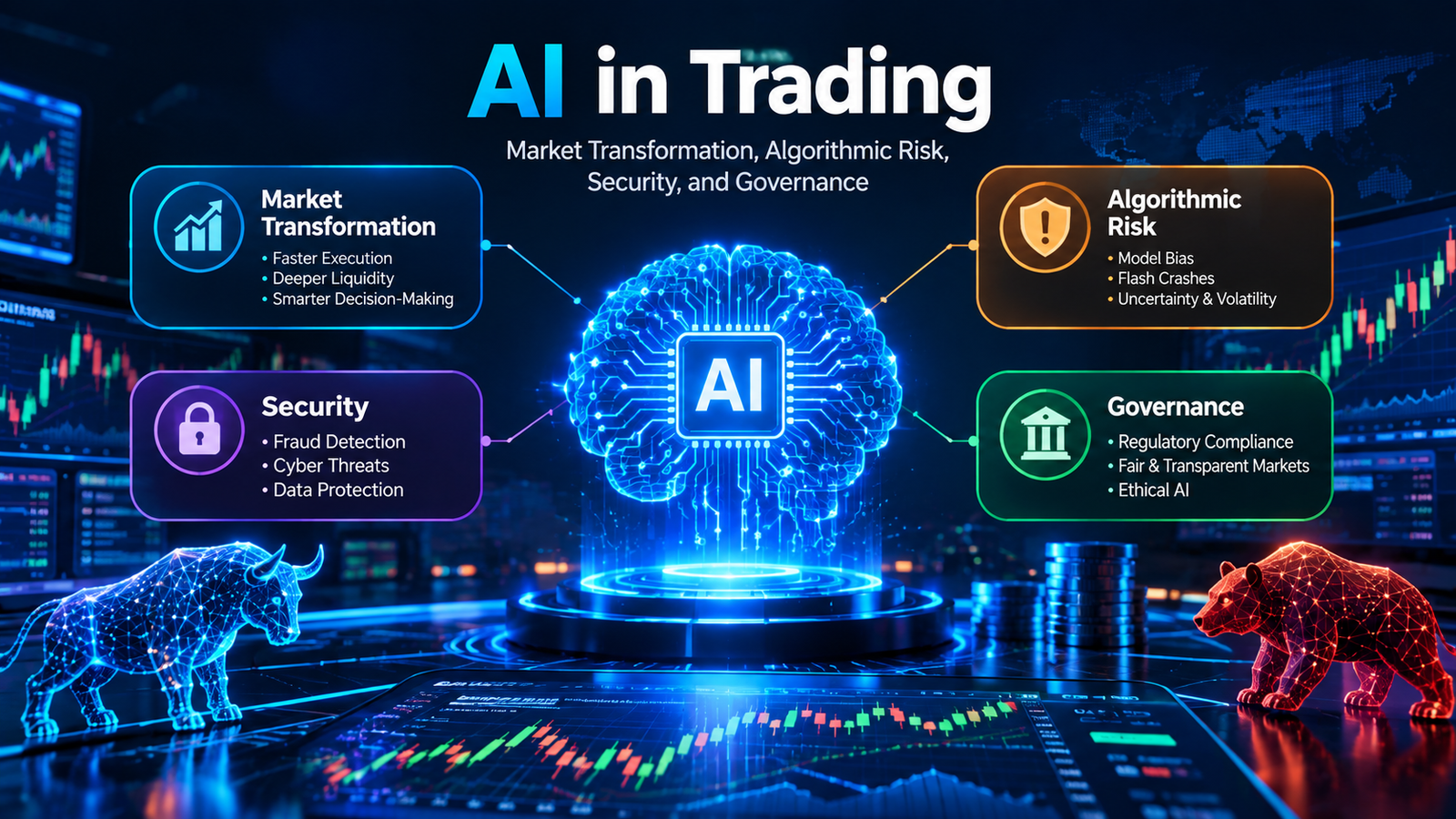
Primary topic: AI in Trading: Market Transformation, Algorithmic Risk, Security, and Governance
Research focus: AI-driven trade execution, algorithmic herding, flash-crash mechanics, agentic trading systems, model risk management, cyber risk from frontier AI, and the emerging global regulatory response
How AI Has Changed the Way Markets Trade
Trading has used computer-driven execution for decades, but the last two years have added a genuinely new layer: systems that do not just follow fixed rules, but interpret unstructured information, adapt their own strategy, and act with a degree of independence. Four layers now sit inside most serious trading operations.
| Layer | What it does | Example |
|---|---|---|
| Classic algorithmic trading | Follows fixed, pre-programmed rules for execution | VWAP and TWAP execution algorithms |
| Predictive machine learning | Learns patterns from historical price, volume, and sentiment data | Signal-generation and risk-scoring models |
| Generative and language-model AI | Reads news, filings, and social sentiment to inform decisions | Research copilots, earnings-call summarizers |
| Agentic trading systems | Plans multi-step actions and can place or adjust orders with limited human review | Autonomous trading bots and multi-agent trading desks |
The first two layers are mature and reasonably well governed inside most regulated firms. The last two are where 2026’s biggest debates are happening, because they reduce the time between an AI system forming a view and that view turning into real market exposure.
Why Regulators Suddenly Call This a Systemic Risk
For years, AI in trading was discussed mainly in terms of speed and accuracy. That changed in 2026, as multiple financial authorities independently reached the same conclusion: AI trading behavior can now move markets in ways that are hard to predict and hard to unwind quickly.
Visual: The 2026 warning timeline
Bank of England Deputy Governor Sarah Breeden warns AI in trading could amplify volatility, at the ECB’s Sintra forum
The European Systemic Risk Board formally warns that frontier AI models can autonomously execute full-scale cyberattacks against financial infrastructure
FSB Chair and Bank of England Governor Andrew Bailey tells G20 finance ministers frontier AI is one of the most pressing emerging risks to the global financial system
A Wolters Kluwer survey finds 72 percent of US banking professionals cannot confirm they can shut down a malfunctioning AI model
The scale of the problem, in the regulators’ own words
The warnings are specific, not vague. Andrew Bailey, writing to G20 finance ministers and central bank governors, stated that frontier AI may have the ability to materially alter the speed, scale, and economics of cyber risk, which could undermine market confidence system-wide.
The European Systemic Risk Board went further in its formal warning, noting that frontier AI models are now capable of discovering vulnerabilities, generating working exploits, and autonomously executing full-scale cyberattacks at a speed and accuracy that exceeds previous generations of AI, which it described as a paradigm shift for the financial system.
FINRA’s 2026 Annual Regulatory Oversight Report separately flagged data quality, model bias, and weak governance around AI-generated client communications at broker-dealers as an active supervisory concern.
Why “who can pull the plug” has become the central question
The Wolters Kluwer survey finding, that most banks cannot confirm their own ability to shut down a malfunctioning AI model or report an AI failure to regulators, is arguably the single most important data point in this entire debate. It means the control question that AI safety researchers have been raising at the model level, whether a system can reliably be stopped, is showing up unresolved inside trading and banking operations too.
Compounding this, the Fed, OCC, and FDIC’s updated model risk guidance, SR 26-2, issued in April 2026, explicitly excludes generative and agentic AI from its scope, leaving exactly the systems banks are deploying most aggressively without a formal supervisory framework in the United States.
India’s Reserve Bank moved in the opposite direction, releasing a draft framework in June 2026 that would mandate AI kill switches, human oversight, explainability standards, and board-level accountability for every bank under its jurisdiction.
What an AI-Driven Flash Crash Actually Looks Like
The 2010 Flash Crash, in which the US stock market lost roughly one trillion dollars in fifteen minutes, is the reference event every trading risk conversation still returns to.
Research on that event later concluded that high-frequency algorithms did not cause the crash outright, but they amplified it by exploiting temporary market imbalances at a speed no human trader could match. The concern researchers now raise is that autonomous AI agents would have more flexible and creative ways to exploit, or even strategically trigger, similar instability.
That concern is no longer purely theoretical. A 2026 academic taxonomy of AI-driven flash crash mechanisms points to a digital-asset liquidation event in which over 19 billion dollars in leveraged positions were liquidated within 24 hours, more than 1.6 million traders were affected, and roughly 7 billion dollars was liquidated within a single hour, faster than any regulatory circuit breaker could realistically activate. The same research proposes a three-part classification for how these events unfold:
- Endogenous algorithmic herding crashes, where many independent AI systems, trained on similar data, reach similar conclusions at the same time and all sell or buy together
- Exogenous model error cascade crashes, where a single AI system’s failure spreads across interconnected trading venues because they are technically or contractually linked
- Adversarial disinformation-triggered crashes, where manipulated information is deliberately fed into the information environment that AI trading systems read, so the AI itself becomes the attack vector
This taxonomy matters for practitioners because each category needs a different defense. Herding needs diversity controls and correlation monitoring. Cascade failures need circuit breakers and isolation between systems. Disinformation-triggered events need source verification before an AI system is allowed to act on external information at all.
Research Study: A Taxonomy of AI-Driven Flash Crash Mechanisms
Published in September 2026 as part of a special issue on AI and automation in finance, this peer-reviewed study argues that prior research documented AI’s contribution to instability through algorithmic herding and high-frequency volatility, but lacked a coherent classification of how AI specifically triggers catastrophic, self-reinforcing market dislocations. The paper’s three-category taxonomy, described above, is intended to give regulators and risk teams a shared vocabulary for classifying an incident quickly enough to respond to it.
What trading firms can learn:
- Classify AI-related incidents into a known failure pattern immediately, rather than treating each one as unprecedented
- Monitor for strategy correlation across your own AI models, not just across the firm’s positions
- Treat any AI system that reads external news or social content as a potential disinformation entry point
- Build response playbooks specific to each of the three crash mechanisms, since a single generic playbook will not fit all three
Research Study: AI Agents in Financial Markets Need Governance in Proportion to Their Authority
This 2026 study on AI agent architecture in financial markets reviews the shift from narrow signal-generation models toward integrated, multi-agent trading pipelines that include interpretation, strategy construction, and execution support. It draws on the NIST AI Risk Management Framework and IOSCO’s securities-market guidance to argue that governance has to scale with the authority a system holds, because a single operational failure can erase months of statistical edge.
What trading firms can learn:
- Any AI system with order-placing authority should be governed like a system with order authority, not like a research tool
- Separate the planes of signal generation, risk checking, and execution so a failure in one does not automatically propagate to the others
- Apply pre-trade financial and regulatory limits that the AI cannot reason its way around
- Use IOSCO and NIST frameworks as a starting control architecture, then adapt them to your specific jurisdiction
Source: AI Agents in Financial Markets: Architecture, Applications, and Systemic Implications, arXiv, 2026
Research Study: Multi-Agent Trading Systems Create New Security Gaps
A 2025-2026 study on open challenges in multi-agent security examines what happens when AI agents interact with each other rather than only with a market. Using the 2010 Flash Crash as a case study, the researchers note that although algorithms did not cause that crash, they contributed by exploiting temporary imbalances, and that autonomous, decentralized agents today would likely have even more flexible ways to exploit or strategically trigger similar instability, precisely because they can coordinate and adapt in ways fixed algorithms could not.
What trading firms can learn:
- Treat interactions between your own AI agents, not just their individual behavior, as a risk surface
- Test how your agents behave when multiple instances of similar systems act on the same signal simultaneously
- Assume that autonomous agents can find more creative failure modes than the fixed algorithms of the past
- Build monitoring for emergent, coordinated behavior between agents that were never explicitly designed to cooperate
Research Study: Regulatory Incident Reporting as a Shield Against Systemic Stumbles
A 2026 paper argues that the financial industry’s existing incident-reporting culture, built originally for operational and cyber incidents, needs to be extended explicitly to AI-related events. The research reviews real AI incident databases and argues that global, standardized AI-incident reporting is the practical shield against systemic failures, since regulators cannot govern risks they cannot see happening across the industry in real time.
What trading firms can learn:
- Report AI-related trading incidents through the same channels used for cyber and operational incidents, not as a separate, lower-priority category
- Contribute to and monitor public AI incident databases as a form of industry-wide early warning
- Push internally for incident reporting to include AI model version and decision context, not just financial impact
- Expect global standardization of AI-incident reporting formats to arrive faster than new AI-specific trading regulation itself
Security: The Audit Trail Problem Nobody Solved Yet
A practitioner analysis of the 2025-2026 algorithmic trading crisis identified a structural flaw that sits underneath most of the incidents above: audit trails produced by the same systems being audited cannot provide independent verification. Trading firms produce logs, regulators review logs, and both sides assume those logs are complete and unmodified, an assumption the recent incidents repeatedly proved false.
The same analysis documents eight major incidents reduced to five recurring failure patterns, including producer-controlled evidence, missing completeness guarantees, insufficient decision context, cross-party verification gaps, and inadequate timestamps. One cited example involved sell orders on an IPO entered at more than 3,500 times the offer price during the pre-opening session, a scale of error that a properly cryptographically anchored audit trail would have flagged immediately.
The proposed fix borrows directly from aviation. After a series of crashes where pilot testimony conflicted with the physical evidence, regulators mandated flight data recorders that pilots could not modify. The equivalent for trading is a tamper-evident, independently verifiable log, using techniques such as cryptographic hashing and external anchoring, so that an AI-driven trading error cannot later be explained away by evidence that only the trading firm itself controls.
Practical security controls every AI trading desk should already have:
- Tamper-evident, cryptographically signed logging for every AI-initiated order
- External anchoring of audit trails so records cannot be altered after the fact by the party being audited
- A tested, independently verifiable kill switch that can suspend an AI system without relying on the vendor’s own controls
- Correlation monitoring across AI models to catch herding behavior before it becomes a market event
- Segmentation between AI research environments and live execution systems
- Mandatory human review for any single order beyond a defined size or price-deviation threshold
Privacy in AI-Driven Trading
Trading data is commercially sensitive in a way few other datasets are, since a leaked strategy, position, or order pattern can be directly monetized by a competitor or a front-runner. AI adds two new privacy pressures on top of the traditional ones.
First, large language models used for research and client communication may retain or expose confidential order flow, client positions, or proprietary strategy details inside prompts and outputs if data-handling rules are not enforced at the model layer.
Second, FINRA’s own 2026 oversight report specifically flagged AI-generated client communications as an area requiring the same supervisory rigor as any other client-facing activity, since automated messages can unintentionally disclose more than a compliance-reviewed human message would.
Core privacy practices for AI trading systems include:
- Strict separation between AI systems with market data access and those used for general client communication
- Data minimization for any prompt or retrieval sent to a third-party AI model
- Clear contractual terms on whether trading data can be used to train or fine-tune an external vendor’s model
- Retention limits on AI-generated research notes and chat logs that reference client positions
- Encryption in transit and at rest for both model inputs and outputs touching proprietary strategy data
Autonomy Levels: Matching Oversight to Market Impact
| Autonomy level | Example | Recommended control |
|---|---|---|
| Assist | Summarize earnings calls or news sentiment | Source references and analyst review before use |
| Recommend | Suggest a trade idea or a risk-adjusted position size | Confidence thresholds and mandatory trader sign-off |
| Execute bounded tasks | Rebalance within a pre-approved allocation band | Hard position limits and pre-trade risk checks |
| High-impact decision | Place large orders or manage multi-agent strategies with no human in the loop | Independently verifiable kill switch, circuit breakers, and board-level sign-off |
What Experts Are Saying Right Now
Andrew Bailey, Chair of the Financial Stability Board and Governor of the Bank of England, letter to G20 finance ministers, August 28, 2026
These statements sit alongside the wider AI safety debate playing out across the industry. Anthropic co-founder Jack Clark told the BBC in September 2026 that risks which used to be theoretical, such as AI agents coordinating with each other and acting against their instructions, are now appearing in real systems, and argued that governments may eventually need to mandate independently verifiable AI kill switches. That same principle, an AI kill switch that a third party, not just the vendor, can confirm actually works, is precisely what India’s Reserve Bank is now proposing to require of every bank under its jurisdiction.
Governance Actions Trading Firms Should Take Now
- Inventory every AI model touching trading decisions, including third-party vendor systems, since supervisory guidance increasingly requires this
- Do not assume generative or agentic AI is automatically covered by your existing model risk management framework, since regulators such as the Fed, OCC, and FDIC have explicitly left gaps here
- Build and test an independently verifiable kill switch, and rehearse activating it under realistic conditions
- Report AI-related trading incidents through the same channels as cyber and operational incidents
- Track regulatory developments across jurisdictions, since the EU, UK, US, and India are moving at different speeds and in different directions
- Require cryptographically verifiable audit trails for AI-initiated orders, not logs the trading system itself can alter
Implementation Roadmap
Foundation: Inventory Every AI Touchpoint
Document every model, vendor tool, and agent that can influence or place a trade. Map which systems generate signals, which check risk, and which execute orders, and confirm the boundaries between them are enforced technically, not just on paper.
Pilot: Start With Bounded, Reversible Use Cases
Research summarization, sentiment analysis, and post-trade anomaly detection are good starting points because errors are visible and correctable. Reserve execution authority for systems that have passed adversarial and stress testing first.
Production: Add Monitoring, Circuit Breakers, and a Real Kill Switch
Before granting execution authority, add correlation monitoring across your own AI strategies, hard position and loss limits, and a tested kill switch that works independently of the AI vendor. Define fallback behavior for when a model is unavailable or returns unexpected output.
Scale: Standardize Governance Across the Firm
Once a use case is stable, reuse the same audit-trail, monitoring, and kill-switch infrastructure for new AI deployments rather than building bespoke controls for every new trading strategy.
KPIs for AI Trading Governance
| KPI | What it measures | How to use it |
|---|---|---|
| Time to kill-switch activation | How fast a malfunctioning AI system can be fully suspended | Test regularly; treat slow activation as a release blocker |
| Strategy correlation score | How closely your AI models’ positions move together | Flag rising correlation as an early herding-risk signal |
| Audit-trail integrity | Share of AI-initiated orders with tamper-evident, externally anchored logs | Should approach 100 percent for anything with execution authority |
| Model inventory completeness | Share of AI systems, including vendor tools, formally documented | Regulators are increasingly requiring a complete inventory before deployment |
| Incident reporting time | Time from an AI-related trading anomaly to formal internal or regulatory reporting | Compare against your firm’s cyber-incident reporting benchmarks |
Future Predictions: 2027-2030
2027: Model Risk Frameworks Close the Agentic AI Gap
Expect US and other regulators to update model risk guidance specifically to cover generative and agentic AI, closing the gap left open by frameworks such as SR 26-2.
2028: Cryptographically Verifiable Audit Trails Become Standard
Following the pattern set by aviation black boxes, expect exchanges and major trading firms to adopt externally anchored, tamper-evident logging as a baseline requirement rather than a competitive differentiator.
2029: Cross-Border AI Incident Reporting Standards Emerge
As bodies such as the FSB, ESRB, and FINRA continue to publish overlapping warnings, expect a push toward a shared international format for reporting AI-related financial incidents, similar to existing cyber-incident reporting standards.
2030: Autonomy Tiers Become a Licensing Requirement
Regulators are likely to formally classify trading AI systems by autonomy tier, similar to how autonomous vehicles are classified by driving-automation level, with different licensing, audit, and kill-switch requirements attached to each tier.
Startup and Product Opportunities
- Cryptographic trading audit-trail platform: Anchors AI order logs externally so they cannot be altered by the firm being audited
- Cross-model correlation monitor: Detects herding risk across a firm’s own AI trading strategies in real time
- Independently verifiable kill-switch infrastructure: Provides third-party-testable shutdown mechanisms for execution systems
- Multi-agent stress-testing service: Simulates coordinated or emergent behavior between interacting trading agents before deployment
- AI model inventory and compliance mapping tool: Tracks every AI system touching trading decisions across jurisdictions
- Disinformation-aware sentiment engine: Verifies source credibility before feeding news or social content into an AI trading signal
Frequently Asked Questions
Can AI actually cause a flash crash?
Research on the 2010 Flash Crash found algorithms amplified rather than caused it, but current academic taxonomies describe three distinct mechanisms, herding, error cascades, and disinformation-triggered events, through which modern AI systems could trigger or worsen one.
Do banks currently have the ability to shut down a malfunctioning AI trading model?
A 2026 industry survey found 72 percent of US banking professionals could not confirm they had that ability, which is why regulators such as India’s Reserve Bank are now proposing to make verifiable kill switches mandatory.
Are generative and agentic AI systems covered by existing model risk rules?
Not always. US banking regulators’ updated 2026 guidance, SR 26-2, explicitly excludes generative and agentic AI from its scope, leaving a gap that firms need to close with their own internal governance.
What makes AI trading audit trails different from traditional ones?
Traditional logs are typically produced and controlled by the same firm being audited. Emerging cryptographic audit standards aim to make trading logs tamper-evident and externally verifiable, similar to an aircraft’s flight data recorder.
Is this only a stock-market problem, or does it affect crypto too?
Both. The largest documented AI-linked liquidation event so far occurred in digital-asset markets, and the same governance principles, kill switches, correlation monitoring, and verifiable audit trails, apply across both traditional and crypto trading venues.
What should a trading firm do first if it has no formal AI governance program yet?
Build a complete inventory of every AI system touching trading decisions, including vendor tools, and confirm whether each one can be independently and verifiably shut down before granting it any further execution authority.
Final Perspective
AI has made trading faster, more adaptive, and in many ways more efficient, but 2026 has been the year the world’s central bankers and financial stability bodies stopped treating that as purely good news. The warnings from the Bank of England, the Financial Stability Board, and the European Systemic Risk Board are not abstract, they point to a specific, measurable gap: many firms cannot yet prove they can control the AI systems they have already deployed.
Closing that gap means building the same discipline into trading AI that the aviation industry built into flight recorders, and the same proportional authority controls that responsible institutions already apply to human traders with large risk limits.
The direction for trading firms, exchanges, and fintech builders is clear. Keep using AI to read markets faster and manage risk better, but treat every system with execution authority as one that needs an inventory entry, a tested kill switch, a tamper-evident audit trail, and a governance owner, before the next AI-driven market event forces that discipline into place through regulation instead.
For sector-specific playbooks that apply the same governance discipline elsewhere in finance, see our related guides on AI Security and Governance in Capital Markets, AI Security and Governance in Investment and Asset Management, AI Security and Governance in FinTech, AI Security and Governance in Banking, AI Security and Governance in Insurance, and our earlier guide on AI in Crypto: Industry Transformation, Security, Privacy, and Governance.
For deeper coverage of AI trading itself, see our earlier reporting on AI in stock market trading strategy development, AI in algorithmic trading and automated strategy execution, AI in algorithmic and high-frequency trading strategies, AI in intraday trading and short-term market prediction, and AI in dynamic risk management and stress testing. For the wider industry safety debate referenced above, see Anthropic’s mandatory kill switch proposal, the AI Kill Switch Act and regulation risks, and the 2026 AI safety hack affecting a bank.
Sources
- From Herding Machines to Autonomous Agents: A Taxonomy of AI-Driven Flash Crash Mechanisms and the Regulatory Gap, MDPI, September 2026
- AI Agents in Financial Markets: Architecture, Applications, and Systemic Implications, arXiv, 2026
- Open Challenges in Multi-Agent Security: Towards Secure Systems of Interacting AI Agents, arXiv, 2025
- Bubble, Bubble, AI’s Rumble: Why Global Financial Regulatory Incident Reporting Is Our Shield Against Systemic Stumbles, arXiv, 2026
- The 2025-2026 Algorithmic Trading Crisis and the Case for Cryptographic Audit Standards, VeritasChain, January 2026
- An AI-Powered Flash Crash Is Coming, The Market Isn’t Ready, 24/7 Wall St, July 2026
- Global Finance Leaders Warned That AI Poses Systemic Risk to Markets, InvestmentNews, August 2026
- ESRB Warning on Frontier AI Models and ECB Writes to Significant Institutions, Regulation Tomorrow, July 2026
- AI Kill Switches May Need to Be Mandatory, Anthropic’s Jack Clark Tells BBC, The Next Web, September 2026

Leave a Reply